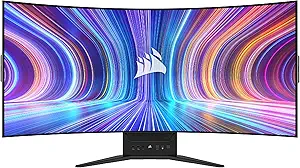





Corsair vs Sceptre: Overview
Comparing Corsair and Sceptre helps you determine which brand is best suited for your needs in Monitors. Both brands offer strong choices depending on your budget and key feature requirements.
Key Features & Comparison
Evaluate factors such as build quality, warranty, customer satisfaction, and total value before making your final purchase choice between Corsair and Sceptre.
Affordability
When evaluating affordability, Sceptre stands as one of the most disruptive budget brands in the display market, engineering monitors that aggressively strip away non-essential features to achieve rock-bottom price points. By relying primarily on mass-produced, cost-effective VA and entry-level IPS panels, Sceptre manages to offer high refresh rates (ranging from 144Hz to 240Hz) and curved profiles at a fraction of the cost commanded by mainstream competitors. For budget-conscious gamers, remote workers, or multi-display home office setups, Sceptre represents exceptional surface-level value, democratizing basic high-speed gaming specs without requiring significant financial investment.
Conversely, Corsair operates firmly in the premium and enthusiast sectors, showing little interest in competing in the entry-level bracket. Corsair's display catalog, headlined by its Xeneon series, demands substantial upfront investment, often running several times the price of a typical Sceptre unit. However, this higher price tag funds advanced panel technologies like QD-OLED, ultra-fast Fast-IPS, high peak brightness, and flexible form factors, such as the bendable Xeneon Flex. While Corsair cannot compete with Sceptre on raw price-to-panel size, it provides a significantly higher ceiling of performance and luxury, making Sceptre the uncontested victor for pure budget efficiency and Corsair the choice for uncompromising premium tier spenders.
Customer Support & Warranty
Sceptre’s post-purchase ecosystem reflects its budget-first business model, providing functional yet relatively basic customer service. The brand typically backs its displays with a limited one-year warranty, which covers core manufacturer defects but leaves little room for nuance regarding issues like minor panel uniformity flaws or isolated dead pixels. Sceptre’s customer support relies primarily on ticket-based online forms and standard phone support, which can occasionally result in slower turnaround times and rigid RMA protocols. For users seeking long-term peace of mind, Sceptre's standard coverage means that out-of-warranty replacements fall squarely on the consumer after a comparatively short period.
Corsair offers a substantially more robust customer support framework designed to reassure consumers investing hundreds or thousands of dollars in high-end gear. Most Corsair monitors come standard with an impressive three-year comprehensive warranty, which crucially includes a Zero Dead Pixel policy and, for its OLED lineup, dedicated burn-in protection. Corsair’s global support infrastructure features comprehensive live chat, active enthusiast forums, direct technical support channels, and seamless cross-shipping RMA options in many regions. This higher tier of institutional reliability and panel protection gives Corsair a clear advantage over Sceptre in customer care and risk mitigation.
Picture Quality
Sceptre focuses on delivering acceptable everyday visual performance, but technical compromises are readily apparent upon closer inspection. While their curved VA panels deliver decent static contrast ratios with deep blacks, they suffer noticeably from slower pixel response times that cause dark-level smearing and motion ghosting in fast-paced scenes. Sceptre displays also tend to feature modest peak brightness levels, mediocre factory color calibration, and narrow color gamuts, often topping out at baseline sRGB coverage. For general office tasks and casual gaming, the picture quality is adequate, but it lacks the color accuracy and dynamic range required for critical creative work or immersive HDR experiences.
In contrast, Corsair emphasizes cutting-edge visual fidelity, deploying state-of-the-art panel tech sourced from industry-leading manufacturers like LG Display. Corsair’s monitors frequently feature wide color gamuts spanning over 95% DCI-P3, factory-calibrated Delta E color accuracy, and true HDR performance through VESA DisplayHDR certifications or self-emissive OLED pixels. In high-motion environments, Corsair’s lightning-fast response times (as low as 0.03ms on OLED variants) eliminate ghosting and motion blur entirely, producing pristine image clarity. While Sceptre provides decent utility for the price, Corsair delivers a visually transformative experience marked by deep blacks, vibrant saturation, and flawless motion rendering.
Build Quality & Durability
To maintain aggressive price margins, Sceptre makes notable concessions in industrial design and material selection. Their monitor housings are almost exclusively constructed from lightweight, hollow plastics, and the included stands typically offer very limited adjustment capabilities—often restricted solely to basic tilt, omitting height, swivel, or pivot functions. Furthermore, internal component choices, such as budget power boards and passive cooling assemblies, can increase vulnerability to long-term wear and tear. While Sceptre displays feature standard VESA mounting holes to bypass their flimsy stands, the overall chassis rigidity remains noticeably utilitarian and delicate.
Corsair exhibits a masterclass in modern hardware craftsmanship, utilizing heavy cast-aluminum stands, premium matte textures, and reinforced chassis designs that exude stability and durability. Their ergonomic stands provide full articulated movement—including smooth height adjustment, swivel, and integrated cable routing channels via their proprietary RapidRoute design. Premium internal engineering, featuring custom heatsinks and fanless thermal cooling solutions, actively prolongs the lifespan of internal driving boards and delicate panels without generating operational noise. Corsair’s superior structural integrity, tactile refinement, and premium engineering make it vastly more durable and resilient than Sceptre's cost-optimized builds.