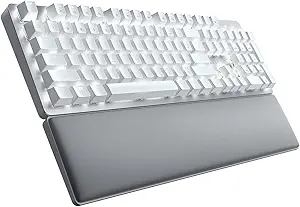





Razer vs SteelSeries: Overview
Comparing Razer and SteelSeries helps you determine which brand is best suited for your needs in Keyboards. Both brands offer strong choices depending on your budget and key feature requirements.
Key Features & Comparison
Evaluate factors such as build quality, warranty, customer satisfaction, and total value before making your final purchase choice between Razer and SteelSeries.
Features
In terms of feature sets, both brands have heavily invested in analog magnetic switch technologies, but their execution and auxiliary hardware differ substantially. SteelSeries set the industry benchmark with its OmniPoint adjustable switches, which allow users to fine-tune actuation points per key from 0.1mm to 4.0mm and map dual actions to a single keystroke. Supplementing this is SteelSeries' iconic integrated OLED Smart Display on flagship Apex models, providing real-time hardware monitoring, quick-setting adjustments without alt-tabbing, and system diagnostics, complemented by a dedicated clickable metal roller for seamless media management.
Razer counters with a staggering array of proprietary innovations, led by their rapid-trigger Analog Optical and Gen-2 Hall Effect switches, which match or exceed the responsiveness of SteelSeries' analog solutions. Beyond actuation features, Razer outclasses most competitors in peripheral connectivity, offering robust multi-device HyperSpeed wireless alongside low-latency Bluetooth and detachable Type-C cabling. Furthermore, Razer’s ecosystem integration through Synapse is unmatched in macro depth, hypershift secondary key mapping, and broad game-reactive Chroma RGB lighting integration, whereas SteelSeries GG provides a cleaner, lighter-weight software footprint that focuses more narrowly on utility and quick customization.
Performance
From a competitive performance standpoint, both manufacturers push latency and responsiveness to absolute extremes, yet they achieve these results through distinct engineering methods. Razer leads the frontier of pure throughput by deploying true 8,000Hz (8K) HyperPolling across its premier keyboards, dramatically reducing input latency to a fraction of a millisecond. Combined with second-generation optical beam interruption and near-instantaneous rapid-trigger reset capabilities, Razer keyboards provide an imperceptible physical actuation delay that is tailor-made for high-velocity competitive titles like tactical shooters and rhythm games.
SteelSeries matches this competitive agility with its OmniPoint 2.0 and 3.0 Hall Effect switch technology, which utilizes magnetic field sensors to register key inputs with zero mechanical contact wear and zero debounce delay. The real-world performance benefit of SteelSeries lies in the consistency and customizability of this actuation, allowing gamers to make movement keys feather-light for strafing while setting ability keys deeper to prevent accidental misclicks. While Razer holds a slight synthetic edge in maximum polling frequencies and optical switch return rates, SteelSeries delivers an exceptionally stable, repeatable keystroke consistency that competitive players find equally potent and reliable in critical moments.
Design
The design ethos of Razer is bold, dynamic, and unapologetically engineered for gaming immersion. In recent generations, Razer has substantially improved its acoustic and structural craftsmanship by incorporating multi-layer sound dampening foams, factory-lubricated stabilizers, and high-density Doubleshot PBT keycaps on flagship boards like the BlackWidow V4 Pro and Huntsman V3 Pro. Razer's visual identity embraces prominent underglow lighting, complex matrix layouts, and dedicated control dials, making their keyboards statement centerpieces of high-end battlestations, albeit sometimes with a larger physical footprint.
SteelSeries favors a sleeker, Scandinavian-inspired design language characterized by clean lines, matte black finishes, and robust 5000-series aircraft-grade aluminum alloy top plates. This rigid metal chassis gives SteelSeries keyboards exceptional structural integrity with zero deck flex, paired with a compact, modern profile that fits comfortably in professional workspace setups as well as competitive arenas. While Razer prioritizes acoustics, macro-density, and immersive lighting dynamics, SteelSeries focuses on structural rigidity, refined industrial aesthetics, and ergonomic modularity, including some of the best magnetic soft-touch wrist rests in the industry.
Compare current retail pricing, active promotions, and verified stock availability directly from authorized stores: