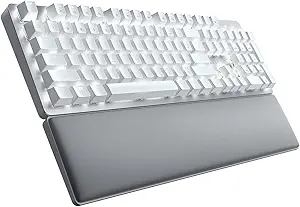
Razer vs Logitech: Overview
Comparing Razer and Logitech helps you determine which brand is best suited for your needs in Keyboards. Both brands offer strong choices depending on your budget and key feature requirements.
Key Features & Comparison
Evaluate factors such as build quality, warranty, customer satisfaction, and total value before making your final purchase choice between Razer and Logitech.
Features
Razer’s feature set is aggressively tuned toward competitive play and deep aesthetic customization. Central to Razer's technical appeal is the integration of analog optical switches on flagship models like the Huntsman V3 Pro series, allowing for dynamic features such as adjustable actuation points (from 0.1mm to 4.0mm) and Rapid Trigger technology, which resets keystrokes instantaneously for ultra-fast inputs in first-person shooters. These cutting-edge mechanical innovations are supported by Razer Synapse, a feature-dense software suite offering granular key remapping, hypershift modifiers, and complex Razer Chroma RGB synchronization. However, Synapse can feel bloated and resource-intensive, often alienating users who prefer lightweight, set-it-and-forget-it software experiences.
Logitech, meanwhile, divides its feature priorities across two fronts: esports minimalism and productivity enhancement. Through its Logitech G HUB software, the company focuses on tournament-ready macro binding, onboard memory profiles, and game-specific lighting profiles without overcomplicating the underlying mechanics. Where Logitech truly distances itself from Razer is in its productivity suite, exemplified by keyboards like the MX Keys and MX Mechanical, which offer multi-device Bluetooth pairing across up to three machines and Logitech Flow for cross-computer clipboard sharing. While Logitech lags somewhat behind Razer in analog actuation features and custom acoustic dampening materials, its features are exceptionally practical, remarkably intuitive, and engineered for frictionless daily workflows.
Performance
In raw gaming performance, Razer consistently sets the benchmark for hyper-responsive input delivery. The brand heavily utilizes true 8,000Hz (8K) polling rates alongside proprietary optical actuation, reducing latency to fractions of a millisecond and ensuring that physical key presses translate to in-game actions with unmatched speed. Their implementation of Rapid Trigger and analog travel gives competitive gamers a tangible mechanical advantage in rapid strafing and movement resets. Furthermore, Razer has made immense strides in acoustic and tactile feedback, outfitting their latest mechanical lines with sound-dampening foam, factory-lubricated stabilizers, and Doubleshot PBT keycaps that deliver a deep, satisfying acoustic profile directly out of the box.
Logitech delivers performance through unwavering connection stability and mechanical consistency. Its proprietary LIGHTSPEED wireless technology is widely regarded as the gold standard in the peripheral industry, offering wireless latency so negligible that it rivals direct wired connections, completely impervious to wireless interference. Logitech’s mechanical offerings, utilizing modified GL low-profile switches or traditional GX switches, provide crisp and reliable actuations, though they generally lack the sub-millimeter customization found in Razer’s top-tier optical boards. For typing endurance and productivity performance, Logitech outshines Razer by a wide margin, as their keyboards deliver exceptional battery life—stretching into months rather than days—and whisper-quiet, ergonomically sound key action that minimizes finger fatigue during extended work sessions.
Design
Aesthetically, Razer adopts a bold, unapologetic gaming design language characterized by crisp angles, stealth black aluminum top plates, and the most vibrant, saturated RGB backlighting on the market. In recent generations, Razer has matured significantly, shifting away from over-stylized gamer tropes toward cleaner, minimalist form factors such as the BlackWidow V4 75%—which actively caters to keyboard enthusiast culture by introducing hot-swappable switch sockets, tape-enhanced PCB designs, and gasket-mounted plates. Razer keyboards feel substantial and robust, though their textured finishes and prominent keycap fonts remain definitively tied to gaming battlestations.
Logitech takes an entirely different design direction depending on the product tier, generally favoring sleek, contemporary, and industrial silhouettes. The Logitech G series, notably the G915 line, introduced ultra-thin, low-profile aircraft-grade aluminum chassis that deliver an elegant, slimline presence on any desk. In their mainstream lineup, Logitech embraces a sophisticated Scandinavian minimalism with matte finishes, soft-touch coatings, and neutral colorways that blend seamlessly into professional modern offices. While Logitech’s hot-swappable offerings and acoustic tuning do not cater to the custom enthusiast crowd as proactively as Razer’s newest models, their structural rigidity, premium materials, and universally appealing form factors give them superior versatility across various professional and casual environments.