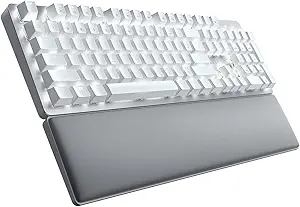





Razer vs reMarkable: Overview & Brand Philosophy
In the broad landscape of input hardware, few brands represent such diametrically opposed design philosophies as Razer and reMarkable. Razer, founded in 2005 with dual headquarters in California and Singapore, is a global titan in the high-performance gaming periphery space. Its brand ethos—"For Gamers. By Gamers."—manifests in aggressive aesthetics, cutting-edge optical and mechanical switch technology, ultra-low-latency wireless connectivity, and deep software-driven customization via the Razer Synapse ecosystem. Razer views the keyboard not merely as a typing tool, but as a high-precision digital weapon designed to eliminate input lag and maximize throughput in competitive environments.
Conversely, Norwegian company reMarkable approached keyboard design from a completely distinct perspective: digital minimalism and deep cognitive focus. Famous for its paper-like E-ink tablets, reMarkable ventured into the typing space with the Type Folio, an integrated mechanical-feel keyboard cover built exclusively for the reMarkable 2 ecosystem. Rather than pursuing hyper-fast actuation speeds, customizable RGB backlighting, or cross-platform utility, reMarkable designs typing experiences that mimic the tactile cadence of a physical typewriter. The company's philosophy centers on the idea of distraction-free productivity, deliberately stripping away browser alerts, notifications, and complex operating systems to facilitate uninterrupted creative flow.
Evaluating Razer against reMarkable is fundamentally an analysis of intent. While Razer engineers standalone keyboards capable of interfacing with PCs, Macs, and consoles for gaming, streaming, and intensive multi-tasking, reMarkable engineers proprietary mobile keyboard hardware explicitly tethered to a closed-loop digital paper ecosystem. Understanding which brand suits you depends on whether your priority is multi-functional computing performance or intentional, focused writing.
Key Differences & Technological Comparison
The technological contrast between Razer and reMarkable keyboards is extensive, spanning switch architecture, connectivity, form factor, and software dependencies.
Switch Architecture & Key Feel: Razer offers a wide array of switch mechanisms across its BlackWidow, Huntsman, and DeathStalker lines. These range from traditional mechanical switches (Green clicky, Yellow linear) to advanced analog optical switches capable of adjustable actuation points (from 0.1mm to 4.0mm) and rapid-trigger resets. In contrast, the reMarkable Type Folio employs custom-engineered scissor switches with a surprising 1.3mm of key travel. It does not attempt to mimic deep mechanical desk switches, but instead offers a firm, tactile, and deliberately tactile response optimized for quiet, portable typing that mimics physical print strikes without acoustic disturbance.
Form Factor, Portability & Power: Razer keyboards range from full-size desktop chassis with aircraft-grade aluminum top plates to 65% wireless form factors utilizing Razer HyperSpeed (2.4GHz) and Bluetooth, powered by dedicated rechargeable lithium-ion batteries. The reMarkable Type Folio is completely distinct: it is a folio case with an origami-style folding mechanism that snaps directly onto the tablet using proprietary magnetic pogo-pin connectors. The Type Folio has no independent battery, requires no Bluetooth pairing, and draws minimal power directly from the E-ink host device.
Display & Environment Integration: A Razer keyboard is designed to sit beneath high-refresh-rate monitors running Windows or macOS, interfacing with complex software suites to remap keys, record macros, and sync lighting profiles. The reMarkable typing experience occurs directly on a monochrome CANVAS display featuring low-latency E-ink technology. There are no web browsers, no dynamic backlights, and no third-party applications running alongside your text document.
Pros & Cons Comparison
Razer
- Pros:
- Industry-leading switch technology, including Gen-2 Optical and Analog switches with customizable actuation.
- Universal compatibility with Windows, macOS, and gaming consoles via wired USB-C, 2.4GHz HyperSpeed, or Bluetooth.
- Deep programmability, on-board profile storage, and macro assignment via Razer Synapse.
- Exceptional build variety, including full-size, tenkeyless, 60%, 65%, and low-profile ergonomics.
- Cons:
- Desktop-oriented designs are generally bulky and less suited for pure mobile drafting.
- Software overhead can be high, with Razer Synapse requiring significant system resources.
- Aesthetic can lean overly gamer-centric with aggressive branding and RGB default states.
reMarkable
- Pros:
- True distraction-free typing environment integrated seamlessly with an E-ink writing surface.
- No charging or pairing required; relies on stable magnetic pogo-pin connections.
- Ultra-slim, protective folio design that adds minimal bulk to a mobile writing workflow.
- Remarkably tactile scissor-switch mechanism that prevents bottom-out fatigue during long typing sessions.
- Cons:
- Zero cross-compatibility; only functions when physically attached to the reMarkable 2 tablet.
- No backlighting, making typing in poorly lit environments challenging on a non-illuminated E-ink screen.
- High cost of entry, as it requires purchasing both the keyboard folio and the proprietary tablet.
- Fixed keyboard layout with no option for key remapping, macros, or alternate switch types.
Performance, Durability & Value Analysis
From an endurance and performance metrics standpoint, Razer keyboards offer staggering durability ratings, often rated up to 100 million keystrokes per switch. The heavy use of doubleshot PBT keycaps on premium models prevents oil buildup and legend fading, while aluminum structural plates resist deck flex under aggressive use. However, complex wireless models introduce common wear points over several years: battery degradation and occasional software glitches following major operating system updates. In terms of raw value, Razer keyboards span from budget-conscious membrane-mechanical hybrids ($50) up to elite analog flagships ($250), delivering measurable value relative to their high-speed utility and hardware versatility.
The reMarkable Type Folio approaches durability from an industrial design perspective. Encased in high-grade artificial leather or woven polymer fabric, it protects the host tablet while handling the physical rigors of transport. The scissor switches lack the 100-million click rating of optical sensors, but the absence of an internal battery means the Type Folio will not experience lithium cell degradation over time. Value, however, is heavily subjective. At nearly $200 for the keyboard accessory alone—on top of the substantial cost of the tablet itself—it represents an expensive, niche luxury. It offers virtually zero value to general computer users, but extraordinary value to long-form writers, academics, and journalists who require physical keys disconnected from the distractions of the modern internet.
Final Verdict: Which Brand Should You Choose?
Selecting between Razer and reMarkable requires a definitive evaluation of what you are using a keyboard to achieve:
Choose Razer if: You need a primary, versatile keyboard for a desktop PC, laptop, or home workstation. If your daily workflow involves gaming, software development, data manipulation, or multitasking between windows, Razer is the obvious selection. Its ultra-low latency, varied switch choices, ergonomics, and broad platform compatibility make it an exceptional tool for both intense digital combat and all-day typing across standard operating systems.
Choose reMarkable if: You are already invested in (or planning to purchase) the reMarkable ecosystem and your explicit objective is focused, uninterrupted prose generation. If you find yourself constantly derailed by desktop notifications, open browser tabs, and digital clutter, the reMarkable Type Folio transforms an E-ink notebook into a modern, portable typewriter. It is the definitive option for authors, thinkers, and professionals who prioritize cognitive focus and tactile simplicity over high-speed multi-platform computing.
Features
Razer's feature set is sprawling and technocentric, highlighted by proprietary mechanical, optical, and analog switches that feature adjustable actuation points and rapid trigger resets. Through the comprehensive Razer Synapse software suite, users can program intricate macros, remap every key across multiple onboard memory profiles, and coordinate elaborate per-key Chroma RGB lighting arrays with third-party ecosystems. Furthermore, Razer boards often incorporate dedicated multimedia dials, detachable magnetic wrist rests, passthrough ports, and multi-host wireless connectivity options like low-latency 2.4 GHz HyperSpeed and Bluetooth, maximizing daily operational utility across diverse environments.
In stark contrast, reMarkable consciously limits functionality to preserve cognitive flow and simplicity. The reMarkable Type Folio features physical keyboard integration that connects directly through magnetic pogo pins, completely eliminating the friction of Bluetooth pairing, battery management, or firmware bloat. While it lacks backlighting, macro programming, RGB customization, and traditional software suites, it offers a seamless tactile bridge between handwritten notes and typed text on an E Ink canvas. Razer wins decisively on technical depth and versatility, while reMarkable succeeds in purposeful minimalism that isolates the user from digital distractions.
Performance
Performance for Razer is benchmarked against ultra-low latency, input accuracy, and mechanical durability. Utilizing features like 8000 Hz polling rates, near-zero debounce delay via optical beams, and high-quality stabilizer bars, Razer keyboards process inputs with instantaneous precision under the most demanding competitive gaming loads. Typing on premium Razer units yields distinct, satisfying tactile or clicky feedback with high key travel, tailored for users who require positive confirmation during hyper-fast keystroke sequences. Switches are often rated for up to 100 million keystrokes, underscoring long-term structural reliability under high stress.
The performance profile of reMarkable centers around tactile comfort within a low-power, constrained envelope. The Type Folio provides surprisingly generous key travel of 1.3 mm for a slim folio form factor, delivering a cushioned, quiet typing feel that resembles traditional mechanical typewriters rather than mushy membrane covers. However, typing speed is naturally bound to the refresh rate of the host tablet's E Ink display; despite clever software tricks to render typed text smoothly, it cannot rival the real-time fluidity or ultra-high responsiveness of a standard monitor driven by a Razer peripheral. For high-speed typing and reaction-critical tasks, Razer dramatically outclasses reMarkable.
Design
From an industrial design standpoint, Razer projects an aggressive, enthusiast-forward aesthetic characterized by aircraft-grade aluminum top plates, laser-etched or doubleshot PBT keycaps, and radiant underglow lighting. Even in their sleeker productivity lines, Razer prioritizes robust ergonomics with multi-stage incline feet, substantial heft to prevent desk slippage, and an unmistakable modern gaming pedigree. The engineering focus is squarely on durability, tactile substance, and visual impact, yielding keyboards that command significant desktop real estate and visual attention.
reMarkable adheres to Scandinavian design principles, emphasizing understated elegance, organic textures, and functional portability. Constructed from premium artificial leather or woven fabrics, the Type Folio is engineered to disguise the keyboard entirely when folded, transforming effortlessly into a protective book-like cover. The mechanism that tilts the tablet into dual ergonomic writing angles relies on meticulously engineered magnetic hinges that open and close with satisfying mechanical fluidity. While Razer designs visually striking centerpieces for modern battle stations, reMarkable crafts a tactile, discreet accessory that seamlessly blends into quiet workspaces, notebooks, and libraries.
Compare current retail pricing, active promotions, and verified stock availability directly from authorized stores:
Compare current retail pricing, active promotions, and verified stock availability directly from authorized stores: