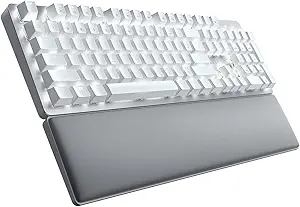
Razer vs NZXT: Overview
Comparing Razer and NZXT helps you determine which brand is best suited for your needs in Keyboards. Both brands offer strong choices depending on your budget and key feature requirements.
Key Features & Comparison
Evaluate factors such as build quality, warranty, customer satisfaction, and total value before making your final purchase choice between Razer and NZXT.
Features
In terms of sheer feature density, Razer is an industry powerhouse that consistently pushes hardware and firmware capabilities to their limits. Premium Razer boards boast analog optical switches with adjustable actuation points, rapid trigger functionality, and dual-step actuation, which provide tangible advantages in fast-paced competitive titles. Razer also offers true 4,000 Hz and 8,000 Hz polling rates, dedicated multi-function digital dials, plush magnetic wrist rests, and proprietary HyperSpeed wireless technology that rivals wired connections. However, managing these extensive features requires Razer Synapse, a powerful but resource-intensive software suite that can feel cumbersome for users who prefer lightweight background processes.
NZXT takes a more restrained, enthusiast-inspired approach to keyboard features by focusing on modularity and practical utility. The standout feature across NZXT's Function lineup is the inclusion of 5-pin hot-swappable switch sockets, allowing users to swap out standard MX-style switches without soldering—a flexibility rarely found on flagship Razer boards. NZXT also incorporates thoughtful quality-of-life additions, such as side-mounted volume rollers and mute buttons, standard bottom rows for universal keycap replacement, and detachable USB-C cables. NZXT CAM software, while less granular than Synapse regarding advanced macros and RGB layering, offers a considerably cleaner, less intrusive interface, appealing to users who want straightforward configuration without bloat.
Performance
Razer dominates the raw performance category, engineering its keyboards specifically for sub-millisecond responsiveness and competitive gaming. Flagship models equipped with Razer Analog Optical Gen-2 switches or linear optical switches deliver practically zero debounce delay and instant light-speed actuation. The implementation of Rapid Trigger technology fundamentally alters gameplay in tactical shooters by allowing keys to reset the moment they travel upward, enabling faster strafing and movement resets. Paired with ultra-high polling rates up to 8,000 Hz, Razer keyboards offer an imperceptible latency floor that satisfies the most demanding professional esports standards.
NZXT's performance profile is anchored in the dependable world of traditional mechanical switches, primarily utilizing pre-lubed Gateron switches. While these switches provide a smooth, satisfying typing experience and reliable gaming responsiveness, they operate on conventional mechanical contact leaves with standard debounce algorithms and a maximum polling rate of 1,000 Hz. In real-world gaming scenarios, NZXT keyboards are more than fast enough for casual and semi-competitive play, but they lack the cutting-edge actuation advantages, analog depth, and microscopic latency optimizations engineered into Razer's high-tier hardware. NZXT prioritizes consistent, enjoyable keystrokes, whereas Razer prioritizes tournament-grade execution speed.
Design
Design language marks a distinct philosophical divide between the two brands. Razer balances aggressive gamer aesthetics with premium chassis construction, frequently utilizing matte aluminum top plates, double-shot PBT keycaps, and brilliant per-key Chroma lighting. While Razer has moved toward cleaner silhouettes in recent generations—such as the refined BlackWidow V4 or Huntsman V2 lines—their products still prominently showcase their gaming DNA through sharp angles, bold branding, and extensive underglow illumination. Acoustically, Razer has made strides by adding internal dampening foam, though some of their stabilized keys can still sound hollow compared to enthusiast builds.
NZXT champions a modern, Scandinavian-influenced minimalism that seamlessly integrates into contemporary minimalist desk setups. Featuring low-profile aluminum top plates, subtle branding, and muted colorways (predominantly matte black, white, and subtle accent trims), NZXT keyboards avoid the traditional aggressive gamer motif altogether. The open-case floating switch design looks sleek and makes cleaning straightforward, though it can allow for more switch stem wobble and acoustic bleed. Nonetheless, NZXT includes sound-dampening foam to reduce case ping, and the hot-swappable design empowers users to modify their sound and feel with custom switches and lubricated stabilizers, granting the user ultimate control over the physical and acoustic aesthetic.