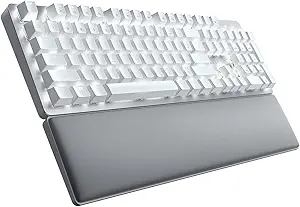
Razer vs Keychron: Overview
Comparing Razer and Keychron helps you determine which brand is best suited for your needs in Keyboards. Both brands offer strong choices depending on your budget and key feature requirements.
Key Features & Comparison
Evaluate factors such as build quality, warranty, customer satisfaction, and total value before making your final purchase choice between Razer and Keychron.
Features
When comparing feature sets, Keychron distinguishes itself through hardware openness and deep enthusiast customization, while Razer leans into specialized gaming features and software-driven automation. Keychron keyboards frequently offer full hot-swappability across standard 3-pin and 5-pin MX-style switches, physical Mac/Windows toggle switches with dedicated keycap sets, and QMK/VIA or Keychron Launcher firmware support. This open-source firmware approach means that key remapping, layered navigation, and custom macros are executed natively on-chip without requiring persistent background software, providing seamless interoperability across macOS, Windows, and Linux.
Razer, on the other hand, outfits its keyboards with high-tier gaming enhancements such as dedicated multi-function digital dials, plush magnetic wrist rests, pass-through ports, and analog switch controls that support features like Rapid Trigger and adjustable actuation points (featured prominently in the Huntsman line). Razer Synapse enables robust macro programming, profile switching tied to specific game launches, and Razer Chroma RGB lighting synchronization across external peripherals and smart lights. However, Razer’s reliance on Synapse represents a notable trade-off: it is heavily Windows-centric, lacks native macOS utility, and requires constant background resource overhead compared to Keychron’s hardware-level memory profiles.
Performance
Performance metrics reveal the starkest divergence between Keychron and Razer, rooted in their intended use cases. Keychron keyboards prioritize the mechanical and acoustic typing experience, focusing on linear, tactile, or clicky keystroke consistency, high-quality pre-lubed stabilizers, and reduced switch wobble. While Keychron's standard wireless Bluetooth models introduce modest input latency suitable for general productivity, their dedicated gaming lineups (such as the Lemokey sub-brand or models equipped with 2.4 GHz wireless and up to 1000 Hz polling) offer sufficient responsiveness for casual-to-intermediate gaming, though they rarely push into extreme esports territory.
Razer delivers state-of-the-art gaming performance, dominating latency benchmarks with up to 8000 Hz HyperPolling rates and specialized optical switches that actuate via light beams rather than physical metal contact. This design eliminates debounce delay and drastically cuts input lag to fractions of a millisecond. Furthermore, Razer’s second-generation analog optical switches unlock rapid reset actuation, allowing competitive players in titles like CS:GO or Valorant to execute rapid counter-strafing that conventional mechanical switches cannot match. For pure competitive reaction speed, Razer holds a definitive technical lead, whereas Keychron offers far superior typing cadence, lower key fatigue, and more satisfying bottom-out feedback for extended productivity sessions.
Design
From an industrial design standpoint, Keychron adopts a clean, minimalist, and utilitarian aesthetic influenced by custom keyboard community trends. Many Keychron boards—particularly the premium Q and Q Pro/Max series—boast heavy, CNC-machined aluminum chassis, multi-layer acoustic foam padding, silicone gaskets, and double-shot PBT keycaps with classic retro or two-tone colorways. The structural design emphasizes acoustic dampening and flexible plate mounting, creating a muted, deeper "thock" sound profile and a cushioned keystroke feel that suppresses hollow reverberation.
Razer embraces an aggressive, gamer-centric industrial design characterized by sleek black or white matte finishes, top plates made of aircraft-grade aluminum, floating keycap architectures, and vibrant per-key underglow. Razer's chassis designs are built with structural rigidity to endure intense tournament use, often featuring integrated cable routing channels and magnetic attachments for ergonomic wrist rests. While Razer has significantly improved its acoustics in recent iterations by adding sound-dampening foam to models like the BlackWidow V4 Pro, its overall acoustic signature remains more hollow and clacky compared to the meticulously gasket-mounted, multi-dampened architecture found standard across Keychron’s enthusiast-tier lineups.