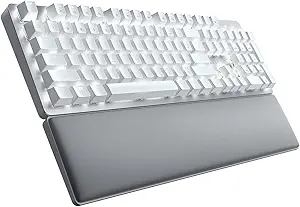
Razer vs Cherry: Overview
Comparing Razer and Cherry helps you determine which brand is best suited for your needs in Keyboards. Both brands offer strong choices depending on your budget and key feature requirements.
Key Features & Comparison
Evaluate factors such as build quality, warranty, customer satisfaction, and total value before making your final purchase choice between Razer and Cherry.
Features
Razer's feature ecosystem is among the most expansive and technologically sophisticated in the consumer market, primarily driven by its proprietary Synapse software suite. Through Synapse, Razer users gain access to granular per-key RGB mapping via Chroma, complex macro recording, cloud-synced onboard profiles, and advanced switch mechanics like Rapid Trigger and adjustable actuation points on its optical and analog lines. Hardware additions are equally comprehensive, often including dedicated media rollers, magnetic plush wrist rests, multi-device HyperSpeed wireless connectivity, and pass-through ports that transform the keyboard into a desktop command hub.
Cherry, by contrast, takes a minimalist, hardware-first stance that intentionally limits software dependence. While modern gaming-focused Cherry boards do support basic software configuration and backlighting adjustments, the brand prioritizes plug-and-play capability, physical switch integrity, and driverless reliability. Features such as full N-key rollover, robust anti-ghosting, and specialized lock keys are standard across their office and enthusiast lines without requiring bloated background applications. However, users seeking deep smart-home synchronization, analog gaming triggers, or elaborate aesthetic ecosystems will find Cherry’s conservative feature set significantly more utilitarian than Razer’s feature-packed offerings.
Performance
In terms of raw competitive performance, Razer holds a definitive edge, particularly for fast-twitch esports titles. By investing heavily in proprietary optical-mechanical and magnetic Hall-effect switches, Razer has effectively eliminated debounce delay and achieved ultra-low input latency supported by polling rates up to 8000Hz. The integration of Rapid Trigger technology on boards like the Huntsman V3 Pro allows keys to reset the instant they travel upward, unlocking unprecedented speed for counter-strafing and micro-adjustments that traditional mechanical switches simply cannot match.
Cherry's performance profile centers on absolute mechanical consistency, tactile feedback, and structural dependability over millions of actuations. Utilizing gold-crosspoint contact technology across their legendary MX switch family—including MX Red, Brown, and Blue variants—Cherry keyboards offer a predictable, satisfying, and fatigue-reducing typing experience that remains the industry benchmark. While standard Cherry MX switches exhibit slight debounce latency inherent to physical leaf contacts, they deliver unmatched mechanical stability that dedicated typists and coders often prefer over the hypersensitive, hair-trigger feel of Razer's gaming-tuned mechanisms.
Design
Razer's design language is distinctly bold, aggressive, and gamer-centric, characterized by sleek matte-black aluminum top plates, angular chassis sculpting, and vibrant underglow lighting. Even in their more refined Mercury or Quartz editions, Razer keyboards command visual attention on any desk. Beyond aesthetics, Razer incorporates thoughtful ergonomic elements such as multi-stage inclination feet, doubleshot PBT keycaps resistant to finger oils, and detachable plush leatherette wrist rests designed to mitigate strain during grueling gaming sessions, though their larger footprints can dominate desk real estate.
Cherry embraces a classic, industrial, and utilitarian aesthetic that seamlessly transitions between corporate offices and home workstations. Their chassis designs lean toward clean lines, low-profile bezels, and durable ABS or reinforced polymer casings that resist flex and internal resonance. While recent series like the Cherry Xtrfy line adopt more vibrant, esports-ready chassis and hot-swappable switch sockets, the overarching Cherry design DNA remains focused on compact efficiency, timeless form factors, and acoustically insulated, rattle-free typing experiences that value functional restraint over decorative extravagance.