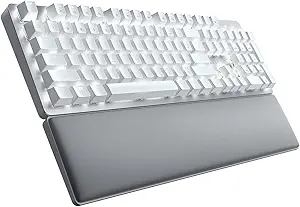
Razer vs Apple: Overview
Comparing Razer and Apple helps you determine which brand is best suited for your needs in Keyboards. Both brands offer strong choices depending on your budget and key feature requirements.
Key Features & Comparison
Evaluate factors such as build quality, warranty, customer satisfaction, and total value before making your final purchase choice between Razer and Apple.
Features
Razer’s feature set is built around deep personalization, versatility, and performance-centric hardware utilities. Most Razer keyboards leverage Razer Synapse, a powerhouse software suite allowing users to map macros, configure complex per-key RGB lighting via Razer Chroma, set adjustable actuation points on analog switches, and save multiple profile layers to onboard memory. Beyond software, Razer incorporates hardware-level features like dedicated media dials, multi-functional digital rollers, magnetic plush wrist rests, and comprehensive connectivity suites encompassing 2.4GHz Razer HyperSpeed wireless, Bluetooth, and detachable Type-C cables, delivering utility that power users can tailor to perfection.
Apple takes the opposite approach, discarding extensive software configuration in favor of elegant, plug-and-play simplicity. The Apple Magic Keyboard features integrated macOS-specific function shortcuts, quick-swap Spotlight controls, dedicated media keys, and, most notably, integrated Touch ID on supported Apple Silicon models for biometric authentication and Apple Pay. While it completely lacks backlighting on desktop variants, macro programmability, and multi-device pairing switches, it compensates with instantaneous pairing, rock-solid Bluetooth reliability within the Apple ecosystem, and months of battery life on a single charge via Lightning or USB-C.
Performance
In pure technical performance, Razer easily outpaces Apple in speed, precision, and latency. Razer equips its keyboards with an array of proprietary mechanical, optical, and analog switches that feature hyper-polling rates up to 8000Hz, near-zero debounce delay, and custom-tuned travel distances. Technologies like Rapid Trigger and adjustable actuation on their Huntsman line allow gamers to register inputs and reset keys at micro-millimeter precision, providing an undeniable competitive edge. Typing feel on Razer boards is tactile, highly responsive, and robust, engineered specifically to handle millions of rapid, aggressive keypresses without dropped signals or key chatter.
Apple’s performance envelope is calibrated strictly for everyday typing, noise reduction, and low-fatigue productivity rather than raw speed. Utilizing a refined scissor mechanism with an ultra-short travel distance (roughly 1mm), the Magic Keyboard facilitates rapid, quiet typing that requires minimal finger excursion. While the shallow bottom-out can feel stiff or jarring during extended typing sessions compared to a cushioned mechanical switch, its stability is exemplary with minimal keycap wobble. Latency is more than adequate for high-speed typing and general UI navigation, though it falls short of the ultra-low latency demands required for competitive esports.
Design
Razer’s design ethos embraces an aggressive, gamer-centric aesthetic, though it has matured in recent years to include sleek, subdued variants like the Pro Type series and BlackWidow V4 lines. Constructed using durable top plates made from aircraft-grade aluminum, paired with double-shot PBT keycaps resistant to shine and oil, Razer hardware feels substantial and heavy-duty. The prominent inclusion of per-key RGB underglow, sculpted keycaps, and ergonomic elevation kickstands reflects an industrial design focused on visual flair, tactile depth, and customizable physical posture on the desk.
Apple exemplifies industrial minimalism with its ultra-thin, unibody anodized aluminum enclosure and iconic flat profile. The Magic Keyboard lies nearly flush with the desk surface, eliminating the physical necessity for a wrist rest and maintaining a clean, clutter-free desktop aesthetic that complements other Apple hardware seamlessly. Its low-profile chiclet keycaps provide a clean, modern silhouette that slips effortlessly into a bag alongside an iPad or MacBook. However, this commitment to thinness sacrifices adjustability; the keyboard sits at a fixed, shallow incline that cannot be raised or reconfigured without aftermarket accessories.
Compare current retail pricing, active promotions, and verified stock availability directly from authorized stores: