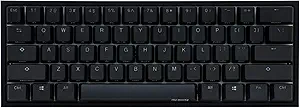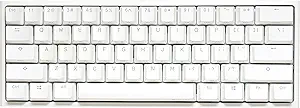







Glorious vs Ducky: Overview
Comparing Glorious and Ducky helps you determine which brand is best suited for your needs in Keyboards. Both brands offer strong choices depending on your budget and key feature requirements.
Key Features & Comparison
Evaluate factors such as build quality, warranty, customer satisfaction, and total value before making your final purchase choice between Glorious and Ducky.
Features
In terms of feature sets, Glorious takes a pronounced lead in modularity, customization, and modern enthusiast appointments. The flagship GMMK Pro, alongside the standard GMMK lines, popularized universal 5-pin hot-swappable switch sockets, rotary encoders, and customizable side-profile diffuse lighting. Glorious also supports open-source firmware solutions like QMK and VIA on select models, alongside their proprietary Glorious CORE software, granting power users granular control over per-key remapping, macro assignment, and complex RGB lighting layers. Furthermore, Glorious offers extensive aftermarket parts directly to consumers, including switch pads, brass or polycarbonate switch plates, and custom top frames, allowing for deep aesthetic and functional personalization.
Ducky approaches features from an onboard, driverless perspective, appealing heavily to purists and competitive players who travel frequently. While modern iterations like the Ducky One 3 series have adopted Kailh hot-swap sockets, Ducky’s standout capability remains its comprehensive onboard hardware programming via Ducky Macro 2.0. Users can configure intricate lighting zones, debounce timings, and layered macros directly from the keyboard without bloatware running in the background. Additionally, Ducky integrates superior stock acoustics out of the box with custom silicone and EVA dampeners engineered into their chassis. While Glorious delivers more visual versatility and software-driven customization, Ducky presents a self-contained feature matrix focused on tactile refinement and driverless independence.
Performance
Performance benchmarks between the two brands reveal subtle differences centered on switch diversity, latency, and typing mechanics. Glorious equips its boards with rapid polling rates up to 1000Hz and exceptionally low input latency, catering directly to competitive esports titles. The brand has also heavily invested in proprietary enthusiast switches, including the pre-lubed Glorious Panda tactiles and Lynx linears, which offer remarkably smooth actuations and minimal stem wobble compared to generic alternatives. However, earlier Glorious models were occasionally plagued by inconsistent factory stabilizer lubrication, requiring user intervention to prevent key rattle on larger keys like the spacebar and shift.
Ducky delivers exceptional consistency through its deep integration of genuine Cherry MX and Gateron switch variants, paired with their proprietary, meticulously tuned stabilizers. Ducky’s true strength lies in its key consistency and acoustic tuning; the chassis resonance is deeply muted, resulting in a solid, hollow-free key strike with every actuation. While Glorious boards can theoretically reach higher performance ceilings when tuned by hand, Ducky provides a superior baseline typing feel and acoustic signature from the moment the box is opened. For pure gaming latency, both brands operate at parity for human perception, but Ducky edges forward in raw typing stability and stabilizer consistency.
Design
Aesthetic and industrial design philosophies sharply contrast between the sleek, modern styling of Glorious and the iconic, artistic flair of Ducky. Glorious heavily embraces minimalist, industrial designs often anchored by heavy, CNC-machined aluminum casings, sandblasted finishes, and crisp chamfered edges, as seen on the GMMK Pro. The overall aesthetic is clean, understated, and built to blend seamlessly into contemporary battlestations, accentuated by perimeter RGB diffusion and subtle branding. Glorious keysets are generally uniform and clean, relying on clean legends and muted color palettes that appeal to modern desk setup aesthetics.
Ducky, on the other hand, embraces dual-tone and multi-color chassis designs complemented by some of the finest stock keycaps in the industry. Ducky’s thick, double-shot PBT keycaps feature crisp, non-gamery legends and textured surfaces that resist shine and degradation over years of heavy use. From their vibrant year-of-the-zodiac limited editions to thematic lines like Matcha or DayBreak, Ducky treats keyboard design as a vibrant canvas. While Ducky frames are predominantly constructed from dense, reinforced ABS plastic rather than full aluminum, their structural rigidity is exceptional, resulting in a durable, character-rich design language that stands distinct from the metallic minimalism of Glorious.