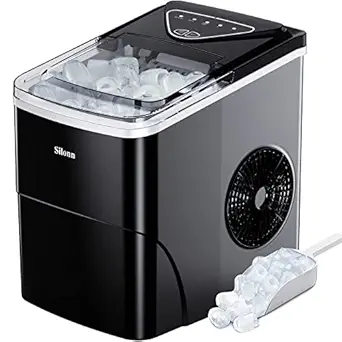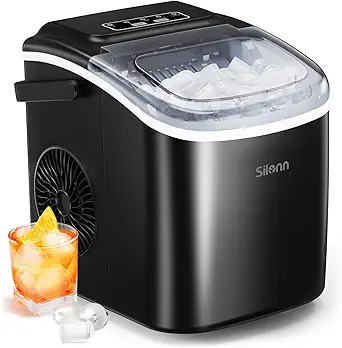






Silonn vs Gevi Household: Overview
Comparing Silonn and Gevi Household helps you determine which brand is best suited for your needs in Ice Makers. Both brands offer strong choices depending on your budget and key feature requirements.
Key Features & Comparison
Evaluate factors such as build quality, warranty, customer satisfaction, and total value before making your final purchase choice between Silonn and Gevi Household.
Features
When evaluating the functional architecture of countertop ice makers, Silonn and Gevi Household diverge significantly in their target output and core freezing mechanics. Silonn predominantly concentrates on fast-cycle, finger-evaporator bullet ice technology. Its feature suite centers on rapid batch production, churning out nine bullet-shaped cubes in roughly six to eight minutes with a selectable dual-size toggle (small and large). This streamlined approach minimizes moving parts and limits cycle complexity. Conversely, Gevi Household distinguishes itself with advanced continuous-extrusion systems engineered primarily for chewable nugget (or "sonic-style") ice alongside commercial-leaning bullet units. Gevi’s engineering integrates auger-driven ice scrapers and robust commercial-grade compressors, allowing the unit to continuously shave and compress ice flakes into porous, syrup-absorbing nuggets, providing a distinctly elevated textural experience that Silonn’s rapid-freeze evaporator rods cannot replicate.
In terms of user interaction, water management, and automation, Gevi Household offers a much more technically expansive feature profile than Silonn. Silonn adopts a minimalist, plug-and-play operational philosophy; its control panels utilize straightforward capacitive or membrane buttons paired with standard infrared sensors that detect "Ice Full" and "Add Water" states. Maintenance is limited to a single-touch automated cleaning flush. Gevi, on the other hand, outfits its higher-end units with sophisticated digital interfaces, programmable timers, and nuanced diagnostic alerts. Critically, several Gevi models incorporate dual water supply capabilities—offering both an internal reservoir and the option for a direct water-line hookup with specialized inlet valves—eliminating the manual refilling that Silonn strictly requires. Furthermore, Gevi’s automated cleaning programs often run multi-stage descaling cycles designed to protect the auger mechanics, giving it an operational edge in hard water environments.
The practical trade-offs between the two feature sets ultimately come down to everyday convenience versus specialized sophistication. Silonn excels in delivering lean, unbloated functionality: its compact footprint, quiet cooling fan operation, and rapid ice cycling make it exceptionally user-friendly for standard beverage chilling without requiring plumbing knowledge or complex upkeep. However, its thermal insulation is relatively basic, relying on standard cyclopentane foam where harvested ice quickly melts back into the reservoir. Gevi compensates for this with superior high-density insulation, integrated melt-water recycling paths, and, in select flagship models, internal UV sanitation lights that maintain pristine water purity. For consumers prioritizing simplicity, low power consumption, and reliable quick-batch ice, Silonn’s feature set hits the optimal price-to-utility ratio; for those seeking continuous hands-off plumbing, soft nugget textures, and advanced automated sanitation, Gevi Household’s feature-rich engineering represents a definitive upgrade.
Performance
When evaluating performance, Silonn and Gevi Household target fundamentally different operational demands within the countertop ice maker segment. Silonn builds its reputation on rapid-cycle refrigeration, predominantly utilizing standard evaporative finger systems that produce classic bullet-shaped ice. Most Silonn units excel in immediate turnaround, pushing out a first batch of nine cubes in as little as six to eight minutes and maintaining an aggregate output of roughly 26 pounds per 24 hours. In contrast, Gevi Household engineers its flagship catalog around complex, continuous-extrusion nugget (pebble) ice systems. Rather than relying on intermittent batch drops, Gevi employs high-torque gear motors and heavy-duty augers to compact micro-ice flakes into soft, chewable cylinder clusters, capable of generating up to 30 pounds per day. While Gevi requires a longer initial warm-up and pull-down period—often taking 15 to 20 minutes before producing optimal ice—the resulting texture, saturation capability, and melt resistance far exceed Silonn’s hollow bullet cubes in high-end beverage applications.
The mechanical integrity and thermal regulation systems further delineate the two brands. Gevi Household integrates commercial-grade compressors with closed-loop refrigerant circuits, supported by high-density polyurethane insulation that significantly reduces internal ambient heat transfer. This engineering approach mitigates the rapid melting of stored ice and curtails constant compressor cycling, while running at a subdued sound threshold typically below 45 decibels. Silonn machines, though admirably efficient for their price-to-footprint ratio, leverage lighter-duty compressors and thinner cabinet insulation. Consequently, Silonn's ice bins experience faster melt rates, which forces the melted water back through continuous re-freezing cycles. While Silonn's water recycling mechanism functions reliably, this sustained thermal load can cause operational fatigue on the compressor during high-ambient-temperature use, such as outdoor summer gatherings.
The practical trade-offs come down to cycle speed and convenience versus sustained output quality. Silonn delivers an agile, plug-and-play performance profile; its low thermal mass allows it to chill quickly, making it ideal for spontaneous entertaining or casual kitchens where fast, basic chilling is paramount. However, Gevi Household represents superior long-term performance engineering for serious ice consumers. Gevi pairs its continuous freezing engine with automated self-cleaning features and advanced descaling alerts to protect against mineral buildup, an essential safeguard given its complex internal mechanics. For users prioritizing rapid-fire batches and low upfront investment, Silonn is an exceptionally responsive performer, but for sustained daily capacity, thermal retention, and the premium mouthfeel of true sonic-style ice, Gevi Household operates in a superior mechanical tier.
Design
From an architectural standpoint, Silonn and Gevi Household approach countertop ice maker design from fundamentally different philosophies, balancing materiality, spatial footprint, and user integration in distinct ways. Silonn prioritizes streamlined minimalism and accessible portability, predominantly utilizing impact-resistant ABS polymers occasionally accented with brushed stainless steel wraps. Its units feature an ultra-compact footprint with gently curved profiles, engineered specifically to slide beneath standard kitchen cabinetry or integrate effortlessly into dorms, RVs, and compact bar setups. In contrast, Gevi Household leans heavily into a high-end, commercial-grade aesthetic characterized by heavy-gauge, anti-fingerprint brushed stainless steel chassis. Gevi's structural design is more imposing, adopting an angular, monolithic silhouette that mimics built-in culinary appliances, signaling superior mechanical durability and enhanced sound dampening at the expense of portability and counter real estate.
The interface design and interior mechanics further highlight the divergent engineering priorities between the two brands. Silonn champions functional simplicity with recessed top-panel membrane buttons or intuitive soft-touch LED interfaces paired with wide transparent viewing lids, allowing users to inspect the ice cycle without breaching the thermal chamber. Its gravity-based ice drop design relies on standard basket extraction, prioritizing lightweight convenience and low maintenance. Gevi Household, however, invests in sophisticated capacitive touch panels integrated seamlessly into the metal facade, often featuring digital status readouts, timer settings, and descaling prompts. More importantly, Gevi’s internal architecture—particularly prominent in its popular nugget ice lineup—incorporates illuminated water reservoirs, insulated double-walled bins to mitigate ambient melt, and advanced continuous-extrusion mechanisms. This elevated complexity delivers a more luxurious tactile experience, though it requires a larger internal footprint to house the heat dissipation and secondary condensation systems.
Ultimately, the practical trade-offs of their respective designs center on the tension between spatial economy and high-capacity luxury. Silonn's design succeeds brilliantly for consumers who value quick relocation, lightweight construction (often under 16 pounds), and minimal visual clutter on the counter. The concession is a reliance on thinner thermal insulation and plastic components that lack the permanence of premium fixtures. Gevi Household demands significant dedicated counter space and robust vertical clearance, weighing upwards of 30 to 40 pounds, which effectively cements it as a permanent kitchen station. However, for users demanding a design that coordinates seamlessly with professional-tier kitchen suites while offering superior ambient heat insulation and automated self-cleaning fluid loops, Gevi delivers an undeniably refined, appliance-grade execution.
Compare current retail pricing, active promotions, and verified stock availability directly from authorized stores: