GE vs NewAir: Overview
Comparing GE and NewAir helps you determine which brand is best suited for your needs in Ice Makers. Both brands offer strong choices depending on your budget and key feature requirements.
Key Features & Comparison
Evaluate factors such as build quality, warranty, customer satisfaction, and total value before making your final purchase choice between GE and NewAir.
Features
Feature-wise, GE sets the standard for modern, connected convenience through its advanced Opal platform. GE machines are renowned for built-in Wi-Fi and the SmartHQ application suite, allowing users to remotely monitor production, schedule ice cycles, and receive push notifications when water levels run low or descaling is required. GE also integrates sophisticated automated cleaning systems that circulate a sanitizing solution through internal tubing at the touch of a button. Furthermore, premium GE units frequently include UV sanitation lighting to inhibit bacterial growth in the water reservoir, alongside optional snap-on side reservoirs that triple the internal water capacity without adding significant counter depth.
NewAir prioritizes utility-driven and mechanical features engineered for practical output rather than software sophistication. Their models frequently feature intuitive push-button or LCD control panels that offer granular control over ice sizing, production timers, and basic self-cleaning cycles, though app-based remote control is largely absent. What NewAir lacks in Wi-Fi connectivity, it makes up for in practical hardware flexibility, such as reversible doors on undercounter models, heavy-duty interior insulation, integrated ice scoops with dedicated mounting brackets, and clear-cube directional freezing technology. For tech-focused users, GE’s ecosystem is unrivaled, whereas NewAir appeals to purists wanting straightforward, hands-on mechanical controls.
Performance
Performance metrics reveal distinct mechanical priorities between the two manufacturers, particularly in terms of ice type, acoustic levels, and thermodynamic efficiency. GE focuses almost exclusively on the mechanical compaction required to manufacture "Sonic-style" nugget ice. This process uses a continuous auger mechanism that freezes thin sheets of ice and scrapes them into soft, chewable clusters. While exceptionally quiet during standard operation and quick to dispense the first batch within 15 to 20 minutes, GE units tend to work steadily over longer periods and require disciplined maintenance to prevent mechanical squeaking or calcium build-up in hard-water environments.
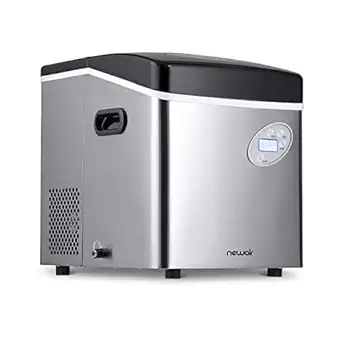
NewAir excels in raw production speed, refrigeration power, and output density. Many of NewAir’s portable units leverage traditional evaporator-finger refrigeration cycles, producing their first batch of bullet ice in as little as six to nine minutes, with aggregate daily yields ranging from 28 to 50 pounds. For high-demand entertaining, NewAir's clear ice units freeze water in continuous layers to push out trapped air and impurities, resulting in hard, slow-melting cubes ideal for cocktails. While NewAir machines can produce more total ice by weight than GE in a shorter timeframe, their compressors and internal cooling fans often generate slightly more ambient noise, and their storage bins generally lack the active refrigeration needed to keep ice frozen indefinitely without melting and recycling.
Design
From an aesthetic and industrial design standpoint, GE treats the ice maker as an extension of a luxury kitchen suite. The Opal series boasts a clean, monolithic presence characterized by wrapped brushed stainless steel, tinted viewing windows, and soft interior LED accent lighting that automatically activates when movement is detected. The integration of high-grade, food-safe plastics alongside heavy-gauge metallic accents gives GE products a distinctly modern, upscale countertop presence. The brand also pays close attention to ergonomics, offering intuitive front-facing pull-out bins or integrated hands-free touch dispensers that reduce cross-contamination.
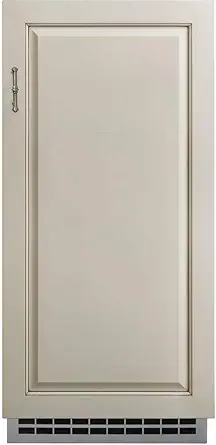
NewAir approaches design from a perspective of functional pragmatism and spatial adaptability. Their catalog spans a spectrum from rugged, colorful countertop plastic shells designed for tailgating to sleek, front-venting stainless steel facades intended for seamless flush-mount cabinetry installations. While NewAir's countertop models are generally lighter, more compact, and easier to transport, their fit-and-finish skews more utilitarian than GE’s curated home aesthetic. However, NewAir outpaces GE in structural variety, offering slim 15-inch and full 24-inch undercounter profiles that integrate beautifully into home wet bars, providing a level of architectural flexibility that GE’s countertop-centric lineup does not match.