Finvie vs Silonn: Overview
Comparing Finvie and Silonn helps you determine which brand is best suited for your needs in Ice Makers. Both brands offer strong choices depending on your budget and key feature requirements.
Key Features & Comparison
Evaluate factors such as build quality, warranty, customer satisfaction, and total value before making your final purchase choice between Finvie and Silonn.
Features
In terms of user-facing features, Silonn ice makers are masterclasses in simplicity and practical automation. Most Silonn countertop models feature an intuitive dual-size bullet ice selection, smart infrared sensor arrays to halt production when the basket is full, and essential low-water alert indicators. Their standout feature across entry-level lines is an integrated automated self-cleaning cycle that requires only a single button hold to activate. Silonn prioritizes zero-friction operation, ensuring that even users entirely unfamiliar with portable refrigeration mechanics can initiate cycles, clear scale build-up, and harvest ice without consulting dense technical documentation.
Finvie counters this with feature sets that frequently emphasize the quality of the ice-making environment. In addition to standard automated cycling and infrared basket sensors, Finvie machines often integrate upgraded multi-stage filtration compatibility and anti-microbial interior coatings within the reservoir. Some Finvie models also showcase upgraded LCD interfaces that provide more granular operational feedback, such as cycle countdowns and ambient temperature-adjusted cycling times, compared to Silonn’s simpler LED indicator panel. While Silonn provides all the essentials needed for daily bullet ice creation, Finvie gives users slightly more sophisticated control over the hygiene and precision of their ice production process.
Performance
From a technical performance standpoint, Silonn is engineered for rapid thermodynamic heat exchange and low-latency yield. Utilizing optimized R600a refrigerant loops paired with high-efficiency copper-aluminum condensers, Silonn units consistently yield their first batch of 9 bullet cubes within 6 to 8 minutes of a cold start. Their maximum daily yield reliably tops out around 26 pounds, with thermal dissipation managed quietly via balanced brushless DC exhaust fans. Silonn’s compressor cycling is tuned aggressively for front-loaded speed, making it an ideal unit for social gatherings where an immediate influx of ice is required to maintain beverage chill.
Finvie, while closely matched in 24-hour total capacity ratings (typically ranging between 26 to 28 pounds), focuses its thermal engineering on cycle consistency and insulation stability. Finvie units frequently employ denser high-density polyurethane foam insulation within the storage bin cavity, which slows the melt-and-recycle loop better than ultra-thin consumer bins. Furthermore, Finvie's evaporator prongs tend to yield slightly denser, slower-melting ice cylinders because the compressor cycle runs marginally longer per batch to maximize ice density. For rapid-fire, high-frequency output, Silonn holds a slight operational edge, but Finvie delivers superior structural integrity per cube alongside slightly quieter ambient operational decibel levels.
Design
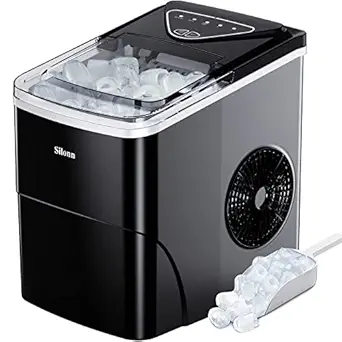
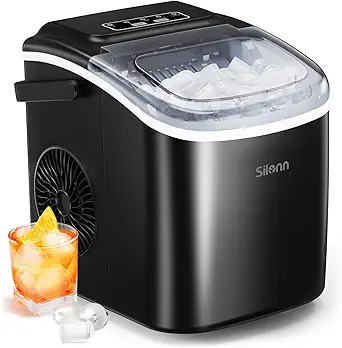
The physical design of Silonn ice makers favors a contemporary, minimalist aesthetic built for space conservation. Silonn typically utilizes lightweight, impact-resistant ABS plastics with matte or faux-brushed finishes, complemented by a large transparent viewing window that lets users monitor bin levels without lifting the lid and breaking the thermal seal. The internal layout is modular, featuring a tapered drip tray, an easily removable basket, and a front-accessible scoop holster. Silonn's primary design strength lies in its tight footprint, engineered specifically to slide beneath standard kitchen cabinet clearances without blocking heat dissipation pathways.
Finvie takes a slightly more industrial approach to its chassis architecture, often integrating true stainless-steel exterior wraps or reinforced polymer housings that project greater structural rigidity. While this occasionally results in a marginally heavier unit, the added mass works to dampen internal compressor vibration and reduce audible chassis resonance during operation. Finvie also places careful attention on drainage ergonomics, frequently utilizing side-mounted or dual-port gravity drain plugs that make the post-cleaning purge process far less awkward than bottom-centered plugs found on basic portable units. Consequently, Silonn wins on modern kitchen integration and light portability, whereas Finvie stands out for structural durability and service-friendly fluid design.