Midea vs Galanz: Overview
Comparing Midea and Galanz helps you determine which brand is best suited for your needs in Freezers. Both brands offer strong choices depending on your budget and key feature requirements.
Key Features & Comparison
Evaluate factors such as build quality, warranty, customer satisfaction, and total value before making your final purchase choice between Midea and Galanz.
Features
From a feature-set perspective, Midea clearly demonstrates its technological lead by incorporating modern usability enhancements across both entry-level and high-capacity units. Midea freezers frequently feature dual-functionality or convertible capabilities, enabling users to switch between refrigeration and deep-freezing modes via electronic touch interfaces. Additionally, Midea models routinely integrate smart multi-airflow ducts, precise digital thermostats, interior LED lighting, and self-closing or multi-angle stay-open hinges. The presence of quick-freeze modes in mid-to-high tier Midea uprights further demonstrates an emphasis on modern thermal food management that protects cellular integrity during bulk stocking.
Galanz, in contrast, adheres to a more conservative, analog feature framework. Most Galanz chest and compact upright freezers rely on external mechanical dial thermostats, manual defrost cycles, and wire basket organization without the digital bells and whistles. While this means fewer microprocessors to fail in harsh environments like unfinished garages, it limits user control to approximate temperature bands rather than exact degrees. Where Galanz excels in features is tailored convenience rather than electronics, offering reversible doors, easy-to-clean liners, and functional vintage-style hardware. Nevertheless, for shoppers prioritizing functional versatility and sophisticated thermal controls, Midea's feature matrix is substantially more robust.
Performance
In terms of performance metrics—namely cooling velocity, thermal stability, and energy conservation—Midea holds a distinct competitive edge thanks to its advanced compressor designs. Utilizing high-efficiency inverter or optimized reciprocal compressors, Midea units generally recover target temperatures much faster following lid or door openings. This dynamic output reduces thermal shock to stored items and lowers overall kWh consumption, allowing a vast majority of their models to meet or exceed strict Energy Star thresholds. Furthermore, Midea’s insulated cabinet walls utilize high-density polyurethane foam injection that retains frigid temperatures effectively during extended power outages, minimizing food spoilage risks.
Galanz delivers dependable, workhorse cooling that performs reliably within standard ambient conditions, but it lacks the refined thermal modulation found in Midea's lineup. Because Galanz models typically employ traditional fixed-speed compressors managed by mechanical relays, they exhibit wider internal temperature swings between cooling cycles. This can occasionally lead to localized frost accumulation and slightly higher long-term energy draw compared to inverter-driven alternatives. Nonetheless, Galanz systems are remarkably durable against electrical fluctuations and operate with minimal acoustic disruption. For baseline freezing needs where tight temperature precision is not critical, Galanz is fully capable, though Midea offers superior thermodynamic stability and lower running costs.
Design
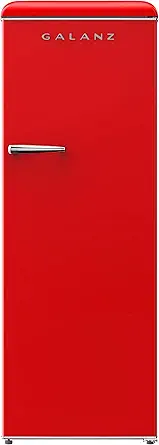
Design philosophy marks one of the sharpest contrasts between the two manufacturers, with Galanz frequently utilizing style as a core differentiator. While both brands produce standard white utility boxes, Galanz has achieved significant market acclaim with its retro-style collections. These units showcase vibrant colorways—such as retro red, mint green, and matte black—complemented by nostalgic chrome pull handles and rounded corners that transform a utilitarian appliance into a deliberate decor statement. The structural layout inside Galanz freezers is straightforward, prioritizing sturdy, unpretentious wire shelving and deep baskets that make the most of limited interior footprints.
Midea approaches design through an ethos of sleek, modern minimalism and ergonomic optimization. Their upright freezers often boast flat-door architecture with integrated pocket handles, seamless white or fingerprint-resistant stainless steel finishes, and low-profile digital displays on the door exterior. Internally, Midea emphasizes modular organization, integrating transparent slide-out drawers, adjustable tempered glass shelves, and strategically placed LED arrays that eliminate dark spots in a fully loaded compartment. While Midea lacks the playful nostalgia of Galanz’s signature retro aesthetic, its clean, contemporary lines and superior internal ergonomics make it significantly more practical for busy modern kitchens and utility pantries.