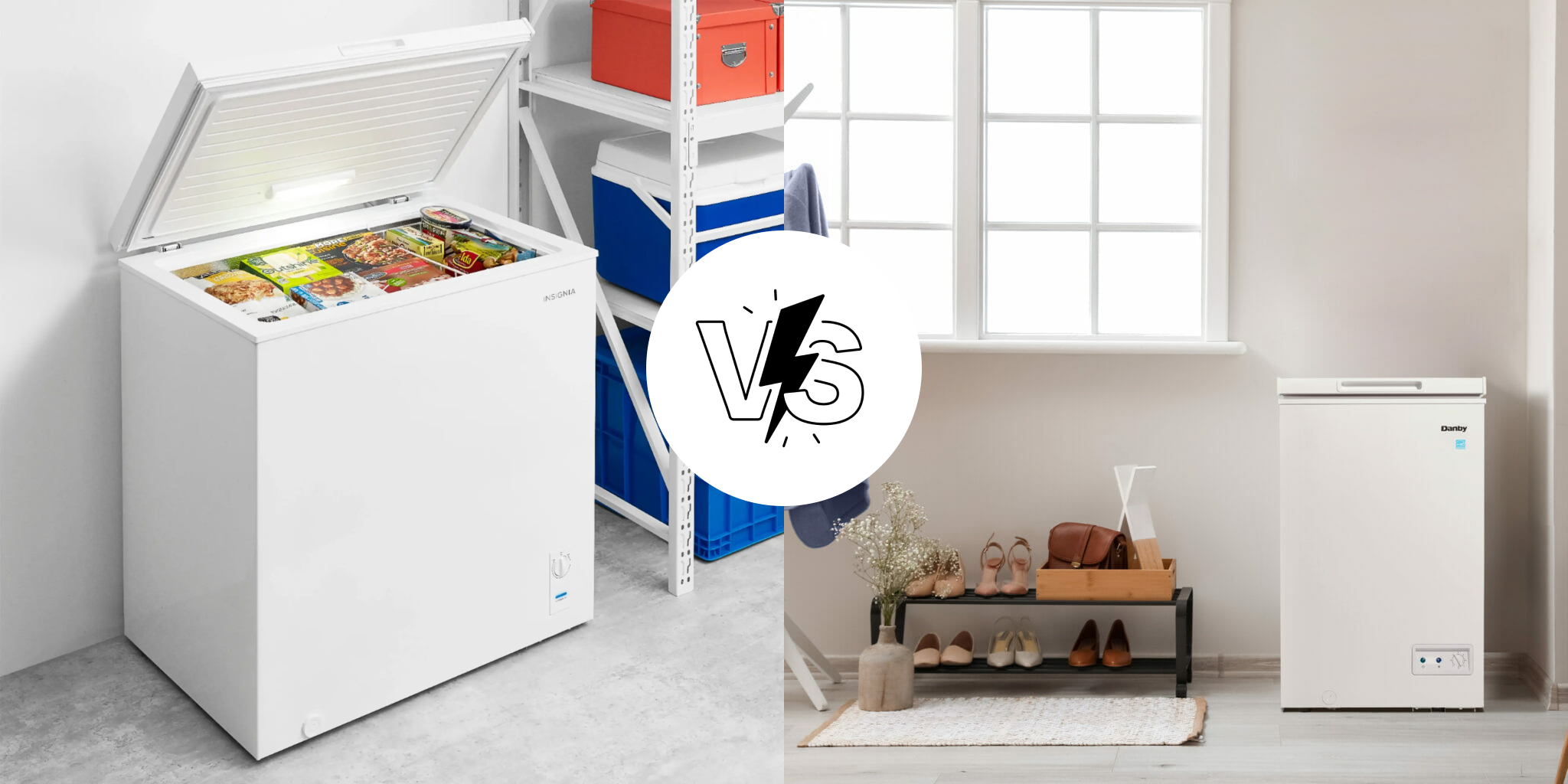
 Selecting the right freezer for your home is a decision that balances cost, quality, and long-term performance. Two notable brands competing in this space are Danby and Insignia. Danby has built its reputation over decades with reliable and energy-efficient products, while Insignia, Best Buy’s exclusive brand, has gained traction as a budget-friendly and practical option. This comparison evaluates both brands across critical factors—availability, affordability, quality and durability, reputation, warranty, and energy efficiency—to help you determine which is the better choice for your needs.
Features
When evaluating the feature ecosystems of INSIGNIA and Danby freezers, the two brands approach food preservation with distinctly different engineering philosophies. INSIGNIA, Best Buy’s house brand, focuses heavily on modern digital utility and multi-functionality. A standout technical strength in several of INSIGNIA’s upright models is the hybrid convertible functionality, allowing users to toggle the unit between a dedicated deep freezer and a standard refrigerator via an intuitive external digital interface. Furthermore, INSIGNIA prioritizes convenient interior amenities, routinely equipping their units with bright LED interior lighting, clear pull-out organizational drawers, and modern frost-free (auto-defrost) cycle programming. In contrast, Danby emphasizes utilitarian longevity and thermal precision. Danby freezers often incorporate their proprietary "Garage Ready" technology, featuring specialized compressors and enhanced cabinet insulation capable of maintaining steady sub-zero performance in ambient temperatures ranging from 0°F to 110°F (-17°C to 43°C)—an operational threshold where standard residential models frequently fail.
From a hardware and usability perspective, Danby integrates features tailored for long-term food preservation security and heavy-duty use. While INSIGNIA models often rely on standard, discreet plastic latches and flush handles, Danby frequently includes front-mounted mechanical key locks with pop-out keys, heavy-duty counterbalanced lid hinges that stay open at varying angles (between 45 and 90 degrees), and high-capacity, vinyl-coated wire baskets designed to hold dense weight without bending. Danby also favors front-mount mechanical thermostats with power-on indicator lights, which provide reliable failure diagnostics and eliminate the vulnerability of electronic control boards to power surges. Conversely, INSIGNIA’s reliance on digital touchpads provides finer incremental degree controls and rapid "quick freeze" functions, but introduces more complex circuitry that may be less resilient in unconditioned spaces like sheds or non-insulated garages.
The practical trade-off between the two brands ultimately centers on lifestyle flexibility versus environmental resilience. Consumers seeking advanced lifestyle conveniences will favor INSIGNIA, which offers the adaptability of convertible cooling, superior internal visibility, and low-maintenance frost-free operation suitable for interior utility rooms and modern kitchens. However, for users prioritizing heavy-duty structural features, energy retention during power outages, and reliable performance under extreme ambient climate shifts, Danby emerges as the technically superior choice. Danby's features are stripped of unnecessary digital complexity, focusing instead on rugged mechanical reliability, superior door seals, and specialized exterior drainage ports that simplify manual defrosting routines for maximum thermodynamic efficiency.
Performance
When evaluating performance in the freezer category, Danby demonstrates superior thermal engineering and long-term temperature stability, largely due to its commercial heritage and optimized refrigeration loops. Danby freezers frequently employ high-density foam insulation and heavy-duty, energy-efficient compressors that excel at rapid pulldown times and minimal temperature hysteresis. A standout technical advantage for Danby is its extensive implementation of "Garage Ready" engineering across both chest and upright models, ensuring consistent freezing performance in extreme ambient temperatures ranging from 0°F to 110°F (-17°C to 43°C). Furthermore, Danby’s interior evaporator coils are typically integrated with greater surface area contact, reducing the frequency of severe hot spots and minimizing the risk of freezer burn during extended storage cycles.
INSIGNIA, Best Buy’s house brand, focuses on accessible, budget-oriented performance that meets standard household demands without the specialized resilience of its competitor. While INSIGNIA units offer respectable cooling speeds and adequate daily temperature maintenance, their compressors tend to work harder and cycle more frequently to sustain sub-zero environments, which can translate to slightly higher acoustic output and reduced energy efficiency under heavy loads. INSIGNIA’s upright models frequently boast modern conveniences like intuitive digital touch controls and user-friendly frost-free operation, whereas Danby often retains manual defrost designs to maximize internal humidity control and food preservation longevity. However, INSIGNIA struggles in unconditioned environments; without dedicated garage-ready safeguards on many of its lower-tier models, ambient temperature swings can cause compressor short-cycling or unintended defrosting.
Ultimately, the practical performance trade-offs highlight different consumer priorities. Danby is the technically superior choice for buyers requiring uncompromising cold retention, energy conservation, and operational reliability in volatile environments like basements, garages, or utility rooms. INSIGNIA delivers commendable value for secondary kitchen or pantry placement where ambient room temperatures are climate-controlled. While INSIGNIA provides a lower barrier to entry with modern electronic interfaces, Danby outclasses it in critical performance metrics, including thermal recovery after door openings, mechanical component durability, and long-term food preservation consistency.
Design
When evaluating the design paradigms of INSIGNIA and Danby in the freezer category, the distinction lies between modern utilitarian minimalism and classic, reliability-focused engineering. INSIGNIA, Best Buy’s proprietary house brand, leans heavily into contemporary aesthetics characterized by clean, flat-door styling, integrated pocket handles, and versatile convertible capabilities. Many of INSIGNIA’s upright models uniquely feature firmware and thermodynamic engineering that allow the entire unit to switch seamlessly between a deep freezer and a standard refrigerator via digital external controls. Additionally, INSIGNIA favors bright, interior LED lighting arrays and clear, plastic slide-out bin configurations that optimize visibility. However, this streamlined approach sometimes reveals minor trade-offs in structural rigidity, as their chest freezers and entry-level uprights frequently rely on thinner-gauge exterior sheet metal and basic mechanical dial placements that prioritize manufacturing cost-efficiency over tactile feedback.
Danby, by contrast, takes a more conventional, specialty-appliance approach to freezer architecture, emphasizing mechanical durability and functional longevity. Danby’s upright and chest freezers frequently utilize textured scratch-resistant worktops, robust rounded cabinet corners, and front-mount mechanical thermostats with power-on indicator lights for quick diagnostics. A hallmark of Danby’s engineering is its clever interior space management; their chest freezers typically feature reinforced, high-durability wire storage baskets that slide along specialized interior ledges, and their upright units boast heavy-duty door gasket seals that excel at maintaining thermal retention during power outages. Furthermore, Danby demonstrates thoughtful design in its drainage systems—incorporating easily accessible front-mounted defrost drains with threaded adapters to simplify maintenance, compared to INSIGNIA’s occasionally recessed or lower-profile drains which can complicate the manual defrosting process.
From an ergonomics and spatial practicality standpoint, both brands address distinct consumer workflows. INSIGNIA excels in high-traffic residential spaces such as open-concept utility rooms or modern kitchens where sleek aesthetics, silent door hinges, and reversible hinge kits make seamless installation effortless. Conversely, Danby’s design is engineered for environmental resilience, making it particularly well-suited for secondary placement in basements, pantries, or garages where fluctuating ambient temperatures require robust cabinet insulation and dense polyurethane foaming. While INSIGNIA wins on smart, flexible features and modern styling, Danby holds the technical edge in structural ruggedness, hardware reliability, and ease of long-term maintenance.
Conclusion
Both Danby and Insignia offer compelling options, but your choice depends on your priorities: Danby is the ideal choice if you value energy efficiency, premium features, and a trusted brand reputation. Their freezers deliver long-term performance and sustainability, making them a worthwhile investment. Insignia stands out for affordability, practical garage-ready designs, and consistent functionality. If budget is a primary consideration, Insignia provides excellent value without compromising reliability. Whether you are looking for premium features or cost-effective solutions, both brands excel in delivering dependable freezer options tailored to your needs.