











Looking for the best freezer to handle your meal preps, frozen veggies, or backup meats? You’re not alone. Two names that often pop up in the hunt for reliability and value are Insignia and Frigidaire. But which one really delivers the right mix of performance, efficiency, and everyday usability?
In this head-to-head comparison, we break down everything — from storage space and energy efficiency to real-world features and durability. Whether you're after a budget-friendly garage freezer or a fully-loaded upright model, this guide will help you decide which brand fits your frozen lifestyle in 2025.
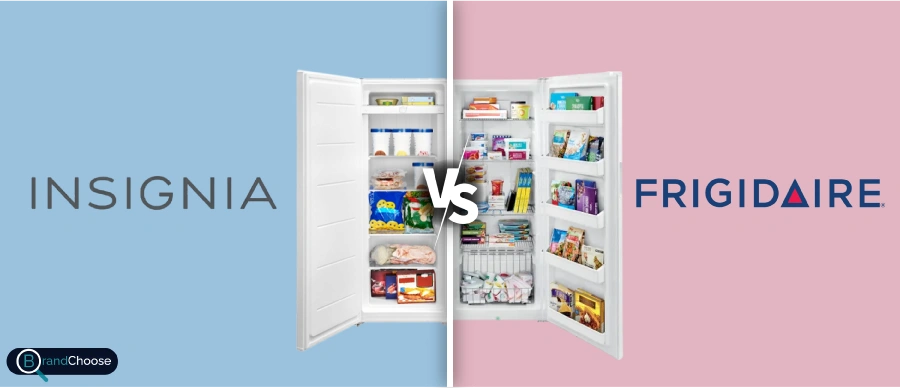
Features
When evaluating the feature ecosystems of INSIGNIA and Frigidaire freezers, the core distinction lies between fundamental utility and advanced preservation engineering. INSIGNIA, Best Buy’s proprietary house brand, focuses on essential, no-frills functionality engineered for cost-conscious consumers. Its feature set primarily emphasizes mechanical simplicity and reliable spatial utility, offering basic manual temperature dials, removable wire storage baskets, and balance-hinged lids on chest models. However, INSIGNIA has made notable strides in its upright lineup with convertible functionality, allowing users to toggle between all-refrigerator and all-freezer modes via a digital interface. While this flexibility is a strong technical selling point, INSIGNIA generally lacks proprietary food-preservation technologies, often relying on basic static or frost-free cooling systems that experience wider internal temperature swings, thereby increasing the risk of long-term freezer burn.
Conversely, Frigidaire leverages decades of thermal engineering to deliver an advanced, performance-driven suite of features aimed at long-term food preservation and operational security. Frigidaire freezers stand out with sophisticated technical integrations such as the EvenTemp Cooling System, which utilizes smart sensing technology and variable-speed airflow to distribute cold air uniformly throughout the cabinet, minimizing temperature fluctuations. Furthermore, Frigidaire heavily prioritizes cold retention through superior cabinet insulation; many of their models boast a "Freeze Proof" power outage rating capable of keeping food frozen for over 48 hours without electricity. High-end user conveniences are also standard across their catalog, including external LED temperature displays, visual and audible door-ajar and high-temperature alarms, soft-freeze zones for ice cream, and built-in keyed locks that pop out automatically upon fastening.
The practical trade-offs between the two brands center on the balance between initial purchase economy and specialized preservation capabilities. INSIGNIA provides unmatched value per cubic foot, making its straightforward feature set ideal for secondary storage in basements or garages where basic freeze-down capability is all that is required. However, the trade-off is a lack of protective redundancies; a failure in power or a cracked door seal may go unnoticed due to the absence of smart monitoring and alarms. Frigidaire commands a higher price point, but its robust engineering features—such as interior LED floodlighting, advanced organizational dividers, and fail-safe alarm systems—provide higher peace of mind and significantly extend the shelf life of costly bulk provisions, making it the superior choice for users with demanding preservation needs.
Performance
When evaluating thermal performance in freezers, Frigidaire holds a decided advantage rooted in decades of refrigeration engineering, while Insignia—Best Buy’s private-label house brand—delivers respectable, entry-level capability. Frigidaire freezers excel primarily in temperature consistency and rapid pulldown speeds, driven by heavy-duty, optimized compressors and superior cabinet insulation. Many of Frigidaire’s mid-to-high-tier upright and chest models incorporate specialized performance features such as EvenTemp cooling systems, which actively circulate cold air to eliminate micro-climates, and Power Outage Assurance, engineered to maintain sub-freezing temperatures for over 48 hours without power. In contrast, Insignia utilizes standard, cost-effective static cooling systems and baseline compressors. While Insignia units reliably reach and hold the standard zero-degree Fahrenheit threshold, they exhibit wider temperature swings during defrost cycles and take considerably longer to recover their set internal temperature after the door has been opened frequently or stocked with a large haul of ambient-temperature food.
The technical trade-offs between the two brands become most apparent under heavy operational stress and extreme ambient conditions. Frigidaire models are frequently built with robust external condensers and "Garage Ready" certification, allowing them to perform seamlessly in ambient environments ranging from 0°F to 110°F without compressor failure or internal thawing. Insignia does offer select garage-ready models, but their tolerance margins are narrower, and they tend to struggle with severe heat or freezing ambient shifts, resulting in excessive frost buildup in manual-defrost variants or overworking the compressor. Furthermore, Frigidaire’s frost-free uprights feature smarter defrost sensors that only trigger when frost accumulation demands it, minimizing thermal shock and reducing freezer burn on sensitive goods. Insignia’s frost-free mechanisms rely on simpler timer-based cycles that can introduce unnecessary temperature spikes.
Ultimately, the performance gap defines the ideal consumer use case for each brand. Insignia provides completely adequate, cost-efficient freezing performance for standard, climate-controlled basement or kitchen environments where bulk items are simply stored for everyday rotation. However, for users demanding precision temperature management, long-term food preservation without freezer burn, rapid freezing capabilities for fresh game or produce, and reliable off-grid resilience during utility failures, Frigidaire is objectively superior from an engineering, recovery-speed, and thermal stability standpoint.
Design
From an architectural and engineering standpoint, the design philosophies of INSIGNIA and Frigidaire diverge significantly, balancing cost-efficiency against long-term operational durability. INSIGNIA, Best Buy’s house brand, focuses on utilitarian minimalism that optimizes usable capacity per square inch of footprint. Their upright and chest freezers generally feature lightweight, clean-lined stamped sheet metal exteriors paired with simplified, space-saving recessed handles and basic mechanical or entry-level electronic control interfaces. In contrast, Frigidaire leverages decades of thermal engineering heritage to deliver a robust, heavy-duty build. Frigidaire freezers stand out with thicker door assemblies, reinforced commercial-grade metallic hinges, and high-density, multi-layer polyurethane foam insulation. While INSIGNIA models are tailored for unpretentious integration into laundry rooms or utility closets, Frigidaire designs emphasize structural rigidity and tighter seal tolerances, incorporating robust gasket geometry that significantly reduces thermal leakage and frost accumulation.
Feature distribution and interior layout engineering further distinguish the two brands. Frigidaire consistently outperforms in organizational ergonomics through its SpaceWise organization system, which integrates heavy-gauge adjustable wire or glass shelving, deep full-width door bins, and modular sliding baskets capable of handling high-mass loads without deflection. Additionally, Frigidaire incorporates advanced functional design elements such as high-output directional LED lighting, integrated door-ajar and high-temperature alarms, and bottom-mounted front leveling legs engineered to withstand heavy torque. INSIGNIA counters this with intelligent, multi-functional flexibility; several of their upright units feature convertible design architecture, allowing users to toggle the internal thermostat between freezer and refrigerator modes via an intuitive external touch-control panel. However, INSIGNIA’s internal shelving is typically lighter gauge and offers fewer customization slots, which can lead to shelf-sag under sustained, high-density bulk storage.
When weighing the practical trade-offs of design, consumer choice hinges on operational environments and intended utility. INSIGNIA’s streamlined, lightweight chassis makes it easier to transport and install in tight secondary spaces, delivering exceptional value for standard, climate-controlled residential use. However, its aesthetic refinement is basic, and interior plastics can feel brittle under sub-zero conditions. Frigidaire, conversely, justifies its premium through resilient, garage-ready engineering; their designs are optimized with advanced compressors and sealed cooling circuits built to maintain consistent sub-zero internal environments even when ambient temperatures fluctuate from 0°F to 110°F. For buyers prioritizing functional adaptability and entry-level affordability, INSIGNIA’s design provides modern necessities without excess, whereas Frigidaire delivers a professionally engineered, highly ergonomic design built for severe operational conditions and extended longevity.
Conclusion
If you're seeking a cost-effective freezer for basic needs, Insignia delivers reliable performance at an attractive price point. However, if you prioritize advanced features, energy efficiency, and robust build quality, Frigidaire emerges as the superior choice. Your decision ultimately hinges on balancing budget constraints with desired features and long-term value.





