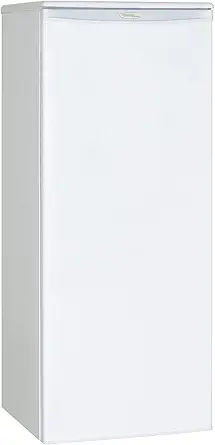
Frigidaire vs Danby: Overview & Brand Philosophy
When selecting a dedicated freezer, consumers typically weigh capacity, thermal stability, footprint, and long-term operating costs. In the refrigeration arena, few names carry as much historical weight as Frigidaire. Operating as a core brand under the Electrolux umbrella, Frigidaire is widely credited with pioneering home refrigeration over a century ago. Today, the brand’s design philosophy revolves around high-capacity utility, family-focused engineering, and seamless integration into modern home kitchens, basements, and garages. Frigidaire primarily targets mid-to-high capacity demands, offering both upright and chest freezers packed with advanced preservation technologies like frost-free auto-defrosting and power-outage cold retention.
Conversely, Danby occupies a distinctly different, yet fiercely competitive, segment of the market. Founded in Canada in 1947, Danby built its legacy by engineering compact appliances tailored for smaller living spaces, apartments, dormitories, and budget-conscious consumers. Danby's operational philosophy centers on pragmatic engineering: delivering maximum storage density per square foot while maintaining high energy efficiency and simple mechanical reliability. Rather than competing directly with large commercial-scale domestic units, Danby specializes in compact-to-mid-size chest freezers and space-saving upright units that prioritize accessible pricing and straightforward, mechanical cooling systems.
This brand divergence creates a clear competitive line between the two manufacturers. Frigidaire positions itself as the comprehensive solution for large households, bulk shoppers, and homeowners looking for high-volume, feature-rich units. Danby, on the other hand, is the premier option for homeowners needing secondary storage, condo residents navigating spatial constraints, or anyone seeking high efficiency with minimal upfront capital expenditure.
Key Differences & Technological Comparison
Evaluating Frigidaire and Danby across technical benchmarks reveals stark contrasts in cooling mechanics, spatial configuration, and user ergonomics.
- Defrosting Systems: Frigidaire heavily features advanced, total frost-free systems in its upright line, utilizing automated heating elements and forced-air fans to prevent ice accumulation. While Danby offers select frost-free models, a significant portion of its lineup uses direct-cool, manual defrost systems. Manual defrost requires periodic maintenance, but it preserves internal moisture better, prevents freezer burn on unsealed proteins, and consumes considerably less electricity than active-defrost heaters.
- Extreme Temperature Adaptability (Garage Readiness): A critical differentiator for standalone freezers is their ability to perform in unconditioned environments. Frigidaire leads this segment with its certified "Garage Ready" technology, featuring robust compressors and upgraded thermal insulation designed to function reliably in ambient outdoor temperatures ranging from 0°F to 110°F (-18°C to 43°C). While modern Danby chest freezers feature improved R600a compressors and enhanced cabinet insulation, only specific models are officially rated for extreme sub-freezing ambient temperatures, making Frigidaire the superior choice for uninsulated garages in cold climates.
- Storage Architecture & Ergonomics: Frigidaire emphasizes customizable interior architecture. Many of its upright models incorporate the Store-More™ shelving system, heavy-duty wire or glass baskets, and deep, gallon-sized door bins. Danby approaches space from a minimalist standpoint, utilizing fixed wire shelves (often integrated directly with the cooling coils) and removable vinyl-coated wire baskets in their chest models to maximize internal cubic feet relative to external dimensions.
- Temperature Control and Monitoring: Frigidaire units frequently feature external digital control pads, precision microprocessors, and audiovisual high-temperature alarms that alert homeowners if the internal temperature exceeds safe thresholds. Danby leans toward mechanical, turn-dial thermostats located near the base of chest freezers or internally on uprights, which simplifies repairs and reduces circuit board vulnerability at the expense of precise numerical temperature setting.
Pros & Cons Comparison
Frigidaire
- Pros:
- Industry-leading "Garage Ready" performance across numerous mid-to-large models.
- Robust frost-free technology eliminates the chore of manual ice removal.
- Sophisticated interior organization, including heavy-duty bins, adjustable shelves, and LED interior lighting.
- Cold-retention designs engineered to keep food safely frozen for up to 48 hours during grid power outages.
- Cons:
- Higher entry-level price points compared to budget-focused competitors.
- Frost-free cycles slightly increase continuous energy consumption and can accelerate freezer burn on improperly packaged goods.
Danby
- Pros:
- Outstanding price-to-capacity ratio, offering some of the most budget-friendly freezers on the market.
- Exceptional energy efficiency, with most direct-cool models earning high Energy Star ratings.
- Compact physical footprints engineered specifically for apartments, offices, and tight utility closets.
- Simple mechanical thermostat controls minimize internal electronics and reduce failure points.
- Cons:
- Preponderance of manual-defrost models requires regular water drainage and physical maintenance.
- Fewer structural features for interior customization; shelves in upright units are frequently fixed in place.
- External mechanical controls lack digital precision, requiring an independent internal thermometer for exact calibration.
Performance, Durability & Value Analysis
From a performance perspective, both manufacturers achieve stable core temperatures, but their thermal dynamics differ fundamentally. Danby relies primarily on direct static cooling, wherein cold refrigerant flows directly through plates or coils built into the walls or shelves. This methodology provides rock-solid, uniform thermal stability without the air-drying effect of circulating fans, leading to long-term preservation of meats and bulk ingredients. However, the accumulation of frost over months of use will slowly degrade efficiency, requiring users to manually cycle down the unit once or twice annually. Frigidaire's dynamic air-circulation designs maintain consistent internal temperatures throughout large, high-capacity cavities, rapidly recovering safe temperatures after frequent door openings, though the fan system introduces slightly higher operational decibel levels.
When measuring durability against long-term cost, the equation depends on deployment environment and usage frequency. Frigidaire justifies its price premium with superior structural hinges, more resilient cabinet liners, and seals designed to withstand heavy daily access. For large households stocking up through wholesale clubs, Frigidaire delivers high value per year of service life. Danby represents peak immediate value for secondary utility: the upfront acquisition cost is exceptionally low, replacement parts are inexpensive, and their minimalist mechanical designs offer fewer failure points over five to ten years of baseline operation.
Final Verdict: Which Brand Should You Choose?
Choosing between Frigidaire and Danby comes down to available installation space, desired storage capacity, and preferred maintenance level:
Choose Frigidaire if: You have a large household, buy meat or produce in high volume, and plan to place your freezer in an uninsulated garage, shed, or basement. Frigidaire is also the clear winner if you require the convenience of true frost-free technology, dynamic airflow, customizable interior shelving, and external digital monitoring that removes the guesswork from food preservation.
Choose Danby if: You are seeking an affordable, energy-efficient secondary freezer for an apartment, condo, pantry, or finished basement where space is at a premium. If you prioritize low initial cost and high efficiency, and do not mind the occasional manual defrosting session, Danby provides unmatched cooling reliability on a budget.
Features
When evaluating the feature ecosystems of Frigidaire and Danby freezers, the two brands cater to fundamentally different consumer priorities, with Frigidaire focusing on advanced climate engineering and Danby emphasizing practical, utility-driven enhancements. Frigidaire, a legacy heavyweight in major appliances, outfits its chest and upright freezers with sophisticated preservation technology. Standout proprietary features include the EvenTemp Cooling System, which utilizes multi-channel airflow to eliminate hot spots, and advanced digital temperature management with external alert indicators for power outages and temperature spikes. Higher-end Frigidaire models also integrate robust automatic defrost (frost-free) engineering and high-performance insulation rated for "Garage Ready" operation in ambient extremes ranging from 0°F to 110°F. In contrast, Danby relies on straightforward, highly dependable electromechanical designs. Their technical hallmark is the Smart Freeze and "Garage Ready" functionality across compact to mid-size units, often complemented by intuitive mechanical thermostats and environmentally conscious R600a refrigerant circuits optimized for low baseline energy consumption.
The divergence in design philosophies is particularly noticeable in internal organization, user accessibility, and storage flexibility. Frigidaire excels in large-capacity modularity through its SpaceWise organization system, incorporating heavy-duty adjustable wire shelves, deep door bins capable of holding gallon-sized items, slide-out storage baskets with color-coded clips, and interior LED lighting that brightly illuminates every tier. Danby, a master of compact and mid-range space optimization, focuses its feature set on maximizing usable internal volume per square foot of floor space. Danby chest and upright units feature scratch-resistant worktops, front-mount mechanical thermostats for easy blind adjustments, front-access defrost water drains for simplified manual thawing, and counterbalanced lid hinges that stay open securely. While Danby's organizational components are simpler—usually limited to one or two vinyl-coated wire baskets and fixed door shelving—they prioritize durability and ease of cleaning over complex adjustability.
Ultimately, the practical trade-off between Frigidaire and Danby hinges on advanced climate precision versus utilitarian reliability. Frigidaire offers a technically superior, feature-rich platform ideal for large households and high-volume food stockpilers who require automatic defrosting, superior air circulation, and comprehensive digital alarms to protect expensive frozen investments. However, these electronic micro-controllers and automated frost-free cycles introduce slightly higher operational noise, elevated energy draw, and more points of potential electronic failure over a ten-year lifespan. Danby presents a more conservative, mechanically robust value proposition suited for apartments, secondary storage, or budget-conscious consumers. By prioritizing manual-defrost efficiency, simplified maintenance access, and robust thermal retention that preserves cold air exceptionally well during grid failures, Danby sacrifices smart-adjacent luxury features in exchange for uncompromised, long-term operational simplicity.
Performance
When evaluating core freezing performance, Frigidaire holds a distinct advantage in rapid temperature pull-down and long-term thermal stability. Engineered with heavy-duty compressors and proprietary cooling technologies like EvenTemp, Frigidaire freezers excel at circulating cold air uniformly throughout the cabinet, effectively eliminating warm micro-pockets that lead to premature freezer burn. In chest and upright formats alike, Frigidaire models frequently boast power-freeze capabilities designed to quickly lock in the freshness of newly introduced, room-temperature groceries. Furthermore, their superior cabinet insulation and robust magnetic door gaskets provide exceptional cold retention during power outages, often keeping food safely frozen for up to two full days under ambient conditions.
Danby, while generally targeted at compact living and budget-conscious consumers, delivers commendable, efficient performance through a more utilitarian approach. Most Danby freezers rely on static cooling systems rather than advanced forced-air circulation, which results in quieter, energy-efficient operation but requires manual defrosting to maintain peak thermodynamic efficiency. While Danby units lack the high-velocity freezing speeds of Frigidaire, their simplified refrigeration loops achieve solid baseline coldness, maintaining standard zero-degree-Fahrenheit thresholds reliably. However, Danby models exhibit more pronounced temperature variance between upper and lower shelving, and their recovery times after frequent door openings lag behind the more powerful cooling mechanisms found across Frigidaire's lineup.
The practical trade-offs regarding performance ultimately center on usage intensity and environmental extremes. Frigidaire designs a substantial portion of its portfolio to be "garage ready," meaning the mechanical components and ambient sensors are rated to operate reliably in harsh external temperatures ranging from 0°F to 110°F. Conversely, while Danby offers certain garage-ready models equipped with basic ambient shields, its units are fundamentally optimized for climate-controlled indoor spaces. For consumers demanding high-volume freezing, industrial-grade temperature consistency, and the capability to weather fluctuating ambient environments, Frigidaire is the superior performer. Danby remains a highly competent secondary option for smaller spaces where steady, low-draw maintenance of pre-frozen goods takes precedence over rapid temperature cycling.
Design
When evaluating the design philosophy of freezers, Frigidaire leans heavily into robust, high-capacity utility and kitchen-grade aesthetics, while Danby prioritizes compact efficiency, functional minimalism, and spatial adaptability. Frigidaire's engineering showcases a commercial heritage, featuring heavy-duty steel construction, thick insulated walls engineered to maintain freezing temperatures for over 48 hours during power outages, and refined exterior finishes such as smudge-resistant stainless steel. Their upright models frequently integrate ergonomic exterior digital temperature controls and door-ajar alarms, elevating user convenience. In contrast, Danby excels in spatial problem-solving, engineering sleek, small-footprint upright and chest units designed specifically for apartments, basements, or secondary storage. While Danby uses lighter gauge metals and plastic hinges compared to Frigidaire’s industrial-grade components, they maximize thermal retention through high-density foam injection and scratch-resistant, worktop-style lids that double as functional utility surfaces.
Internally, the two brands diverge significantly in layout flexibility and organizational features. Frigidaire demonstrates superior interior architecture, particularly in its medium-to-large capacity upright and chest freezers. Their proprietary Store-More organization system includes adjustable, heavy-gauge wire or tempered-glass shelving, tilt-out door bins, and modular colored storage baskets that simplify inventory management in high-volume settings. Danby, on the other hand, adopts a more utilitarian approach with fixed wire shelving and basic hanging baskets. However, Danby holds a clear technical advantage in tight spaces due to its thoughtful clearance engineering, often featuring true flush-back designs, concealed condenser coils, and effortlessly reversible door swings. Furthermore, Danby frequently incorporates low-profile integrated handles, whereas Frigidaire often relies on prominent, heavy-duty external pocket or bar handles that require more door-swing clearance.
The practical trade-offs in design ultimately align with different consumer priorities regarding longevity versus footprint. Frigidaire’s design strengths lie in structural durability and advanced features like bright LED interior multi-level lighting and intuitive frost-free engineering, making them the preferred choice for primary, high-traffic household food storage. The compromise is that Frigidaire units are notably bulkier, heavier, and demand greater clearance around the perimeter for proper ventilation. Conversely, Danby’s primary trade-off is the widespread reliance on manual defrost systems and less granular internal organization, which requires more user maintenance over time. However, Danby offsets this with whisper-quiet, space-saving designs that integrate seamlessly into tight urban living spaces where every inch of floor plan and low ambient operating noise are paramount.