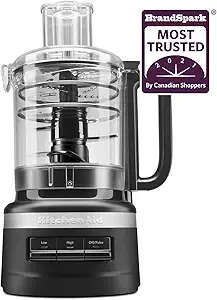
Ninja vs KitchenAid: Overview & Brand Philosophy
When selecting a food processor, consumers inevitably encounter two dominant forces in the culinary appliance space: Ninja and KitchenAid. While both brands enjoy immense market share and strong consumer loyalty, they approach kitchen prep from fundamentally different design philosophies. Ninja, a flagship brand under JS Global's SharkNinja umbrella, has built its reputation on high-velocity power, disruptive multi-functionality, and aggressive value. Born out of modern blender technology, Ninja food processors often feature stacked-blade arrays and high-RPM motors intended to pulverize, chop, and blend with uncompromising speed and modern digital convenience.
Conversely, KitchenAid carries more than a century of heritage rooted in classic culinary mechanics. Best known for its iconic stand mixers, the Whirlpool-owned brand prioritizes precision, deliberate torque, and long-term mechanical reliability over raw speed. KitchenAid’s food processors are engineered specifically for traditional culinary tasks: clean dicing, uniform slicing, emulsifying, and gentle kneading. Where Ninja aims to be an all-in-one kitchen powerhouse capable of crushing ice and blending smoothies alongside food processing, KitchenAid remains dedicated to the classic craft of food preparation, emphasizing aesthetic elegance, quiet operation, and refined blade geometry.
Key Differences & Technological Comparison
The primary technological divergence between Ninja and KitchenAid lies in their motor architecture and blade designs. Ninja food processors typically rely on universal, high-speed motors ranging from 850 to 1400 peak watts. These high RPMs make them exceptionally capable at turning tough root vegetables into coarse mince in seconds, but they can easily over-process delicate ingredients into mush. Ninja's signature technology is its multi-tiered stacked blade system, which cuts across multiple vertical planes simultaneously. While effective for bulk volume processing, it lacks the precision required for uniform culinary knife cuts.
KitchenAid utilizes lower-speed, high-torque induction or heavy-duty DC motors, often operating between 250 and 500 watts. Despite lower nominal wattage ratings, these motors deliver superior rotational force under heavy loads, ensuring the motor will not stall when kneading stiff bread dough or slicing dense butternut squash. Furthermore, KitchenAid shines in its blade engineering: its ExactSlice system allows users to adjust slicing thickness externally via a lever without changing the blade. KitchenAid also features bottom-mounted, s-curve micro-serrated blades that pull food down into the cutting zone rather than aggressively battering it, yielding far more consistent textures.
Build materials and user interface also differ substantially. Ninja embraces lightweight BPA-free plastics, snap-and-twist locking mechanisms, and digital control panels featuring Auto-iQ—pre-programmed pulse, pause, and processing patterns optimized for hands-off operation. KitchenAid prioritizes heavier die-cast metal or thick, weighted composite bases, one-click bowl assembly that requires no twisting, and tactile push-buttons or paddle levers. This results in KitchenAid appliances remaining significantly more stable on the countertop during operation, whereas high-speed Ninja units often require suction-cup feet to prevent walking across the surface.
Pros & Cons Comparison
Ninja Food Processors
- Pro: Raw Power and Speed: Exceptional motor wattage shreds and purees rapidly, effortlessly handling frozen foods and tough fibers.
- Pro: Versatile Multi-System Kits: Many Ninja models integrate food processor bowls with high-performance blending pitchers and single-serve cups on a single base.
- Pro: Automated Smart Programs: Auto-iQ technology takes the guesswork out of processing with calibrated pulse-pause cycles.
- Pro: Budget Accessibility: Delivers significant capacity and feature sets at a lower price point relative to competing premium brands.
- Con: Lack of Slicing Precision: High blade speeds and stacked configurations often result in uneven, bruised, or over-processed cuts.
- Con: High Operating Noise: High-RPM motors produce considerable decibel levels compared to traditional food processors.
- Con: Component Durability: The extensive use of lightweight plastics and complex lid latches increases the risk of mechanical fatigue over years of heavy use.
KitchenAid Food Processors
- Pro: Superior Cut Uniformity: ExactSlice mechanisms and calibrated low-speed torque deliver professional-grade, uniform slices and dices.
- Pro: Heavyweight Countertop Stability: Weighted bases and solid construction eliminate unit walking during heavy dough kneading.
- Pro: Quiet Operation: High-torque motors operate at significantly lower acoustic levels than high-RPM blender-style processors.
- Pro: Intuitive Assembly: Modern latch-and-go bowl designs eliminate complex twist locks and reduce seal leakage.
- Con: Higher Initial Cost: KitchenAid command premium prices for comparable bowl capacities.
- Con: Limited Blending Utility: Lacks the extreme blade speed necessary to produce smooth purees, nut butters, or crushed-ice drinks as effectively as Ninja.
- Con: Heavy Footprint: Substantial weight makes these units less ideal for users who frequently move appliances in and out of storage cabinets.
Performance, Durability & Value Analysis
From a performance perspective, your choice depends strictly on your definition of food prep. If your workflow involves grating pounds of cheese, emulsifying dressings, or slicing vegetables for gratin with uniform thickness, KitchenAid easily outperforms Ninja. The lower RPM blade sweep ensures ingredients are cleanly sliced rather than shredded by kinetic impact. However, if your processing routine involves pureeing dense bean dips, chopping onions without strict size requirements, or making frozen desserts, Ninja's sheer power delivers faster results. In multi-stage culinary prep, KitchenAid functions as a high-precision automated sous-chef, while Ninja operates as a high-force pulverizer.
Regarding durability and lifetime value, KitchenAid generally commands a higher cost-per-year advantage despite its steeper upfront price tag. Its robust motor housings, reinforced drive shafts, and simplified mechanical parts mean fewer points of failure over five to ten years of ownership. Ninja models offer exceptional out-of-the-box value, providing an all-in-one ecosystem for consumers who lack counter space for separate blenders and processors. However, the prevalence of multi-piece plastic interlocking safety tabs makes Ninja units more susceptible to accidental breakage or wear over sustained domestic use, placing them firmly in the high-utility, mid-term lifespan consumer tier.
Final Verdict: Which Brand Should You Choose?
Choose Ninja if you are looking for maximum versatility on a practical budget. If you want a single machine that can act as both your morning smoothie maker and an efficient vegetable chopper, Ninja’s high-wattage Auto-iQ systems provide unrivaled convenience. It is the ideal selection for busy households, meal-preppers focused on rapid bulk chopping, and home cooks who prioritize speed and multifunctional utility over exact culinary tolerances.
Choose KitchenAid if you are an avid home cook, baker, or culinary enthusiast who demands precision, consistency, and a refined kitchen experience. If you require perfectly diced produce, cleanly sliced meats and vegetables, quiet motor mechanics, and an appliance durable enough to leave permanently on the countertop, KitchenAid is well worth the higher financial investment. It is the definitive choice for those who view food preparation as an art rather than just a chore.
Features
When evaluating the feature landscape of food processors, KitchenAid and Ninja represent fundamentally different engineering philosophies: culinary finesse versus multi-functional power. KitchenAid focuses on precision prep and traditional culinary execution, prominently featuring their externally adjustable ExactSlice system, which allows users to alter slicing thickness via an external lever without disengaging the bowl or swapping blades. Furthermore, KitchenAid machines emphasize versatility through tiered feed-chute architectures—utilizing 3-in-1 multi-width pushers that handle delicate single carrots up to whole beefsteak tomatoes. In contrast, Ninja engineers its feature set around velocity and multi-appliance hybridization. The cornerstone of the Ninja ecosystem is its high-torque, vertically stacked blade assemblies (such as the Triple Prep and Auto-iQ systems), which leverage pre-programmed pulsing patterns and rotational speeds exceeding 10,000 RPM. While KitchenAid excels at uniform, liquid-free dicing, shredding, and delicate emulsification, Ninja leans into raw kinetic force, enabling its units to transition seamlessly between standard chopping, frozen blending, and nutrient extraction.
The technical trade-offs between the two feature sets become starkly apparent during daily meal preparation. KitchenAid’s feature architecture is designed with specialized attachments—such as dedicated commercial-style dicing kits with integrated grid cleaners, reversible shredding discs, and low-speed dough hooks engineered to mimic manual kneading without overheating gluten networks. Ninja counters this with proprietary automation: its Auto-iQ programs use intelligent vessel detection to automatically adjust speed curves and micro-pauses based on whether the processing bowl, a single-serve blending cup, or a traditional pitcher is locked onto the motor base. However, this high-speed, vertical-blade design comes at the expense of slicing precision; Ninja processors are prone to pulverizing the bottom layer of aromatics like onions before the top layer is caught by the blades, and their feed chutes are often narrower, requiring more manual pre-cutting compared to KitchenAid’s wide-mouth designs.
Ultimately, the choice in feature sets hinges on whether the consumer prioritizes culinary mechanics or modern convenience and multi-purpose utility. KitchenAid delivers a feature suite built for serious home cooks and bakers who demand exact, repeatable blade work, superior liquid seals for leak-free soups, and whisper-quiet induction or DC motor performance. Ninja, on the other hand, wins on footprint economy and sheer functional scope, offering busy households an all-in-one platform capable of replacing a food processor, a high-performance blender, and an ice crusher. While KitchenAid provides the definitive feature set for classical ingredient prep and texture control, Ninja delivers a feature-dense, budget-conscious ecosystem engineered for speed, automation, and effortless cleanup via completely dishwasher-safe modular components.
Performance
When evaluating performance in the food processor category, Ninja and KitchenAid take fundamentally different engineering approaches: Ninja prioritizes raw, high-velocity power, whereas KitchenAid relies on controlled torque and meticulous precision. Ninja’s machines are equipped with aggressive, high-wattage motors (often exceeding 1,000 watts) paired with their signature multi-tiered blade towers. This configuration creates a violent vortex capable of pulverizing fibrous ingredients, turning ice into snow, and tackling dense purees in seconds. Conversely, KitchenAid leverages lower-wattage, direct-drive induction motors engineered for sustained rotational force rather than sheer speed. This high-torque approach ensures the blades spin at a steady, deliberate pace that minimizes friction, prevents premature pureeing of delicate items, and provides superior control over uniform texture.
These divergent mechanical designs yield distinct strengths and limitations across day-to-day culinary tasks. For prep work requiring consistent sizing—such as dicing onions, julienning vegetables, or finely slicing produce—KitchenAid significantly outperforms Ninja. Its heavy base eliminates counter-walking, and the low-positioned, razor-sharp multi-purpose S-blade, combined with the innovative externally adjustable slicing discs, creates clean, commercial-grade cuts without bruising or macerating food. Ninja's tall blade stack, while exceptional for making smoothies or chopping large volumes in bulk, often yields uneven results during basic prep; ingredients at the bottom can be pulverized into mush before items at the top are properly cut. However, Ninja retaliates strongly in multi-functional processing, excelling at high-speed emulsification, heavy nut-butter grinding, and blending tasks where KitchenAid’s traditional basin and slower blade tip speed can feel sluggish.
Dough handling further highlights this performance trade-off. KitchenAid's heavy-duty internal gearing effortlessly powers through dense bread and pie doughs without overheating, utilizing the motor's native torque to simulate manual kneading cleanly. Ninja’s lighter, high-RPM motors compensate for lower native torque by spinning dough blades faster, which can easily overwork delicate pastry gluten, cause the motor housing to strain, or prompt the lightweight plastic base to vibrate vigorously across the countertop. Ultimately, consumers prioritizing raw power, rapid blending, and fibrous purees will find Ninja's aggressive performance optimal, whereas culinary purists who value precise knife-cut replication, exceptional slicing uniformity, and superior pastry-dough development will find KitchenAid’s refined torque engineering vastly superior.
Design
When evaluating the design philosophy of food processors, KitchenAid and Ninja present fundamentally divergent engineering approaches. KitchenAid adheres to a classic, culinary-grade design language characterized by heavy die-cast metal bases, smooth contours, and timeless retro aesthetics that seamlessly integrate into high-end kitchens. This substantial heft is not purely aesthetic; the low center of gravity provides exceptional stabilization during high-torque, heavy-load tasks like kneading dense bread dough. In contrast, Ninja embraces an aggressive, modern, and utility-driven aesthetic defined by hard plastics, angular lines, and touch-screen or membrane control panels. Ninja prioritizes footprint efficiency and multi-appliance convergence, often engineering their motorized bases to double as high-speed personal and pitcher blenders via modular vertical assemblies.
Functionally, the design differences become stark when examining bowl assembly, drive mechanisms, and processing mechanics. KitchenAid revolutionized food processor ergonomics with its one-click, twist-free bowl assembly and latched lid designs, eliminating the frustrating locking pins and complex alignment steps typical of traditional processors. Internally, KitchenAid relies on an induction-style motor coupled with a bottom-mounted, S-blade or adjustable slicing disc, leveraging downward gravity to pull ingredients through the blades. Ninja, conversely, is famous for its proprietary stacked multi-blade shaft technology, which features multiple tiers of blades extending up through the center of the processing pitcher. While this vertical multi-blade architecture excels at rapid coarse chopping and crushing ice evenly without bottom-layer overprocessing, it introduces distinct usability hurdles: the towering blade tree is notoriously sharp, difficult to clean safely, and must be completely removed before emptying processed food to prevent it from tumbling out.
From a user-centric and longevity perspective, each design represents clear trade-offs. KitchenAid excels in storage solutions and precision prep; its feed chutes frequently feature 2-in-1 or 3-in-1 nested pushers to accommodate ingredients of varying diameters, and the inclusion of dedicated, secure in-bowl accessory caddies protects attachments. Ninja sacrifices some of this culinary precision for sheer versatility and aggressive processing speeds, but its lighter plastic housing can vibrate across countertops under intense loads despite suction-cup base feet. Ultimately, KitchenAid’s design prioritizes durability, traditional culinary techniques, and countertop permanence, whereas Ninja’s modular, tech-forward design targets fast-paced home cooks demanding multi-functional efficiency and easy cabinet stowability.