KitchenAid vs Cuisinart: Overview
Comparing KitchenAid and Cuisinart helps you determine which brand is best suited for your needs in Food Processors. Both brands offer strong choices depending on your budget and key feature requirements.
Key Features & Comparison
Evaluate factors such as build quality, warranty, customer satisfaction, and total value before making your final purchase choice between KitchenAid and Cuisinart.
Features
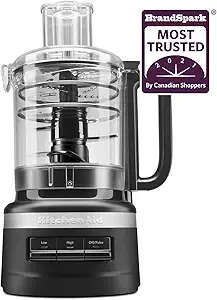
Feature sets across both brands highlight contrasting approaches to culinary versatility and user control. KitchenAid’s signature technological highlight is its proprietary ExactSlice system, which allows users to alter slicing thickness via an external lever without disassembling the bowl or swapping cutting discs. Additionally, KitchenAid frequently employs multi-in-one feed tubes with nested pushers to handle ingredients of radically different diameters without tipping, paired with modular nesting drive systems that allow work bowls to drop straight down onto the motor base without twisting or complex lock-in maneuvers.
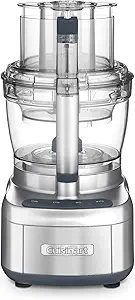
Cuisinart counters with a technical repertoire grounded in time-tested professional utility and blade innovation. Many premium Cuisinart processors feature reversible shredding discs, dedicated adjustable slicing discs, and patented dough blades designed to mimic manual folding rather than pure shearing. While Cuisinart traditionally relied on robust mechanical paddles with basic Pulse/On/Off functionality, their contemporary lines introduce electronic touchpads with pre-programmed speeds for puree, chop, and mix. While Cuisinart offers larger total capacities (often topping out at 14 to 16 cups versus KitchenAid’s typical 7 to 13 cup residential offerings), it eschews some of KitchenAid’s clever mechanical micro-adjustments in favor of brute-force efficiency and maximum liquid volume capacity.
Performance
In terms of raw cutting performance, Cuisinart remains exceptionally difficult to outperform. Powered by heavy, low-RPM, high-torque direct-drive induction motors, Cuisinart machines plow through dense root vegetables, block cheeses, and heavy yeast doughs without bogging down, overheating, or suffering from rotational speed drop. The placement and geometry of Cuisinart's stainless steel S-blades sit exceptionally close to the bottom and perimeter of the work bowl, minimizing unprocessed dead zones and delivering an extraordinarily uniform dice or emulsification with fewer unchopped stragglers left behind.
KitchenAid relies primarily on geared DC motors, which provide rapid acceleration and adequate power while maintaining a lighter footprint. In tasks like pureeing soups, emulsifying vinaigrettes, and precision-slicing tender vegetables, KitchenAid matches Cuisinart stride for stride, with its ExactSlice disc delivering remarkably clean, unbruised cuts. However, when subjected to high-resistance workloads, such as kneading double-batches of artisanal bread dough or continuous shredding of semi-hard cheeses, KitchenAid units can show mild mechanical strain, manifesting as thermal buildup or minor chassis vibration that Cuisinart’s heavier base absorbs with ease.
Design
Aesthetically and architecturally, KitchenAid sets the benchmark for contemporary industrial design. Drawing inspiration from its iconic stand mixers, KitchenAid food processors feature clean lines, rounded silhouettes, premium die-cast or high-impact composite housings, and an extensive palette of signature colorways. Crucially, KitchenAid revolutionized the category by eliminating the frustrating twist-and-lock bowl mechanism, replacing it with a hinged, latched lid and a drop-in bowl design. This design architecture also incorporates leak-resistant silicone gaskets around the lid and drive hub, allowing cooks to process wet mixtures to higher volumes without liquid escaping down the central spindle.
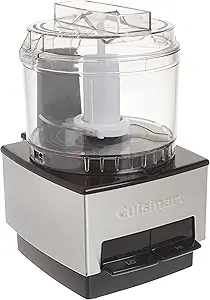
Cuisinart’s design language is unabashedly functional, retro-industrial, and tailored for culinary purists. Featuring brushed stainless steel bases, simple geometric paddle controls, and clear, heavy-gauge polycarbonate bowls, Cuisinart units look right at home in a commercial kitchen. While the traditional twist-lock assembly and rigid safety interlock stem can feel cumbersome or mechanically stiff compared to KitchenAid’s one-click latches, this design distributes mechanical stresses evenly across the bowl's perimeter. The trade-off is in storage and cleanup: Cuisinart parts generally consume more vertical cabinet space and feature more structural crevices, whereas KitchenAid emphasizes compact, in-bowl accessory storage and smooth, easily wiped surfaces.