Tribit vs GPX: Overview
Comparing Tribit and GPX helps you determine which brand is best suited for your needs in Boomboxes. Both brands offer strong choices depending on your budget and key feature requirements.
Key Features & Comparison
Evaluate factors such as build quality, warranty, customer satisfaction, and total value before making your final purchase choice between Tribit and GPX.
Features
The feature sets of Tribit and GPX reflect a distinct technological divide between cutting-edge outdoor performance and traditional audio versatility. Tribit incorporates modern, high-tier connectivity features such as Bluetooth 5.3, multi-speaker pairing ecosystems, customizable RGB lighting arrays, and companion app integration with multi-band equalizers. Furthermore, Tribit models often double as power banks, leveraging their internal lithium-ion power packs to charge external smartphones and devices via USB-C. Their feature set is deliberately curated to enhance the streaming experience, outdoor resilience, and acoustic personalization.
In contrast, GPX specializes in media versatility that caters to physical format enthusiasts and utility-minded users. A standard GPX boombox frequently integrates top-loading CD players, analog AM/FM tuners with telescoping antennas, and auxiliary inputs, with select models offering cassette recording capabilities. While GPX incorporates Bluetooth for wireless playback, its wireless implementation is typically basic, lacking companion app support or advanced codec transmission. The trade-off is clear: Tribit excels in smart digital features and power management for streaming, while GPX delivers an all-in-one entertainment hub capable of playing legacy physical media without relying on an external smart device.
Performance
In terms of acoustic performance and power delivery, Tribit vastly outperforms GPX across almost every measurable metric. Tribit boomboxes are built with substantial transducer arrays, utilizing dedicated neodymium tweeters, long-throw woofers, and high-excursion passive radiators driven by robust Class-D amplification. This architecture, coupled with proprietary DSP algorithms like XBass, enables Tribit devices to produce authoritative low-end extension down into the sub-bass frequencies without compromising mid-range vocal clarity, even at high volume levels. Battery performance is equally formidable, consistently yielding 20 to 30 hours of continuous playback on a single charge.
GPX, on the other hand, operates within the parameters of budget-tier, low-wattage amplification that is typical of traditional household boomboxes. Their drivers are predominantly modest, full-range paper-cone units housed in lightweight plastic enclosures, resulting in a sound signature characterized by prominent upper-mid frequencies and minimal true low-frequency extension. At higher volumes, GPX units are prone to total harmonic distortion (THD) and cabinet rattling. Furthermore, when used portably, GPX units often rely on disposable C or D-cell alkaline batteries rather than high-density lithium-ion cells, leading to brief operating times and recurring costs under continuous field use.
Design
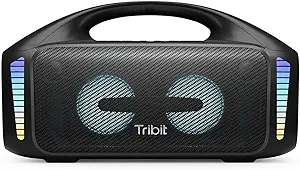
The structural design and industrial aesthetic of Tribit products convey ruggedness, weatherproofing, and modern durability. Built with heavy-duty polycarbonate shells, high-impact rubberized corner bumpers, and metal grilles, Tribit boomboxes are engineered to endure harsh outdoor conditions. They typically boast IPX7 or higher ingress protection ratings, rendering them fully waterproof and capable of submersion. Ergonomically, they feature integrated, heavy-duty carrying handles and sealed tactile push-buttons, giving the hardware a dense, premium weight that signals component quality and acoustic chamber mass.
GPX adopts a lighter, utilitarian aesthetic reminiscent of late 1990s and 2000s consumer electronics, marked by molded plastic chassis, visible seams, and mechanical switches. Because GPX designs must accommodate mechanical trays for CD mechanisms and internal space for AM ferrite antennas, their enclosures are larger in volume yet noticeably lighter and more fragile than Tribit speakers. They lack certified water or dust resistance ratings, making them unsuitable for poolside, beach, or wet environments. While GPX offers superior portability in terms of gross weight and easy-to-read analog dials, Tribit delivers vastly superior structural integrity, modern styling, and environmental resilience.
Compare current retail pricing, active promotions, and verified stock availability directly from authorized stores: