TOSHIBA vs Aiwa: Overview
Comparing TOSHIBA and Aiwa helps you determine which brand is best suited for your needs in Boomboxes. Both brands offer strong choices depending on your budget and key feature requirements.
Key Features & Comparison
Evaluate factors such as build quality, warranty, customer satisfaction, and total value before making your final purchase choice between TOSHIBA and Aiwa.
Features
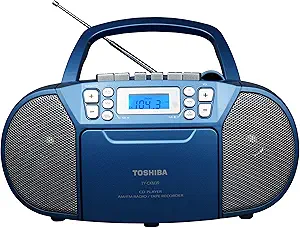
In terms of feature sets, Toshiba stands out for its exhaustive multi-format playback support across almost all price brackets. Many Toshiba boomboxes are equipped with traditional top-loading CD mechanisms, dual cassette decks with recording capabilities, digital AM/FM synthesizers with robust preset memories, and USB ports for MP3 playback. They also frequently incorporate modern conveniences such as Bluetooth 5.0 streaming and 3.5mm auxiliary inputs. Toshiba excels at keeping legacy media alive, making it the superior choice for users who still own extensive collections of physical cassettes and compact discs and desire an all-in-one entertainment station.
Aiwa takes a more selective, performance-oriented approach to its feature integrations, prioritizing acoustic enhancements and seamless modern connectivity over physical media redundancy. While certain retro-inspired models retain CD functionality, Aiwa primarily emphasizes high-grade Bluetooth codecs, True Wireless Stereo (TWS) pairing for linking multiple units, onboard digital signal processing (DSP) controls, and integrated high-capacity lithium-ion power banks capable of charging external devices. Aiwa's approach delivers a streamlined, modern experience focused on wireless streaming fidelity and outdoor usability rather than accommodating legacy tape formats.
Performance
Acoustic performance presents the clearest technological divergence between the two manufacturers. Toshiba's audio tuning is typically balanced, neutral, and vocal-centric, driven by modest amplifier modules ranging from 5 to 20 watts of total peak output. These units reproduce spoken word, acoustic music, and standard radio broadcasts with pleasant clarity and low midrange distortion. However, Toshiba boomboxes tend to struggle at high volume thresholds, showing audible compression and limited bass extension due to compact speaker enclosures and passive equalization profiles that prioritize clean dialogue over subterranean low-end punch.
Aiwa, by contrast, focuses squarely on high-output sound reproduction characterized by deep, punchy low frequencies and crystal-clear highs. Utilizing high-efficiency Class-D amplification, dedicated passive radiators, and custom-tuned woofers, Aiwa boomboxes routinely deliver substantial wattage that easily fills large open spaces and outdoor areas without harsh clipping. The low-end response is significantly richer and more authoritative, giving contemporary electronic, hip-hop, and rock tracks the visceral energy that defined the original Aiwa legacy, making it clearly superior for bass-heavy applications and high-volume listening.
Design
Toshiba’s design philosophy prioritizes practical ergonomics, utility, and classic retro aesthetics. Many of their models mimic the angular, functional boombox profiles of the late 1980s and 1990s, complete with physical tactile push-buttons, rotary analog volume dials, integrated carrying handles, and mechanical cassette bay doors. Construction generally utilizes lightweight, rigid ABS plastics designed for easy indoor transport between bedrooms, workshops, or patios. While functional and straightforward, the materials used by Toshiba emphasize lightness and economy over ruggedized, heavy-duty build quality.
Aiwa implements an aggressive, contemporary design language that marries industrial durability with modern lifestyle aesthetics. Featuring reinforced chassis architectures, silicone-sealed ports, tactile rubberized controls, and water-resistance ratings ranging from IPX4 to IPX5 on their flagship outdoor models, Aiwa units feel substantially denser and better equipped for outdoor environments. The integration of high-grade metal speaker grilles, ergonomic contoured carry straps, and tasteful ambient LED lighting arrays gives Aiwa boomboxes a premium, contemporary presence that stands up to both environmental exposure and physical abuse far better than Toshiba's lighter builds.