Sony vs Singing Wood: Overview
Comparing Sony and Singing Wood helps you determine which brand is best suited for your needs in Boomboxes. Both brands offer strong choices depending on your budget and key feature requirements.
Key Features & Comparison
Evaluate factors such as build quality, warranty, customer satisfaction, and total value before making your final purchase choice between Sony and Singing Wood.
Features
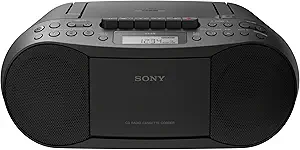
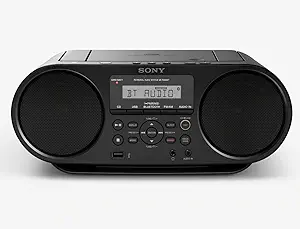
Sony’s feature suite reflects a sophisticated bridge between legacy analog audio and contemporary digital streaming. Depending on the model, Sony boomboxes often include high-precision top-loading CD players, functional cassette decks with recording capabilities, digital AM/FM tuners with programmable presets, and Bluetooth pairing with support for high-quality codecs. Many Sony units also incorporate advanced playback tools like USB audio recording, auxiliary inputs, sleep timers, and proprietary sound modes like Mega Bass, giving listeners deep granular control over playback and media transfer across generations of physical and digital formats.
Singing Wood takes a more minimalist, user-friendly approach to features, emphasizing simplicity over complex signal processing. Their boomboxes typically cover the fundamentals: basic CD-R/CD-RW playback, straightforward analog or digital AM/FM tuning, standard Bluetooth connectivity, and an auxiliary input for mobile devices. While you will rarely find cassette decks or USB encoding options on standard Singing Wood units, their controls are intentionally intuitive, featuring large dials and clear readouts that cater to younger users or seniors. For listeners wanting an exhaustive multimedia tool, Sony is far superior, but Singing Wood remains perfectly adequate for basic, day-to-day CD spinning and radio tuning.
Performance
Acoustic performance is where the disparity between Sony and Singing Wood is most pronounced. Sony employs precision-tuned dynamic drivers housed in acoustically reinforced enclosures, often augmented by tuned bass reflex ports. This architecture ensures that even at elevated volumes, the audio profile remains balanced with clear mids, crisp highs, and distinct, punchy low-end response courtesy of their dedicated digital signal processing (DSP). Battery efficiency is another major performance pillar for Sony, providing extended playback durations on standard alkaline cells without noticeable audio distortion or sudden output degradation as power depletes.
Singing Wood provides adequate sound reproduction for close-range, low-volume listening, but it cannot match Sony's dynamic headroom or frequency response. The drivers used in Singing Wood boomboxes favor the upper midrange, which works well for spoken-word podcasts, audiobooks, and talk radio, but lacks the lower-end impact required for rich musical genres like hip-hop or rock. At higher volume thresholds, Singing Wood units are prone to harmonic distortion and chassis vibration. For passive background noise or language lessons, Singing Wood performs reliably, but Sony remains the undisputed choice for listeners seeking room-filling volume, balanced stereo imaging, and musical depth.
Design
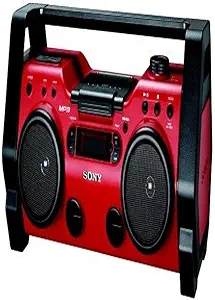
From an industrial design standpoint, Sony projects utilitarian durability and modern refinement. Sony boomboxes typically exhibit an understated, clean aesthetic using high-grade, impact-resistant matte plastics, integrated carry handles, and thoughtfully recessed buttons that prevent accidental presses during transit. The internal assembly reflects Sony's rigorous drop-testing standards, with CD transport mechanisms shielded from skipping caused by external vibrations. The layouts are modern and ergonomic, utilizing crisp LCD screens that display track information and radio frequencies with clarity under various lighting conditions.
Singing Wood, by comparison, adopts a playful, retro-inspired aesthetic that prioritizes portability and desk-friendly footprints. Many of their units come in vibrant dual-tone colorways and rounded, soft-cornered shapes that appeal to lifestyle-oriented decor and children's rooms. While their lighter weight makes them effortless to transport, the plastics feel lighter and more brittle compared to Sony's structural composites. Buttons and top-loading lid latches have a simpler mechanical feel, making them easier for small hands to operate, though less resistant to aggressive wear and tear. Sony’s design signifies professional endurance, while Singing Wood excels in approachable charm and compact convenience.