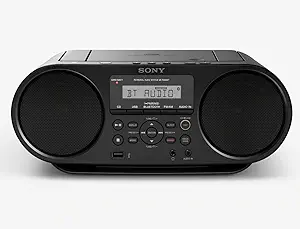
Sony vs Magnavox: Overview
Comparing Sony and Magnavox helps you determine which brand is best suited for your needs in Boomboxes. Both brands offer strong choices depending on your budget and key feature requirements.
Key Features & Comparison
Evaluate factors such as build quality, warranty, customer satisfaction, and total value before making your final purchase choice between Sony and Magnavox.
Features
Sony takes a meticulously curated approach to feature sets, prioritizing digital audio fidelity and seamless integration over sheer quantity of novelties. Most contemporary Sony boomboxes offer standard CD playback, modern Bluetooth streaming with stable AAC codec support, precise AM/FM digital tuners with extensive presets, and auxiliary inputs. Higher-end variants frequently incorporate USB recording capabilities, allowing users to rip audio tracks directly to flash drives. Sony's proprietary Mega Bass technology is seamlessly implemented via dedicated circuitry, providing a tangible low-end boost without distorting mids and highs. The operational interface is intuitive, emphasizing precision volume encoders and responsive tactile buttons designed to resist mechanical fatigue.
Magnavox counters by packing an expansive array of versatile multimedia capabilities into highly affordable footprints, often serving the niche market that still demands cassette recording and playback. While Sony has largely phased out tape decks in modern offerings, Magnavox actively caters to retro media enthusiasts by combining top-loading CD mechanisms, cassette decks with auto-stop functions, and Bluetooth connectivity on a single chassis. Furthermore, Magnavox models frequently include colorful LED party lights, dual-power operation (AC adapter or multi-battery configurations), and external headphone jacks. The trade-off lies in the execution: Magnavox features utilize cheaper mechanical switches, standard analog or basic digital tuners with lower selectivity, and basic Bluetooth chips that prioritize simple pairing over high-bitrate streaming.
Performance
In terms of acoustic performance, Sony clearly sets the benchmark with superior frequency response, low total harmonic distortion (THD), and clean output even at elevated volumes. Sony leverages custom-engineered dynamic drivers housed in acoustically optimized bass-reflex enclosures, producing clear vocals, distinct treble delineation, and controlled low-frequency extension. The integration of proprietary digital amplification circuits ensures that the sound remains balanced across various genres without the muddy resonance typically associated with plastic portable enclosures. Additionally, Sony's power management systems are significantly more efficient, providing extended battery life under continuous playback conditions, which is crucial for authentic portable operation.
Magnavox delivers modest acoustic output that is well-suited for spoken-word radio, casual backyard listening, or background music, but it struggles to match Sony's dynamic range and technical clarity. The drivers employed in Magnavox boomboxes are generally generic full-range cones mounted in unsealed or lightly damped cabinets, which can result in cabinet resonance, hollow midrange, and noticeable distortion when the master volume exceeds moderate thresholds. Bass output tends to lack physical punch and definition, often sounding thin compared to Sony's bass-enhanced profiles. Nevertheless, for users whose primary requirements are intelligible talk radio or reliable voice playback at reasonable sound pressure levels, Magnavox provides adequate, straightforward performance.
Design
Sony’s industrial design philosophy centers on understated elegance, ergonomic efficiency, and structural rigidity. Built from thick, impact-resistant ABS plastics with matte, fingerprint-resistant finishes, Sony boomboxes exhibit exceptional fit and finish with minimal panel gaps. Recessed carry handles are engineered to fold flush into the chassis, optimizing transportability while preserving a sleek silhouette. The layout of the control panel reflects careful human factors engineering, offering high-contrast, clearly labeled tactile buttons alongside backlit LCD displays that remain legible under direct sunlight. Internally, components are well-secured to withstand the mechanical shocks inherent to outdoor and travel use.
Magnavox adopts a more utilitarian, retro-futuristic aesthetic that often features bolder color accents and integrated visual flair like dynamic ambient lighting. The chassis construction uses thinner polymers, resulting in an ultra-lightweight design that is exceptionally easy to carry, though considerably more vulnerable to scratches, cracks, and physical drops over time. Handle designs are often fixed or basic hinge configurations, and the physical push-buttons—especially the mechanical piano-key controls on cassette-equipped models—have a hollow, plastic feel with higher mechanical resistance. While Magnavox designs may lack the refined, monolithic feel of Sony, their lightweight footprint and vibrant visual presentation appeal directly to users seeking a fun, non-intimidating portable audio device.