Pyle vs Tribit: Overview
Comparing Pyle and Tribit helps you determine which brand is best suited for your needs in Boomboxes. Both brands offer strong choices depending on your budget and key feature requirements.
Key Features & Comparison
Evaluate factors such as build quality, warranty, customer satisfaction, and total value before making your final purchase choice between Pyle and Tribit.
Features
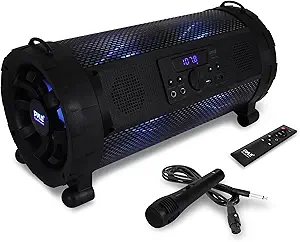
In terms of feature diversity, Pyle takes a kitchen-sink approach, packing their boomboxes with legacy and modern physical interfaces that appeal to hobbyists, performers, and retro enthusiasts. It is common to find Pyle units equipped with quarter-inch microphone inputs with independent echo controls, dedicated guitar jacks, physical FM radio tuners, onboard equalization sliders, and native recording capabilities onto USB or SD media. This sheer density of inputs makes Pyle boomboxes functioning portable PA systems, providing extensive utility for street performers, public speakers, or karaoke sessions without requiring external mixers or outboard gear.
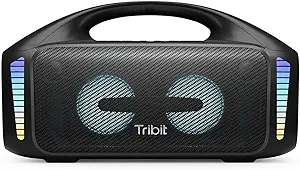
Tribit shifts the feature focus from analog versatility to cutting-edge digital integration and environmental resilience. Instead of multiple analog jacks, Tribit emphasizes modern wireless connectivity via advanced Bluetooth codecs, True Wireless Stereo (TWS) linking for multi-speaker arrays, and proprietary dynamic lighting synchronization that reacts directly to low-frequency playback. Furthermore, Tribit integrates intelligent power-bank functionality through high-current USB-A and USB-C ports, alongside companion mobile applications that enable granular multi-band parametric EQ adjustments and over-the-air firmware updates—features completely absent in Pyle’s more rudimentary, analog-leaning portfolio.
Performance
Acoustic performance presents the sharpest contrast between the two brands, particularly in how power and frequency response are managed. Pyle models often advertise staggering peak power ratings (PMPO) that translate to loud, forward-projecting audio, but this output is typically undermined by relatively high total harmonic distortion (THD) at upper volumes. Mid-range frequencies can sound hollow or boxy, and the low-end often lacks deep sub-bass extension, instead relying on upper-bass punch to create the illusion of depth. They are undeniably loud and capable of cutting through background noise, but they lack the dynamic control required for critical listening.
Tribit models, by contrast, utilize sophisticated digital signal processing (DSP) algorithms—such as their proprietary XBass technology—to extract massive, distortion-free low-end response from comparatively compact enclosures. By pairing custom-tuned neodymium long-throw woofers with dual balanced passive radiators and silk dome tweeters, Tribit delivers clean, full-bodied bass that reaches down into true sub-bass territory without muddying the vocal midrange. Even at maximum output, Tribit’s integrated power management prevents audible clipping and harsh treble peaks, resulting in a significantly more balanced, Hi-Fi soundstage that outperforms Pyle across virtually every musical genre.
Design
The physical design and build architectures of Pyle boomboxes lean heavily toward either vintage retro-nostalgia or utilitarian, heavy-duty industrial casings. Many Pyle models feature classic street-boombox styling complete with metallic grills, analogue VU meters, and prominent carry handles, while their outdoor barrels use hard plastic composites with rubber bumpers. However, the material choices often feel lightweight and hollow to the touch, and ingress protection (water and dust proofing) is either absent or restricted to minimal splash resistance, making them vulnerable in harsh outdoor environments or near water.
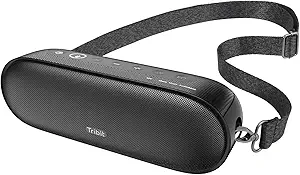
Tribit approaches industrial design with a contemporary, high-density focus on structural rigidity and extreme environmental survivability. Utilizing thick, non-resonant ABS plastics, dense metal speaker grilles, and overmolded silicone contact points, a Tribit boombox feels exceptionally solid and premium in hand. Crucially, Tribit consistently achieves rigorous IPX7 or IP67 waterproof and dustproof certifications, allowing their boomboxes to be submerged in water without sustaining damage. This makes Tribit far superior for beach, pool, and rugged camping use, whereas Pyle units are best suited for dry garages, indoor setups, or controlled outdoor gatherings.
Compare current retail pricing, active promotions, and verified stock availability directly from authorized stores: