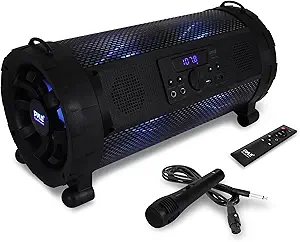
Pyle vs GPX: Overview
Comparing Pyle and GPX helps you determine which brand is best suited for your needs in Boomboxes. Both brands offer strong choices depending on your budget and key feature requirements.
Key Features & Comparison
Evaluate factors such as build quality, warranty, customer satisfaction, and total value before making your final purchase choice between Pyle and GPX.
Features
Feature-wise, Pyle embraces a maximalist approach, outfitting many of their boombox models with professional-grade versatility. Beyond standard Bluetooth streaming and FM tuners, Pyle units frequently integrate 1/4-inch microphone inputs for PA use or karaoke, auxiliary line inputs, USB and SD card readers for direct media playback, and sophisticated digital equalizers. High-end Pyle models also boast integrated multi-color LED party lights, rechargeable high-capacity lithium-ion battery packs, and robust wireless recording capabilities. This expansive toolset transforms a basic music player into a self-contained entertainment station capable of hosting events and amplifying spoken word.
In contrast, GPX adheres to a purist, legacy-oriented feature set tailored to users who value traditional media formats. GPX remains one of the premier entry-level brands offering top-loading programmable CD players and functional cassette tape decks with recording capabilities alongside modern Bluetooth receivers. While GPX units generally omit advanced public address features, dynamic sound shaping, and elaborate lighting, their inclusion of physical dial tuners, telescoping antennas, and dedicated headphone jacks appeals directly to traditionalists. The trade-off is clear: Pyle dominates in modern digital multimedia integration and utility, whereas GPX excels at preserving physical media compatibility with minimal operational complexity.
Performance
Acoustic performance constitutes the most pronounced disparity between these two manufacturers. Pyle prioritizes dynamic range, volume headroom, and low-frequency response, utilizing larger woofer diameters, ported speaker enclosures, and high-wattage Class-D amplifiers. This hardware configuration allows Pyle boomboxes to deliver punchy bass, prominent midrange projection, and room-filling volume levels without suffering excessive thermal or harmonic distortion. For outdoor parties, gyms, or job sites where ambient noise is a substantial factor, Pyle's engineering provides the necessary sound pressure levels to maintain clarity and energy across open spaces.
GPX, on the other hand, operates within a modest acoustic envelope engineered primarily for personal or small-room listening. Equipped with lower-wattage amplifiers and compact, full-range dynamic drivers, GPX boomboxes focus on vocal clarity, intelligible speech, and balanced midrange performance suitable for talk radio, acoustic music, and casual playback. When pushed toward their maximum gain stages, GPX units can exhibit mechanical cabinet rattle and audible clipping, as their primary engineering goal is power efficiency rather than high sound pressure levels. For high-decibel bass response and open-air audio fidelity, Pyle easily outclasses GPX, but GPX delivers perfectly acceptable clarity at low to moderate listening volumes.
Design
The industrial design of Pyle boomboxes conveys durability, aggression, and utilitarian readiness. Many Pyle models borrow styling cues from tactical gear, featuring heavy-duty ABS plastic molds, reinforced rubberized bumper corners, steel speaker grilles, and integrated carry straps or molded handles built to survive rough handling. The controls frequently incorporate textured rotary knobs, sealed push-buttons, and bright digital status displays. While this rugged construction increases the physical footprint and weight of the devices, it ensures they can withstand the rigors of travel, outdoor exposure, and high-impact environments.
GPX approaches design with an emphasis on compactness, lightweight ergonomics, and retro-modern minimalism. Characterized by smooth curves, lightweight polymer shells, and unobtrusive control surfaces, GPX boomboxes are remarkably easy to transport from room to room using fold-down carrying handles. The tactile experience centers on simple mechanical push-buttons, analog slider switches, and intuitive top-loading lids for CD and cassette mechanisms. While GPX chassis materials feel noticeably more plasticky and delicate compared to Pyle's heavy-duty builds, their lightweight footprint makes them far superior for effortless portability and unobtrusive placement on crowded countertops and shelves.
Compare current retail pricing, active promotions, and verified stock availability directly from authorized stores: