Jensen vs Pyle: Overview
Comparing Jensen and Pyle helps you determine which brand is best suited for your needs in Boomboxes. Both brands offer strong choices depending on your budget and key feature requirements.
Key Features & Comparison
Evaluate factors such as build quality, warranty, customer satisfaction, and total value before making your final purchase choice between Jensen and Pyle.
Features
From a feature architecture perspective, Jensen emphasizes physical format versatility within retro ecosystems. Many of Jensen's most popular boombox units feature top-loading CD players with programmable memory, integrated cassette decks with recording capabilities, and digital or analog AM/FM tuners. While newer Jensen models have integrated basic Bluetooth reception and auxiliary 3.5mm inputs, their feature roadmap remains firmly anchored in legacy physical media playback. This focus makes them particularly attractive for listeners with established CD and cassette libraries who want reliable transport mechanisms and intuitive tactile switchgear without dealing with complex menus.
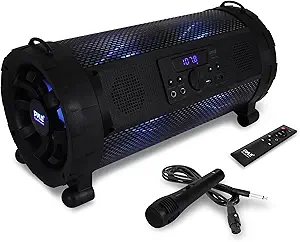
Pyle, conversely, engineers its boomboxes with modern multimedia functionality and pro-audio utility at the forefront. Across its diverse lineup, Pyle consistently incorporates high-bandwidth Bluetooth streaming, USB flash drive and SD card MP3 readers, and digital FM radios with auto-preset scanning. More crucially, Pyle frequently equips its systems with dedicated 1/4-inch microphone and guitar inputs with independent gain controls, echo effects, and dynamic multi-color LED lighting arrays. This extensive input array grants Pyle a distinct edge for karaoke, public speaking, and active event hosting, providing an expansive digital feature set that dwarfs Jensen's traditional capabilities.
Performance
In terms of acoustic performance, Jensen adheres to a balanced, low-distortion tuning profile suitable for intimate listening environments. Driven by modest class-AB or low-draw digital chipsets, Jensen units deliver nominal outputs typically ranging from 2 to 5 watts RMS per channel through full-range dynamic drivers. This conservative amplification preserves clarity in the vocal midrange, making Jensen boomboxes exceptionally well-suited for spoken-word talk radio, podcasts, acoustic music, and classical compositions at low-to-moderate listening levels. However, low-frequency extension is fundamentally limited by small driver footprints and standard ported enclosures, leading to audible compression or port chuffing when pushed beyond reasonable room-filling volumes.
Pyle fundamentally diverges by prioritizing high sound pressure levels (SPL) and bass impact. Engineering their portable rigs with higher-wattage Class-D amplifiers, Pyle frequently quotes peak outputs well into the hundreds of watts, paired with larger woofer cones and dedicated high-frequency tweeters. This high-efficiency architecture yields significantly louder overall output and punchier lower-frequency response, making Pyle units far more capable of cutting through ambient noise in outdoor parks, garages, and gymnasiums. The trade-off is a somewhat aggressive, mid-forward EQ curve that can exhibit harmonic distortion at maximum volume thresholds, but for raw decibel capability, Pyle clearly outpaces Jensen.
Design
The industrial design of Jensen boomboxes reflects a retro, practical aesthetic defined by curved ABS plastic shells, classic silver accents, and straightforward ergonomics. Control surfaces are predominantly mechanical, featuring tactile pushbuttons for tape transports, rotary dials for volume and radio frequency tuning, and integrated top-folding carry handles. This functional design philosophy ensures maximum accessibility for users of all technical proficiencies, maintaining a lightweight footprint that makes units easy to transport from room to room. Build quality is geared toward domestic use, prioritizing clean lines and easy cleaning over ruggedized drop protection.
Pyle takes a radically different design approach, frequently adopting cylindrical "bazooka-style" forms or ruggedized rectangular enclosures equipped with protective rubberized bumpers, metal front grilles, and heavy-duty nylon carrying straps. The overall aesthetic is aggressive, modern, and built for durability under strenuous conditions. Pyle's control layouts are denser, featuring rotary potentiometers for EQ adjustments, digital push-button clusters, and integrated display screens that communicate input modes. While heavier and bulkier than Jensen's compact units, Pyle's physical construction provides significantly superior resilience against the bumps, scrapes, and environmental demands of active outdoor transport.