JBL vs Ultimate Ears: Overview
Comparing JBL and Ultimate Ears helps you determine which brand is best suited for your needs in Boomboxes. Both brands offer strong choices depending on your budget and key feature requirements.
Key Features & Comparison
Evaluate factors such as build quality, warranty, customer satisfaction, and total value before making your final purchase choice between JBL and Ultimate Ears.
Features
From a feature and functional capability perspective, both brands offer robust ecosystems, yet they emphasize different user experiences. JBL integrates practical power-bank capabilities across its boombox lineup, allowing users to charge mobile devices via USB-A and USB-C ports directly from the speaker's massive internal battery. JBL’s PartyBoost (and newer Auracast integration) provides broad ecosystem linking, enabling users to daisy-chain dozens of compatible JBL speakers together. Furthermore, JBL retains legacy analog 3.5mm auxiliary inputs across most models, providing latency-free wired playback for external instruments, mixers, or legacy audio sources alongside standard Bluetooth streaming.
Ultimate Ears adopts a smarter, software-driven feature matrix that caters to modern party dynamics and convenience. The Hyperboom features adaptive acoustic room balancing with an integrated microphone that reads the room’s boundaries and continuously optimizes the equalization profile in real time. Connectivity is another distinct UE triumph: dual Bluetooth radio modules allow two simultaneous host devices to switch tracks seamlessly without disconnecting, supplemented by an optical audio input that allows the speaker to double as a competent TV soundbar. While UE’s companion app offers superior parametric EQ adjustments and alarm functions, JBL remains more hardware-focused with quick-access ambient lighting controls and physical bass boost toggles.
Performance
In acoustic performance, JBL is renowned for its authoritative low-end extension, dynamic punch, and immense decibel output. Utilizing bi-amplified driver arrays paired with opposing passive radiators—and in models like the Boombox 3, a dedicated racetrack subwoofer flanked by discrete midrange drivers and tweeters—JBL creates an acoustic presentation with staggering low-frequency impact reaching down to 40 Hz. When powered by AC mains, JBL units automatically switch power rail rails to deliver higher wattage headroom, maintaining transient clarity and minimal harmonic distortion even at maximum volumes, making them unmatched for outdoor crowds.
Ultimate Ears approaches sound reproduction with an emphasis on analytical balance, vocal clarity, and 360-degree sonic dispersion. The Hyperboom and related models utilize angled driver configurations that distribute audio more evenly across an entire room, eliminating narrow listening sweet spots. The bass reproduction in UE boomboxes is fast, tight, and articulate, yet it deliberately avoids the exaggerated low-frequency rumble found in JBL's acoustic tuning. While UE may yield several decibels of peak outdoor volume to equivalent JBL hardware, it compensates with lower coloration in the midrange frequencies, offering richer vocal reproduction and acoustic instrument separation across diverse genres.
Design
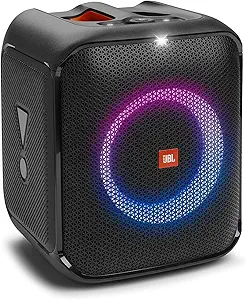
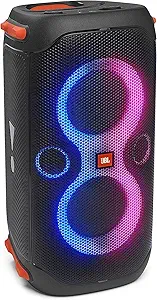
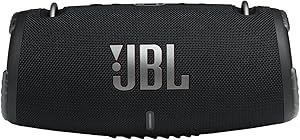
The industrial design languages of JBL and Ultimate Ears reflect their divergent target environments and usage scenarios. JBL adheres closely to the heritage boombox aesthetic, featuring a horizontal cylindrical chassis anchored by an ergonomic, heavy-duty metal handle with silicone grips. Built for demanding physical environments, JBL builds include thick, rubberized end-caps that absorb drops and a structural shell clad in tight acoustic fabric. With full IP67 ingress protection, JBL boomboxes are not only completely dustproof and waterproof, but they are also engineered to withstand submergence and float, making them exceptionally resilient for beach or poolside use.
Ultimate Ears adopts a distinctly architectural, monolithic design approach that integrates more discreetly into modern residential decors. Units like the Hyperboom employ a vertical cuboid silhouette finished in minimalist, stain-resistant acoustic mesh, framed by a soft-touch top control interface with oversized iconic volume buttons. While still highly durable with an IPX4 splash-proof rating, UE boomboxes prioritize space efficiency and indoor footprint over extreme ruggedization. The pull-out rubberized handle lays flush against the chassis when not in use, demonstrating a clean aesthetic that trades the rough-and-tumble expedition nature of JBL for sophisticated, contemporary urban styling.