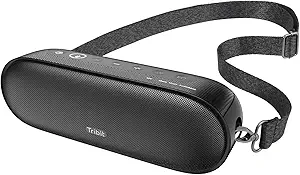
JBL vs Tribit: Overview & Brand Philosophy
In the portable audio landscape, the modern boombox represents the pinnacle of outdoor performance, combining high-decibel output, visceral bass response, and ruggedized portability. JBL, a cornerstone subsidiary of Harman International (itself owned by Samsung Electronics), approaches this segment with decades of legacy acoustic engineering. Rooted in arena sound reinforcement and professional studio monitoring, JBL's consumer lineup—headlined by the flagship Boombox series—is designed to project uncompromising power, punchy dynamic tuning, and industrial-grade resilience tailored for large outdoor gatherings and commercial-scale durability.
Conversely, Tribit has emerged as one of the most formidable direct-to-consumer challenger brands in modern acoustics. Rather than relying on multi-million dollar marketing campaigns or heritage brand equity, Tribit’s brand philosophy centers entirely on disruptive value engineering. Through offerings like the StormBox Blast, Tribit targets discerning audiophiles and budget-conscious consumers alike by implementing premium multi-driver topologies, integrated ambient lighting, and proprietary DSP-driven bass amplification at a fraction of the cost of legacy incumbents.
The philosophical divide between these two audio giants highlights a fundamental consumer choice: JBL delivers an established pedigree, unmatched maximum sound-pressure levels (SPL), and broad ecosystem connectivity, while Tribit delivers exceptional acoustic fidelity per dollar spent, proving that high-output bass and advanced waterproofing need not demand an enterprise-tier investment.
Key Differences & Technological Comparison
Evaluating these two brands across their primary boombox hardware reveals distinct approaches to industrial design, transducer layouts, and onboard software capabilities:
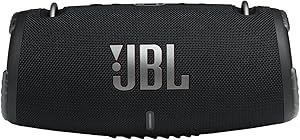
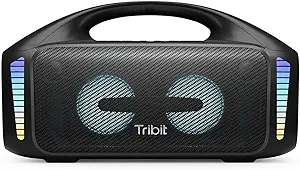
- Acoustic Architecture and Driver Configuration: JBL’s Boombox 3 features a complex 3-way driver topology comprising a dedicated racetrack subwoofer, two midrange drivers, and dual tweeters, flanked by external passive radiators. This setup minimizes intermodulation distortion at elevated volumes. Tribit, in models like the StormBox Blast, relies on a 2-way architecture with twin mid-woofers and twin silk dome tweeters, augmented by passive radiators. While Tribit achieves remarkable clarity and surprisingly deep extension via its XBass DSP, JBL’s dedicated center subwoofer yields a tighter, more physically felt sub-bass impact below 50Hz.
- Digital Signal Processing & Equalization: JBL employs highly aggressive limiters and dynamic EQ through the JBL Portable app. At moderate volumes, the bass response is deep and forward; at peak volumes (approaching 100dB+), JBL's internal DSP aggressively attenuates sub-bass to protect the drivers from over-excursion and eliminate audible distortion. Tribit's companion app offers a more granular 9-band custom EQ along with its hardware-toggled XBass mode. Tribit allows for a flatter, more neutral frequency response out of the box, whereas JBL is tuned aggressively toward the Harman curve with enhanced low-end and crisp, energetic treble.
- Chassis Engineering & Durability: Both brands emphasize outdoor survivability, but with different certifications. JBL devices typically boast an IP67 rating, meaning they are completely dust-tight and capable of surviving submersion in up to one meter of water for 30 minutes. Tribit products, such as the StormBox Blast, generally hold an IPX7 rating; they handle total water immersion with ease but lack an official certified dust ingress rating. JBL also features heavier use of thick rubberized bumpers, structural metal handles, and marine-grade woven fabric covers.
- Ecosystem and Connectivity: JBL leverages its proprietary PartyBoost and Auracast wireless ecosystems, allowing users to link dozens—or even hundreds—of compatible JBL speakers together in synced party mode or stereo configurations. Tribit supports True Wireless Stereo (TWS) pairing, but this is typically restricted to pairing identical units together, limiting scalability if you plan to link varied speakers across a wider outdoor environment.
Pros & Cons Comparison
JBL Boomboxes
- Pros:
- Superior peak dynamic range and acoustic headroom with a dedicated 3-way driver topology.
- IP67 certification offers certified protection against both fine dust/sand and water ingress.
- Extensive multi-speaker connectivity through mature PartyBoost and modern Auracast protocols.
- Premium build materials, including high-tensile silicone grips and metal carry handles.
- Cons:
- Significantly higher retail price point, frequently costing more than double equivalent competitors.
- In-app equalization options are relatively basic compared to professional DSP tools.
- Noticeable sub-bass attenuation applied by internal DSP limiters at maximum volume levels.
Tribit Boomboxes
- Pros:
- Exceptional price-to-performance ratio, delivering near-flagship performance at an entry-level price.
- 9-band customizable EQ within the companion app allows for highly accurate sound profiling.
- Built-in reactive LED party lighting built flush into the chassis without demanding extra accessories.
- Extended real-world battery longevity, often sustaining high playback hours with power bank functionality.
- Cons:
- Lacks official dust-resistance rating (IPX7 water resistance only).
- More industrial, utilitarian plastic chassis that lacks the refined premium touch of fabric-wrapped rivals.
- Multi-speaker pairing is generally limited to identical hardware pairs rather than an expansive multi-model ecosystem.
Performance, Durability & Value Analysis
From an acoustic endurance standpoint, real-world deployment demonstrates where engineering investments translate to tactile gains. JBL boomboxes demonstrate superior high-volume discipline. If you are projecting audio across open-air venues, tailgates, or beach environments, JBL’s superior driver displacement and advanced amplification deliver greater acoustic throw with less perceived strain at volumes exceeding 85% capacity. Its IP67 chassis guarantees that abrasive beach sand or fine dust will not foul internal components or degrade passive radiator surrounds over years of heavy use. In contrast, while Tribit’s construction is rigid and dense, the unrated dust chassis requires more cautious handling in sandy or arid outdoor environments.
When analyzing pricing value, however, Tribit radically alters the conversation. In blind A/B listening tests conducted at low to moderate listening levels (40% to 75% volume), the delta in acoustic quality between a Tribit StormBox Blast and a JBL Boombox 3 narrows considerably. Tribit provides clean highs, coherent midrange separation, and substantial low-end extension via its XBass processing. For the price of a single flagship JBL boombox, a consumer could purchase two Tribit units to establish a true wireless stereo field, effectively doubling acoustic spread and total dynamic displacement while still retaining change in their pocket.
Final Verdict: Which Brand Should You Choose?
Your decision ultimately hinges on environmental demands, ecosystem integration, and budgetary tolerance:
Choose JBL if: You demand maximum acoustic volume, frequently host events in harsh environments (beaches, construction sites, dusty parks) where full IP67 ingress protection is essential, or already own PartyBoost/Auracast-compatible hardware. JBL is the definitive choice for enthusiasts who demand the highest tier of commercial-grade build quality and are willing to pay the premium for industry-standard reliability and physical bass presence.
Choose Tribit if: You want class-leading acoustic performance without the steep legacy brand tax. If your usage consists primarily of backyard barbecues, poolside gatherings, garage workshops, or indoor parties, Tribit delivers an astonishing 85% to 90% of JBL’s acoustic capability at roughly 40% of the price. For pure acoustic value, balanced custom tuning, and sheer audio-per-dollar efficiency, Tribit is the undisputed champion in the modern boombox arena.
Features
When evaluating the feature ecosystem of portable boomboxes, JBL and Tribit approach functional design from contrasting product philosophies, with JBL prioritizing ecosystem integration and refined hardware execution. JBL’s flagship boomboxes, notably the Boombox series, excel with proprietary features like PartyBoost and the newer Auracast-enabled Bluetooth 5.3 architecture, allowing seamless multi-speaker pairing across dozens of compatible units with negligible latency. In terms of technical strengths, JBL incorporates highly sophisticated dual-charge output capabilities via robust, integrated power banks that can distribute high-wattage USB-A and USB-C power without destabilizing ongoing audio playback. Furthermore, the companion JBL Portable app provides a polished, low-latency interface featuring specialized audio modes, granular equalizer bands, and OTA (over-the-air) firmware stability, backed by an IP67 rating that reliably delivers both submersible waterproofing and complete dust ingress protection.
Conversely, Tribit—epitomized by its StormBox Blast series—disrupts the category by democratizing high-tier features typically reserved for premium pricing tiers, focusing heavily on audiovisual spectacle and output optimization. Tribit's engineering standout is its patented XBass technology, an active DSP (digital signal processing) hardware switch that mechanically shifts driver excursion and amplifies low-end presence on demand, paired with dynamic 32-LED rhythmic light arrays that pulse in synchronization with track transients. While Tribit matching JBL's IPX7/IP67 durability metrics and offering onboard power bank functionality, its trade-offs become apparent in its connectivity framework. Tribit relies primarily on traditional TWS (True Wireless Stereo) pairing, which limits multi-speaker linking to only two identical units, lacking the expansive, broadcast-style multi-device networking that JBL achieves through Auracast.
Ultimately, the practical trade-off between the two brands hinges on whether a user values scalable infrastructure or localized value-per-feature. JBL represents the engineering gold standard for modular, expansive use cases where software refinement, ruggedized build quality, and enterprise-grade multi-speaker synchronization are paramount for large outdoor gatherings. Tribit, on the other hand, delivers superior feature density out of the box for the budget-conscious consumer, bundling dynamic ambient lighting, aggressive hardware-level DSP bass boosting, and competent app-based parametric EQ into a package that rivals JBL’s core functionality at a fraction of the cost, even if it sacrifices broader ecosystem scalability.
Performance
When evaluating performance in the portable boombox category, JBL sets the benchmark with high-grade acoustic engineering and sophisticated digital signal processing (DSP). Flagship models like the JBL Boombox 3 utilize a dedicated three-way speaker topology—incorporating a central racetrack subwoofer, dual midrange drivers, and twin tweeters—powered by robust amplification that yields exceptionally high sound pressure levels (SPL) with negligible distortion, even near maximum volume. JBL’s tuning profile emphasizes a visceral, tight low-frequency response that easily cuts through open-air environments without muddying vocal clarity. In contrast, Tribit has engineered punchy, competitive contenders like the StormBox Blast that punch well above their price point, leveraging high wattage and dual passive radiators. While Tribit delivers an impressive, bass-forward sound signature that appeals heavily to casual listeners, it relies more aggressively on DSP compression at higher thresholds, resulting in a somewhat narrower dynamic range and occasional upper-register harshness compared to JBL’s composed acoustic staging.
In terms of operational performance and battery efficiency, both brands excel but present distinct engineering trade-offs. JBL's heavy-duty lithium-ion battery architectures are optimized to maintain consistent wattage delivery over prolonged sessions, preventing the severe dynamic throttling that often plagues lesser speakers as power reserves drop. Furthermore, JBL's ecosystem integration via PartyBoost or Auracast allows for low-latency synchronization across multiple units, a critical metric for expansive outdoor coverage. Tribit counters with astonishing endurance, frequently matching or exceeding JBL's real-world playtime at medium volumes while offering practical party-centric additions like reactive LED lighting. However, the practical trade-off boils down to acoustic fidelity versus value-driven capability: JBL delivers studio-grade cohesion, tighter bass transients, and sustained volume without frequency masking, whereas Tribit provides approximately 80 to 85 percent of that acoustic authority at a fraction of the cost, making it an extraordinary budget performer that only slightly trails JBL in refined audiophile metrics.
Design
When evaluating the industrial design of modern boomboxes, JBL sets the benchmark for rugged refinement and recognizable aesthetics. Iconic models like the JBL Boombox 3 showcase a muscular, cylindrical architecture engineered around a high-grade metal handle with textured silicone grips, creating a seamless fusion of portability and heavy-duty structural integrity. JBL’s design ethos leans heavily into premium, lifestyle-oriented durability, featuring tightly woven acoustic fabric grilles that are rated IP67 for total dust and water submersion. The internal chambering is meticulously engineered with rigid plastic end-caps and weighted, exposed passive radiators on the flanks, which deliver an engaging visual tactile response to sub-bass frequencies. Every control surface, from the embossed physical buttons to the battery status LED lightbar, reflects a mature manufacturing pipeline characterized by tight tolerances and high-end materials that easily withstand outdoor abuse.
In contrast, Tribit approaches boombox design with a hyper-pragmatic, value-forward philosophy that often incorporates bold, party-centric elements. Flagship units like the Tribit StormBox Blast feature a boxier, utilitarian silhouette reminiscent of traditional 1980s street stereos, integrated with modern ABS plastic chassis and built-in, unreinforced plastic carry handles. While Tribit also achieves an impressive IPX7 or IP67 ingress protection rating, their exterior utilizes more exposed molded hard plastics and perforated metal grilles rather than wrapped acoustic textiles, which can make the units feel slightly less luxurious in hand. However, Tribit excels by integrating vibrant, customizable multi-color LED light arrays along the speaker faces that sync dynamically to audio playback—a design feature that JBL largely reserves for its distinct, larger PartyBox series rather than its standard boomboxes.
The practical trade-offs between the two brands ultimately center on aesthetic sophistication versus feature density at a given price point. JBL’s engineering advantages lie in its acoustic damping, lower-profile physical footprint, and superior balance, making a JBL boombox easier to carry over long distances without body fatigue despite substantial internal magnet weight. Tribit’s trade-offs manifest in bulkier, somewhat front-heavy enclosures and less refined button tactile feedback, but the brand compensates with accessible utility, including flush-mounted rubberized port flaps and high-contrast button layouts that are effortless to operate in low light. For consumers prioritizing sleek craftsmanship, weather-tested materials, and acoustic enclosure engineering, JBL remains the definitive design leader; conversely, Tribit delivers an impressively sturdy, feature-packed party aesthetic that maximizes functional durability without the premium markup.
Compare current retail pricing, active promotions, and verified stock availability directly from authorized stores: