JBL vs Aiwa: Overview
Comparing JBL and Aiwa helps you determine which brand is best suited for your needs in Boomboxes. Both brands offer strong choices depending on your budget and key feature requirements.
Key Features & Comparison
Evaluate factors such as build quality, warranty, customer satisfaction, and total value before making your final purchase choice between JBL and Aiwa.
Features
JBL’s feature architecture is deeply rooted in modern convenience, environmental resilience, and multi-device networking. Flagship JBL boomboxes boast an industry-leading IP67 ingress protection rating, ensuring complete defense against dust intrusion and full water submersion. On the software front, the JBL Portable companion app provides firmware updates, basic three-band EQ manipulation, and PartyBoost or Auracast pairing, enabling users to synchronize dozens of compatible speakers effortlessly. Additionally, JBL units serve as reliable power banks via high-output USB-A ports, utilizing their massive internal lithium-ion cells to charge external mobile devices during extended outdoor excursions.
Aiwa approaches the feature landscape with a purist, hardware-centric methodology that hearkens back to retro audio monitors. Rather than relying heavily on app-based controls, models like the Aiwa Exos-9 incorporate an onboard, illuminated 5-band graphic equalizer with customizable presets, allowing on-the-fly acoustic tailoring without a smartphone. Connectivity extends beyond standard Bluetooth with aptX low-latency codecs to include direct 3.5mm auxiliary jacks and balanced line-in potential. Crucially, Aiwa often features user-replaceable, quick-swap battery packs—a rare feature in modern portable audio that eliminates planned obsolescence and allows continuous operation via secondary batteries, offsetting its lack of serious water resistance.
Performance
In terms of acoustic performance, JBL tunes its boomboxes to deliver maximum impact, dynamic bass extension, and expansive projection in open-air environments. Utilizing dual long-throw subwoofers, dedicated midrange drivers, and dual tweeters, modern JBL units produce a warm, V-shaped sound signature characterized by punchy, visceral low-end authority that does not distort even at peak volumes. JBL's advanced digital signal processing (DSP) dynamically manages driver excursion and frequency distribution, ensuring that bass notes remain deep and controlled while high frequencies cut through ambient environmental noise with clarity.
Aiwa counters with an uncompromising focus on acoustic fidelity, dynamic headroom, and linear frequency reproduction. Delivering upwards of 200 continuous watts of bi-amplified class-D power through a 5-driver array—including a dedicated 6.5-inch dual-voice-coil subwoofer—Aiwa delivers clean, distortion-free output across a broader dynamic range. The low end is tighter, faster, and more natural than JBL's bass-heavy DSP tuning, while the dedicated mid-range drivers and silk dome tweeters reproduce vocal nuance and instrumental separation with studio-monitor precision. While JBL wins on raw perceived bass outdoors, Aiwa superiorly resolves complex musical passages with lower total harmonic distortion (THD).
Design
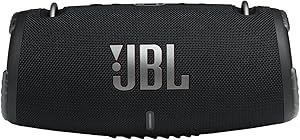
JBL's industrial design is modern, athletic, and purposefully rugged. Constructed from high-density ABS plastic wrapped in heavy-duty acoustic fabric and reinforced with thick silicone end-caps, JBL boomboxes are designed to survive drops, sand, and accidental drops into water. Ergonomically, models like the Boombox 3 feature a robust, integrated aluminum carry handle lined with textured silicone grips, balancing substantial heft with transportability. The visual aesthetic is unmistakably contemporary, dominated by bold, embossed branding, exposed passive radiators with metal accents, and an overall profile that blends lifestyle flair with industrial durability.
Aiwa embraces a clean, retro-utilitarian design language that prioritizes functional elegance and internal acoustic volume over extreme ruggedness. Featuring a boxy, geometric silhouette that directly references high-end classic boomboxes and desktop studio monitors, Aiwa relies on rigid MDF wood or dense composites inside a durable plastic chassis to minimize internal resonance. The front is dominated by a clean metal speaker grille and an illuminated digital LCD interface displaying EQ curves and battery metrics. While Aiwa includes integrated carrying recesses, its form factor is noticeably bulkier and lacks water-resistant sealing, making it distinctly suited for patios, garages, and indoor spaces rather than wet, unpredictable outdoor expeditions.
Compare current retail pricing, active promotions, and verified stock availability directly from authorized stores: