Ninja vs NuWave: Overview
Comparing Ninja and NuWave helps you determine which brand is best suited for your needs in Air Fryers. Both brands offer strong choices depending on your budget and key feature requirements.
Key Features & Comparison
Evaluate factors such as build quality, warranty, customer satisfaction, and total value before making your final purchase choice between Ninja and NuWave.
Features
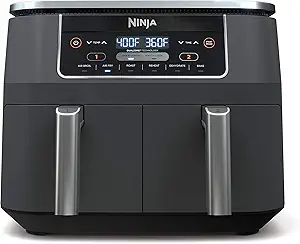
Ninja sets the standard for consumer convenience through engineered, multi-modal feature suites such as DualZone technology, which incorporates independent heating elements and fans alongside features like 'Smart Finish' and 'Match Cook' to harmonize different dishes. Beyond multi-zone synchronization, flagship Ninja units often bundle high-temperature Max Crisp functionality (reaching up to 450°F), built-in Foodi smart thermometers for precise internal protein monitoring, and specialized dehydrate and broil cycles. These presets are meticulously tuned to specific fan speeds and heat outputs, reducing the guesswork for the end user and delivering reliable, repeatable outcomes across varying food types.
NuWave, on the other hand, distinguishes itself through unmatched granularity in base-level operational controls. Rather than locking users into rigid presets, many NuWave air fryers—such as the Brio series—allow temperature adjustments in fine 5-degree increments across an expansive range from 50°F to 400°F or higher, alongside integrated digital probe capabilities on select models. NuWave also provides multi-layer cooking racks, rotisserie forks, and skewering systems right out of the box on their larger oven-style units. While NuWave provides broader baseline customization and accessory packaging, Ninja’s execution feels more cohesive, with software-hardware integration that genuinely automates the cooking process rather than requiring constant user programming.
Performance
In empirical cooking performance, Ninja is defined by rapid, intense convection dynamics. Ninja leverages high-wattage heating loops paired with tightly directed, downward-facing high-velocity cyclonic fans. This engineering generates superior Maillard browning and moisture evacuation, making it exceptional at turning frozen items, poultry wings, and breaded proteins exceptionally crispy without drying out the interior. Thermal recovery times after opening the basket are notably short, which stabilizes cooking parameters and ensures uniform heat distribution across the entirety of the cooking chamber without leaving cold spots.
NuWave relies on a combination of conduction, convection, and intense radiant heat, which provides consistent and thorough thermal penetration, particularly for larger whole meats or multi-tiered batches. However, NuWave units often feature slightly lower air-circulation velocity compared to Ninja's high-speed fans. As a result, NuWave excels at deep, steady roasting and delicate low-temperature dehydration, but may require slightly longer cook times or manual basket agitation to achieve the same shattering exterior crunch that Ninja achieves automatically. Additionally, Ninja maintains tighter thermal equilibrium at maximum temperatures, whereas NuWave’s precision is most apparent in the low-to-mid thermal ranges.
Design
From a design and build perspective, Ninja showcases a polished, modern industrial aesthetic characterized by brushed stainless-steel accents, soft-touch matte plastics, and intuitive, high-contrast LED control panels. Their baskets are constructed with heavy-gauge materials and coated with durable, PTFE/PFOA-free ceramic non-stick linings that resist chipping and simplify cleanup. The ergonomic engineering extends to the pull handles and basket glides, which operate smoothly with satisfying tactile feedback, ensuring the unit feels premium and structurally sound on the kitchen countertop.
NuWave prioritizes utilitarian spatial architecture, often maximizing internal quart capacity while maintaining a lightweight footprint, though this occasionally results in a more plasticky, budget-oriented tactile feel. NuWave’s interfaces tend to be denser, featuring an array of numeric pads and function keys that present a steeper learning curve compared to Ninja’s streamlined rotary dials and clean button arrays. While NuWave's use of stainless steel interiors and multi-level rack slots on their oven models offers functional, industrial utility, Ninja maintains a clear edge in day-to-day ease of cleaning, exterior noise insulation, and overall kitchen counter aesthetic appeal.
Compare current retail pricing, active promotions, and verified stock availability directly from authorized stores: