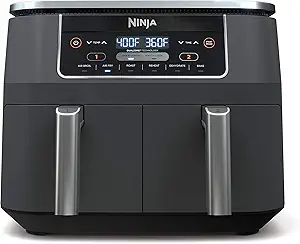
Ninja vs Crux: Overview
Comparing Ninja and Crux helps you determine which brand is best suited for your needs in Air Fryers. Both brands offer strong choices depending on your budget and key feature requirements.
Key Features & Comparison
Evaluate factors such as build quality, warranty, customer satisfaction, and total value before making your final purchase choice between Ninja and Crux.
Features
Ninja sets an industry standard with its multi-functional capabilities, frequently combining convection frying, roasting, broiling, dehydrating, and reheating into cohesive units. Advanced models, such as the Foodi DualZone series, introduce proprietary technologies like Smart Finish—which synchronizes cooking times across two independent baskets—and Match Cook to easily duplicate settings. Furthermore, Ninja often incorporates integrated probe thermometers to automate internal temperature monitoring for proteins. Their control panels are comprehensively labeled and supported by optimized algorithmic temperature curves, ensuring presets translate to actual, reliable cooking outcomes rather than arbitrary heat bursts.
Crux emphasizes core functionality without the overwhelming digital complexity, delivering the essential presets needed for common items like fries, poultry, and baked goods. While select Crux models experiment with dual-zone setups or digital touchscreens, their feature set is fundamentally streamlined. You will rarely find advanced internal probe integrations or nuanced heat-convection syncing on Crux models. Instead, Crux prioritizes quick-start simplicity with standard countdown timers and straightforward heat dials or digital pads. While adequate for baseline air frying, it lacks the technical depth, accessory ecosystem, and fine-tuned programmability that give Ninja its culinary versatility.
Performance
In terms of raw cooking performance, Ninja consistently outperforms Crux due to superior airflow dynamics and high-wattage heating elements. Ninja’s proprietary cyclonic air circulation technology drives intense, dry heat around food rapidly, resulting in superior Maillard reaction and even crisping without overcooking the interior. Recovery times after opening the basket are exceptionally short, minimizing heat loss. Whether executing a multi-tier dehydrating session or achieving deep-fried texture on frozen wings, Ninja appliances maintain precise internal temperatures, keeping hot spots to an absolute minimum.
Crux delivers respectable cooking results for simple tasks, but it exhibits noticeable performance limitations under closer scrutiny. The thermal distribution across Crux baskets can be uneven, frequently requiring users to shake or turn food more often to avoid localized scorching or undercooked centers. Its fans generally move air at lower cubic-feet-per-minute (CFM) rates than Ninja's high-velocity blowers, which can lead to slightly longer cook times and a higher likelihood of trapped moisture, yielding soggy rather than crisp textures when baskets are loaded to capacity. For basic reheating and smaller batches, Crux is adequate, but it struggles to match Ninja's speed, thermal stability, and textural results.
Design
Ninja approaches product design from a strictly utilitarian and ergonomic perspective. The aesthetic is modern industrial, featuring durable dark plastics, brushed stainless steel accents, and intuitive, angled control panels that maximize visibility. Ninja’s non-stick baskets frequently utilize high-grade, ceramic coatings that are free of PTFE and PFOA, resisting peeling and offering superior scratch resistance over prolonged dishwasher cycles. The mechanical fit and finish—from the tactile click of basket insertion to the robust hinges on combination models—reflects heavy engineering designed to withstand the rigors of a busy kitchen.
Crux distinguishes itself primarily through fashion-forward design language, often incorporating matte finishes, rose gold or copper accents, and minimalist footprints designed to look sleek on open countertops. While visually attractive, the material quality is notably lighter and less rugged than Ninja’s construction. Crux baskets commonly use standard PTFE non-stick coatings, which are more susceptible to degradation, flaking, or warping under sustained high heat over time. Additionally, the tolerances on basket handles and sliding mechanisms feel less refined, reflecting the brand’s cost-effective manufacturing compromises in exchange for trendy countertop aesthetics.
Compare current retail pricing, active promotions, and verified stock availability directly from authorized stores: