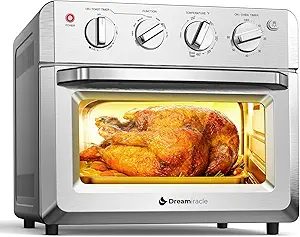
Dreamiracle vs SAKI: Overview
Comparing Dreamiracle and SAKI helps you determine which brand is best suited for your needs in Air Fryers. Both brands offer strong choices depending on your budget and key feature requirements.
Key Features & Comparison
Evaluate factors such as build quality, warranty, customer satisfaction, and total value before making your final purchase choice between Dreamiracle and SAKI.
Features
From a feature architecture perspective, SAKI distinguishes itself through robust smart ecosystem integration, commonly incorporating Wi-Fi-enabled companion apps, remote control, and direct-to-machine recipe execution. SAKI's algorithmic cooking programs modulate both heat and internal air circulation to automatically adapt to specific ingredients, ensuring reproducible results with minimal manual intervention. The integration of high-visibility, crisp digital displays and intuitive push-notification status updates highlights SAKI’s focus on connected kitchen convenience.
Dreamiracle adopts a more traditional, tactile feature strategy centered on expansive one-touch preset arrays directly on the control fascia. Rather than routing functionality through mobile applications, Dreamiracle incorporates high-utility baseline settings tailored for universal kitchen staples such as poultry, frozen foods, and roasting. Additionally, Dreamiracle appliances frequently feature dual-fan mechanics, clear viewing panels, and integrated internal illumination, prioritizing immediate physical verification of the cooking process over software-dependent automations.
Performance
Thermal performance between the two brands reveals contrasting thermodynamic priorities. Dreamiracle air fryers are engineered with high-wattage heating coils and aggressive convection fans designed to rapidly reach operational temperatures and blast food with rapid, uniform heat. This results in superior exterior crisping, making Dreamiracle exceptionally proficient for high-volume items, thick cuts of meat, and batch-fried frozen foods where rapid moisture evaporation is essential to prevent sogginess.
SAKI focuses on precision temperature management and balanced heat convection, which excels in culinary tasks that require thermal stability, such as dehydrating, delicate baking, and controlled reheating. Its microprocessor-controlled heating curves mitigate thermal overshoot, ensuring that edges do not char before the interior finishes cooking. While SAKI may exhibit marginally slower initial crisping compared to Dreamiracle’s intense airflow, it yields higher interior moisture retention and consistent edge-to-edge cooking uniformity.
Design
In terms of industrial design, Dreamiracle favors utilitarian efficiency and high-capacity internal volume. The housing typically incorporates a blend of brushed stainless steel accents and resilient matte plastics engineered to withstand high ambient kitchen temperatures. The exterior geometry is optimized to accommodate deep, square-shaped baskets that maximize usable surface area, though this can result in a bulkier footprint that demands considerable countertop space in smaller kitchens.
SAKI approaches product design with an emphasis on modern Scandinavian minimalism and space-saving ergonomics. Its chassis designs lean toward monolithic forms, smooth matte finishes, and subtle capacitive touch surfaces that integrate seamlessly into contemporary high-end interiors. SAKI prioritizes dishwasher-safe, ceramic or premium non-stick coatings and compact internal architecture, offering an aesthetically pleasing appliance that balances external proportions with sufficient internal cooking volume.
Compare current retail pricing, active promotions, and verified stock availability directly from authorized stores: