Dreamiracle vs Aigostar: Overview
Comparing Dreamiracle and Aigostar helps you determine which brand is best suited for your needs in Air Fryers. Both brands offer strong choices depending on your budget and key feature requirements.
Key Features & Comparison
Evaluate factors such as build quality, warranty, customer satisfaction, and total value before making your final purchase choice between Dreamiracle and Aigostar.
Features
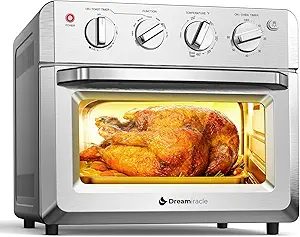
Feature architecture between Dreamiracle and Aigostar reflects their contrasting approaches to food preparation versatility. Dreamiracle appliances often incorporate robust multi-tier cooking racks, rotisserie shafts, and dehydration presets, delivering an expansive feature suite more reminiscent of miniature wall ovens. Their digital control boards typically host extensive preset arrays covering poultry, baking, broiling, and dehydrating, accompanied by broad temperature operating ranges that can reach down to lower thresholds needed for fruit drying. This abundance of specialized tooling and pre-programmed algorithm cycles empowers users to tackle intricate, multi-step culinary tasks that standard single-basket fryers simply cannot support.
Aigostar, on the other hand, prioritizes refined essentials and intuitive operation in its feature distribution. Rather than overwhelming users with excessive hardware accessories, Aigostar models typically employ high-efficiency non-stick crisper baskets, precise NTC temperature sensors, and smart memory pause functions that automatically halt heating when the basket is disengaged. Several flagship Aigostar variants also integrate smart connectivity, allowing users to sync their smartphone via dedicated apps to monitor cooking cycles, select pre-configured recipes, and receive alert notifications remotely. While Dreamiracle dominates in mechanical cooking modularity via rotisserie and multi-rack baking, Aigostar counters with smarter digital conveniences, simpler post-cooking cleanup, and targeted presets that cater directly to high-frequency everyday dishes.
Performance
Thermal distribution and convective air velocity reveal critical performance differences between the two brands. Dreamiracle units typically rely on elevated heating element wattages—frequently between 1700W and 1800W—paired with high-output circulation fans designed to push air across multiple interior levels. In practical testing, this generates rapid searing capabilities and superior dehydration airflow across wide surface areas. However, because multi-tier racks introduce vertical thermal gradients, users often find they must manually rotate trays halfway through a cycle to avoid over-browning the top layer while under-crisping the lower tiers, requiring active user intervention to achieve uniform crisping.
Aigostar takes advantage of concentrated, cyclonic airflow dynamics inherent to its deep-basket designs, yielding exceptional consistency in standard batch frying. By funneling high-velocity air directly through perforated crisper plates, Aigostar units achieve crisp, golden textures on frozen foods, wings, and roasted vegetables with virtually no manual tray reshuffling. The thermal ramp-up time on Aigostar fryers is impressively brisk, maintaining stable internal temperatures with minimal thermal cycling dips. While Dreamiracle holds the edge when dehydrating jerky or spit-roasting whole chickens, Aigostar provides superior localized crisping precision and tighter thermal retention, translating to faster cycle times and fewer hot spots during routine weeknight cooking.
Design
The industrial design language and ergonomics of Dreamiracle and Aigostar reflect opposing aesthetic and spatial priorities. Dreamiracle appliances generally adopt an upright, toaster-oven form factor dominated by wide-view heat-resistant glass doors and internal lighting fixtures. This transparent design is an immense practical benefit, enabling cooks to visually monitor crisping and browning progress without breaching the thermal envelope by opening the door. However, this configuration demands significant vertical clearance and countertop depth, while the metal exterior and glass window can become notably hot to the touch during extended cooking cycles, requiring caution in tightly packed kitchens.
Conversely, Aigostar embraces sleek, modern minimalism characterized by rounded geometry, cool-touch glossy or matte BPA-free outer housings, and top-facing LED touch displays. The angled placement of Aigostar’s interface drastically improves readability and reduces glare during operation. Furthermore, the brand’s focus on nested, non-stick pull-out baskets significantly minimizes countertop sprawl and facilitates single-motion transfer of food to the dining table. The ergonomic, heat-insulated handles and lightweight basket assemblies make Aigostar models far more pleasant to clean and store away in standard cabinetry, contrasting sharply with the semi-permanent countertop residency required by Dreamiracle’s heavier, boxier footprint.