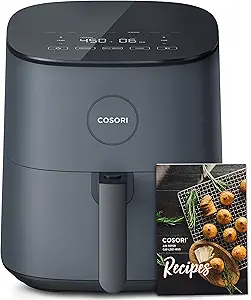






COSORI vs Emeril Lagasse: Overview & Brand Philosophy
The air fryer market has transformed from a niche culinary trend into an essential segment of modern kitchen appliances, with brands differentiating themselves through form factor, user interface, and cooking versatility. COSORI, a flagship brand under the parent company Vesync, approaches kitchen technology from a smart-home, user-centric perspective. With a strong presence in the basket-style air fryer market, COSORI prioritizes sleek aesthetics, companion smartphone integration via the VeSync app, ergonomic interfaces, and targeted thermal performance engineered to make daily, rapid meal preparation effortless for modern households.
In contrast, the Emeril Lagasse brand—developed in partnership with direct-to-consumer manufacturing powerhouse Tristar Products (now under Empower Brands)—approaches the category through the lens of multi-functional countertop culinary centers. Leveraging the culinary authority of celebrity chef Emeril Lagasse, the brand leans heavily into multi-rack, French door, and toaster-oven-style configurations. Rather than focusing merely on rapid air circulation for single-basket cooking, Emeril Lagasse appliances emphasize capacity, multi-tier cooking, rotisserie functionality, and commercial-style stainless-steel builds that aim to replace traditional full-size ovens.
Key Differences & Technological Comparison
The engineering philosophies behind COSORI and Emeril Lagasse reflect distinctly different priorities in design, heat distribution, and operational footprint.
- Form Factor and Capacity: COSORI primarily champions the pull-out basket architecture, exemplified by models like the TurboBlaze and Dual Blaze series, with capacities typically ranging from 4 to 6.8 quarts. Emeril Lagasse focuses predominantly on front-loading, multi-tier oven architectures—such as the Power AirFryer 360 and French Door 360—which boast expansive internal volumes ranging from 15 to 26 quarts, accommodating full chickens, 12-inch pizzas, and multi-tray dehydration.
- Heating Architecture and Airflow: COSORI's standout engineering achievement is its Dual Blaze system, which integrates independent top and bottom heating elements paired with precision sensors, eliminating the need to manually shake the basket or flip food. Emeril Lagasse utilizes 360-degree Quick Cook Turbo Heat technology, often relying on up to five individual heating elements paired with a high-velocity convection fan to circulate heat across multiple rack levels simultaneously.
- Smart Features and Connectivity: COSORI leads significantly in smart-kitchen integration, offering Wi-Fi connectivity, app-driven cooking notifications, and integrations with Amazon Alexa and Google Assistant across several model lines. Emeril Lagasse maintains an analog-leaning digital interface: high-visibility LCDs with dedicated push-buttons and turn-dials, intentionally avoiding app connectivity in favor of straightforward, on-device tactile controls.
- Versatility and Accessories: While COSORI appliances excel at targeted air frying, roasting, and baking with non-stick, dishwasher-safe crisper plates, Emeril Lagasse units serve as comprehensive hybrid appliances. They frequently arrive bundled with specialized rotisserie spits, pizza racks, baking pans, crisper trays, and drip pans, supporting up to 12 or more discrete cooking functions including slow cooking, broiling, and rotisserie roasting.
Pros & Cons Comparison
COSORI Air Fryers
- Pros:
- Industry-leading dual-element technology (Dual Blaze) eliminates the need to shake or flip ingredients.
- Compact, space-efficient footprints with modern matte finishes that blend seamlessly into contemporary kitchens.
- Superior smart connectivity with comprehensive recipe guidance and remote monitoring via the VeSync app.
- Consistently faster preheat times and rapid thermal transfer within the confined basket space.
- Extremely easy clean-up due to ceramic or premium non-stick basket coatings.
- Cons:
- Limited vertical clearance makes it impossible to cook multi-course meals or large roasts at once.
- Single-zone baskets restrict batch cooking for families larger than four people.
Emeril Lagasse Air Fryers
- Pros:
- Massive interior capacities capable of accommodating multiple racks, full-size poultry, and family-sized portions.
- Includes dedicated rotisserie spit and multi-rack baking options, effectively replacing a standard toaster oven.
- Commercial stainless-steel styling provides a robust, professional look on countertops.
- Intuitive dial-and-button interfaces that do not require smartphones or wireless networks to operate.
- Cons:
- Significantly larger countertop footprint; requires dedicated kitchen real estate and vertical cabinet clearance.
- More complex cleaning process due to interior walls, wire racks, and heating element exposure.
- Longer preheat cycles and potential for uneven heat distribution across vertical rack positions.
Performance, Durability & Value Analysis
When assessing pure air frying performance, COSORI holds a distinct advantage in crisping speed and texture uniformity. The concentrated airflow within its closed-basket design, combined with advanced DC motors (as seen in the TurboBlaze line), delivers exceptional Maillard browning with minimal moisture loss. Emeril Lagasse units perform exceptionally well when utilized as mini convection ovens or rotisseries, but when operating strictly as air fryers, they often take several minutes longer to achieve comparable crispiness, particularly when multiple racks obstruct direct convection paths. In terms of durability, Emeril Lagasse models benefit from stainless-steel outer shells and robust door hinges, though the interior sheet metal and exposed elements can degrade or accumulate baked-on grease if not meticulously maintained. COSORI units rely more heavily on high-grade thermal plastics for their exterior, but their non-stick internal coatings are among the most durable in the consumer market, showing strong resistance to flaking when maintained according to manufacturer guidelines.
From a cost-to-value perspective, both brands offer competitive propositions tailored to distinct use cases. COSORI delivers outstanding value in the $80 to $180 range, offering cutting-edge digital capabilities, whisper-quiet operation, and low energy consumption. Emeril Lagasse units typically command higher retail prices—often between $150 and $250—justified by their multi-appliance utility. An Emeril Lagasse unit can reasonably replace a toaster, a dehydrator, an indoor rotisserie, and a standard countertop oven, yielding exceptional real estate and monetary value for households prepared to integrate a larger footprint appliance into their daily kitchen workflow.
Final Verdict: Which Brand Should You Choose?
Choose COSORI if your primary objective is fast, convenient, weekday meal preparation with minimal cleanup. It is the ideal choice for individuals, couples, and small families who want maximum crispiness for traditional air-fried foods (such as wings, vegetables, and frozen snacks), as well as those who appreciate smart-home automation and modern aesthetics that can be easily stored in a pantry or cabinet when not in use.
Choose Emeril Lagasse if you require an all-in-one culinary workstation designed to remain permanently on the countertop. It is best suited for larger families, meal-preppers, and home cooks who prioritize multi-level cooking capacity, authentic rotisserie functions, and the ability to bake large pizzas or toast broad batches of bread, effectively serving as an everyday replacement for a conventional oven.
Features
When evaluating the feature ecosystems of COSORI and Emeril Lagasse air fryers, consumers are faced with fundamentally divergent engineering philosophies: COSORI champions modern digital automation and smart-home integration, whereas Emeril Lagasse leans heavily into multi-functional culinary versatility modeled after commercial countertop ovens. COSORI’s lineup—most notably the Dual Blaze and TurboBlaze series—distinguishes itself through advanced thermodynamic engineering. Technologies like their patented 360 ThermoIQ system incorporate dual heating elements with automated temperature regulation, entirely eliminating the conventional need to pause, open, and shake the basket. Furthermore, COSORI integrates superior smart features via the VeSync app, granting users the ability to monitor cook times remotely, receive real-time cycle notifications, and execute finely tuned, multi-stage cooking algorithms directly from mobile devices or voice assistants. In contrast, Emeril Lagasse appliances rarely incorporate Wi-Fi capabilities, focusing their engineering instead on sprawling mechanical utility and vast internal volume.
The practical trade-offs become glaringly apparent when analyzing cooking modes, capacity, and user interface design. Emeril Lagasse air fryers—typically designed as multi-tier toaster-oven hybrid configurations—boast upwards of 10 to 14 discrete cooking modes, including dedicated functions for rotisserie spit-roasting, dehydrating, proofing, and slow cooking. For high-capacity cooking, their feature set excels by allowing simultaneous multi-rack baking and large-protein roasting that standard pull-out drawer air fryers simply cannot accommodate. However, this expansive physical architecture comes at the cost of ease-of-use and thermal precision; Emeril Lagasse units often utilize cluttered tactile button layouts and dial interfaces that carry a steeper learning curve and present more points of mechanical wear. Conversely, COSORI prioritizes an intuitive user interface with crisp capacitive touchscreens, highly accurate DC motors that provide up to five variable fan speeds, and specialized presets specifically calibrated to retain internal moisture in standard portions.
Ultimately, the feature-based decision hinges on whether a user values automated precision or physical cooking flexibility. COSORI sets the benchmark for tech-forward kitchens through responsive software integration, dual-element heating parity, and effortless non-stick maintenance via dishwasher-safe ceramic-coated baskets. Emeril Lagasse provides superior value for home cooks seeking an all-in-one appliance to replace multiple countertop machines, offering specialized physical accessories like rotisserie forks, crisper trays, and pizza stones that push the boundaries of traditional convection cooking. While COSORI offers superior automated refinement, rapid preheating, and consistent single-basket precision, Emeril Lagasse wins on sheer operational breadth and physical rack modularity.
Performance
When evaluating core cooking performance, COSORI and Emeril Lagasse embody two fundamentally distinct engineering philosophies. COSORI predominantly focuses on modern, dedicated basket-style units equipped with proprietary heating architectures, such as their ThermoIQ and dual-element technologies. These systems utilize dynamic 360-degree rapid air circulation paired with real-time digital temperature sensors, minimizing thermal fluctuations and ensuring exceptional crisping without requiring frequent manual shaking. In contrast, Emeril Lagasse air fryers—most notably the French Door 360 and Power AirFryer series—are engineered as multi-rack, countertop convection ovens. While they employ robust heating coils (often pushing 1500 to 1800 watts) assisted by high-velocity turbo fans, the larger interior cubic volume leads to a more dispersed airflow. As a result, COSORI reliably achieves a more intense, blistered Maillard reaction in less time on single-layer foods like chicken wings or french fries, whereas Emeril Lagasse models behave more like accelerated convection ovens with gentler, wide-area browning.
The technical trade-offs between the two brands become apparent when considering thermal recovery, heat distribution, and culinary versatility. COSORI excels in rapid preheating and instantaneous heat retention because of its compact, isolated chamber design. Its digital algorithms are tightly tuned for single-basket cooking, yielding superior crispiness and moisture preservation in proteins. However, this focused heat comes at the expense of batch capacity. Emeril Lagasse counters this limitation with superior throughput and expansive multi-tier functionality. Its heating systems are engineered to circulate air across multiple trays simultaneously, accommodating rotisserie chickens, full-size pizzas, and multi-element family meals. The performance compromise with Emeril Lagasse is uneven vertical heat dispersion; food placed closest to the upper heating elements cooks substantially faster, necessitating active tray rotation during longer cycles to achieve uniform results.
Ultimately, your performance-based choice hinges on whether you prioritize hyper-efficient crisping velocity or multi-functional capacity. COSORI delivers superior raw air frying performance, offering ultra-precise temperature management, rapid heat-up times, and peerless convective crisping ideal for everyday, high-speed cooking. Emeril Lagasse, while slightly less aggressive in terms of dedicated air fry velocity and edge-to-edge crisping uniformity, delivers a more flexible heating profile capable of low-and-slow rotisserie roasting, multi-rack dehydrating, and large-format baking. For pure, uncompromising air fry performance, COSORI takes the lead; for broad, oven-style utility that can feed a crowd, Emeril Lagasse provides the more adaptable thermal platform.
Design
When evaluating the design philosophy of air fryers, COSORI and Emeril Lagasse diverge significantly, reflecting modern countertop ergonomics versus traditional culinary appliance aesthetics. COSORI champions a sleek, minimalist approach heavily inspired by contemporary smart home technology. Most COSORI units feature a streamlined pod- or cube-shaped architecture utilizing high-impact matte plastics, angled LED touchscreens, and proprietary non-stick pull-out baskets. In contrast, the Emeril Lagasse lineup is dominated by multi-functional toaster oven-style units framed in brushed stainless steel, sporting French doors or classic drop-down handles, analog-style dials alongside digital readouts, and clear tempered-glass viewing windows. From an engineering and build perspective, Emeril Lagasse leverages heavy-duty sheet metal that conveys commercial-kitchen durability, whereas COSORI prioritizes lightweight construction, refined tactile feedback from capacitive touch sensors, and a smaller countertop footprint that blends effortlessly into modern kitchen decors.
The technical strengths and operational feature sets of both brands highlight distinct user priorities. COSORI excels in user-centric digital design; their controls are systematically arranged with intuitive one-touch presets, integrated preheat alerts, and advanced shake reminders. Higher-end COSORI models also integrate smart Wi-Fi connectivity, allowing users to monitor temperature curves and cooking cycles directly from a smartphone. Conversely, Emeril Lagasse's design centers on multi-rack spatial engineering. By utilizing horizontal, wide-cavity designs with tiered wire racks, rotisserie spits, and specialized crisper trays, Emeril Lagasse appliances emulate miniature convection ovens. This architecture allows for far superior heat distribution over larger surface areas—ideal for roasting whole poultry or baking—whereas COSORI’s deep, vertical basket design relies on optimized high-velocity vortex airflow (often powered by their proprietary ThermoIQ 360-degree technology) to achieve rapid, concentrated crisping in shorter cycle times.
Practical trade-offs between the two designs ultimately hinge on kitchen space, cooking workflow, and maintenance. COSORI’s single-drawer design is inherently more convenient for everyday quick meals; the removable, dishwasher-safe non-stick baskets make disposal of grease and routine cleanups exceptionally fast, though the enclosed design limits visual monitoring without interrupting the cooking cycle. Conversely, Emeril Lagasse’s spacious glass-fronted interiors allow for effortless monitoring and provide the versatility to cook multiple dishes simultaneously, but this comes at the expense of a substantially larger footprint and significant cabinet clearance requirements. Furthermore, the exposed heating elements, crumb trays, and interior metal walls of Emeril Lagasse units demand more rigorous, manual cleaning routines compared to COSORI’s modular, non-stick wash-and-go configurations.