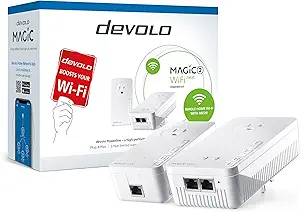
Devolo vs BHDUDF: Overview
Comparing Devolo and BHDUDF helps you determine which brand is best suited for your needs in Wi-Fi Extenders. Both brands offer strong choices depending on your budget and key feature requirements.
Key Features & Comparison
Evaluate factors such as build quality, warranty, customer satisfaction, and total value before making your final purchase choice between Devolo and BHDUDF.
Features
Devolo distinguishes itself through a sophisticated suite of networking features designed to eliminate the bottlenecks typical of standard repeaters. Many Devolo extenders leverage hybrid topology, combining high-speed G.hn Powerline backhauls with dual-band or tri-band Wi-Fi 6 technologies to ensure data is routed through electrical wiring rather than degrading through walls. Furthermore, Devolo’s ecosystem integrates Access Point steering, band steering, and dynamic beamforming under a unified SSID. Its companion application provides granular controls including guest networks, scheduled access, parental controls, and precise transmission power optimization.
BHDUDF devices, on the other hand, concentrate on core utility with a significantly leaner feature set. They generally operate using universal 2.4 GHz and 5 GHz repeating modes, equipped with push-button WPS pairing and lightweight web administrative panels. While some BHDUDF models feature external antennas or multi-mode operation (such as Router, Repeater, and AP modes), they lack proprietary smart mesh roaming algorithms and advanced quality-of-service (QoS) engines. Advanced users will find BHDUDF’s software ecosystem limited regarding deep network telemetry, VLAN support, and firmware lifecycle management, whereas Devolo frequently pushes security and operational updates.
Performance
Performance benchmarks reveal a substantial disparity between the two brands under sustained network load and physical interference. Devolo’s hardware employs high-efficiency RF front-ends, low-noise amplifiers, and intelligent channel selection that dynamically navigate congested residential spectrums. When deployed in multi-story houses or buildings with thick masonry, Devolo maintains low latency and high packet consistency, making it well-suited for simultaneous 4K/8K media streaming, video conferencing, and competitive online gaming. The integration of robust physical backhaul options prevents the 50% throughput penalty commonly seen in standard wireless-only repeating.
BHDUDF provides serviceable performance for day-to-day general web browsing, standard video streaming, and smart home IoT expansion, but shows degradation under strenuous workloads. Because these units generally rely on purely wireless half-duplex repeat signals without dedicated backhaul channels, users often experience elevated jitter, reduced peak speeds at range, and higher latency spikes during concurrent high-bandwidth operations. For basic single-room extension, BHDUDF performs acceptably, but it falters when tasked with maintaining high-speed coherence across wider, multi-device topologies.
Design
From an industrial design standpoint, Devolo balances form and function with a clean, understated aesthetic that reflects modern European domestic design. Built with premium flame-retardant thermoplastics, Devolo extenders emphasize passive thermal dissipation through discreet venting channels, which protects internal silicon from heat-induced throttling over long periods of continuous operation. Thoughtful inclusions, such as pass-through electrical sockets on bulkier adapters, preserve wall outlet availability, while subtle LED status indicators provide immediate diagnostics without introducing disruptive light pollution in bedroom environments.
BHDUDF takes a more conventional, utilitarian design path, often sporting prominent external pivoting antennas meant to maximize directional reception. The enclosures are typically compact and light, making them easy to plug into tight spaces, but they utilize lighter plastics and less optimized internal thermal layouts that can lead to warmth during prolonged high-throughput sessions. While the prominent status LEDs and bold angular styling appeal to users seeking an overt, high-tech aesthetic, BHDUDF devices generally lack the refined ergonomics, socket pass-through convenience, and seamless physical integration offered by Devolo.