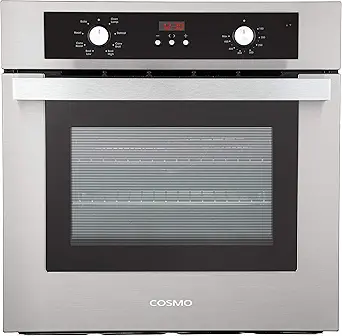
GASLAND vs Cosmo: Overview
Comparing GASLAND and Cosmo helps you determine which brand is best suited for your needs in Wall Ovens. Both brands offer strong choices depending on your budget and key feature requirements.
Key Features & Comparison
Evaluate factors such as build quality, warranty, customer satisfaction, and total value before making your final purchase choice between GASLAND and Cosmo.
Features
In terms of internal features and programming versatility, Cosmo generally outpaces GASLAND by integrating more advanced cooking modes and culinary utilities. Cosmo wall ovens frequently feature multi-functional European convection systems paired with integrated dual-element broilers, precision meat probes, and pre-programmed specialty cycles such as proofing, dehydrating, and dedicated pizza baking. Their digital interfaces lean toward modern capacitive touch controls paired with clear LCD readouts, giving home chefs granular control over the interior thermal microclimate across multiple rack positions.
GASLAND takes a distinctly streamlined approach, favoring practical baseline features that reduce operational complexity and long-term component failure points. While select GASLAND models do offer convection fans and digital timers, their lineups often lean into classic dial-operated interfaces or simplified touch pads accompanied by standard bake, broil, and warm presets. Safety mechanisms like multi-layer cool-touch glass doors and integrated child safety locks are common across their catalog, but users will find fewer automated culinary algorithms, making GASLAND best suited for cooks who prefer manual oversight over automated multifunctionality.
Performance
Thermal dynamics and baking consistency highlight a critical performance divergence between the two brands. Cosmo units benefit from heavier-gauge heating elements and well-calibrated true convection blowers that circulate hot air uniformly across the oven cavity, effectively mitigating cold corners and hot spots. This airflow efficiency proves invaluable when roasting dense proteins or achieving consistent browning across multiple sheet pans of pastries simultaneously. Furthermore, Cosmo ovens tend to recover target temperatures more rapidly after door openings due to their higher-wattage element configurations and dense thermal insulation layers.
GASLAND delivers commendable heating performance within the boundaries of standard thermal and fan-assisted cooking, yet it requires a bit more user accommodation. Preheating cycles on GASLAND ovens can take slightly longer due to modest element wattage engineered to accommodate lower-draw household circuits, and non-convection models can exhibit temperature gradients between top and bottom racks. Nevertheless, for standard family meal preparation, single-tray baking, and standard broiling, GASLAND provides stable, reliable temperature regulation, provided the user is diligent about mid-cycle pan rotation during delicate baking projects.
Design
From an industrial design standpoint, Cosmo embraces a sleek, pro-style European motif that integrates seamlessly into contemporary, upscale kitchen remodels. Cosmo ovens frequently feature brushed #304-grade stainless steel trim, solid cast metal pro-style handles, and edge-to-edge dark tinted glass doors that mimic higher-end boutique luxury appliances. The overall visual weight and structural chassis feel solid, with rigid sheet metal frames and premium glide racks that communicate durability and thoughtful architectural integration.
GASLAND adopts an understated, modern minimalist aesthetic that favors clean glass surfaces and low-profile hardware, blending effortlessly into compact, transitional, or minimalist cabinetry. While their stainless steel treatments and tempered glass fascias look attractive out of the box, the structural gauge of the chassis and door assemblies feels lighter compared to Cosmo's heavy-duty engineering. However, GASLAND’s trim profiles and streamlined exterior dimensions make them exceptionally easy to install into standard cabinetry cutouts, making them a design favorite for space-constrained urban kitchens and straightforward replacement jobs.