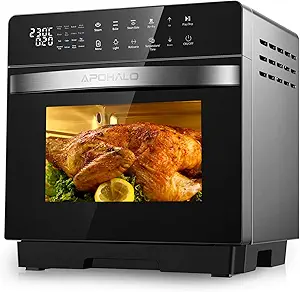







TOSHIBA vs Apohalo: Overview
Comparing TOSHIBA and Apohalo helps you determine which brand is best suited for your needs in Toaster Ovens. Both brands offer strong choices depending on your budget and key feature requirements.
Key Features & Comparison
Evaluate factors such as build quality, warranty, customer satisfaction, and total value before making your final purchase choice between TOSHIBA and Apohalo.
Features
TOSHIBA toaster ovens distinguish themselves through mature electronic interfaces, extensive preset libraries, and precisely tuned sensor technologies. Many TOSHIBA models boast multi-stage cooking sequences, independent upper and lower quartz heating element controls, and advanced convection fan settings that gently circulate hot air for even dehydrating and baking. Additionally, TOSHIBA incorporates thoughtful ergonomic features, such as bright internal halogen lights, clear high-contrast digital displays, and specialized modes for rotisserie or frozen pizza preparation that rely on tested thermal curves.
Apohalo models, while often simpler in software sophistication, punch above their weight class by consolidating air fryer, broil, and toast functions into compact chassis. They frequently utilize high-velocity top-mounted fans combined with rapid-heat stainless steel elements to achieve fast preheating and crisping without requiring lengthy setup times. However, Apohalo generally provides fewer granular adjustments compared to TOSHIBA, leaning more on manual dial configurations or straightforward mechanical timers rather than digital probe sensing and fine-increment temperature controls.
Performance
In practical thermal execution, TOSHIBA demonstrates superior stability and heat distribution across the entire cavity. By employing dual-position rack guides and heavy-duty quartz elements, TOSHIBA ovens minimize cold spots, resulting in edge-to-edge browning on sliced bread and delicate pastry browning that resists scorching. The convection systems are tuned for laminar airflow rather than aggressive turbulence, ensuring meats retain internal moisture while achieving a crisp exterior, backed by heavy-gauge insulation that keeps exterior cabinet temperatures comparatively manageable.
Apohalo delivers aggressive, rapid thermal output that excels in fast-paced tasks such as reheating fried foods, searing, and rapid toasting. Because many Apohalo designs prioritize intense convective heat, they reach target temperatures exceptionally fast, reducing cooking times compared to traditional countertop units. Nevertheless, this aggressive heating profile can lead to hotspots in larger bakeware, and the thinner wall insulation found on budget-tier Apohalo units can result in higher exterior shell temperatures and slight temperature dips when the door is opened frequently.
Design
From an aesthetic and structural perspective, TOSHIBA adheres to an understated, professional design philosophy marked by brushed stainless steel exteriors, solid handle dampening, and heavy-gauge sheet metal construction. The door assemblies feature dual-pane tempered glass on premium units, minimizing heat radiation and maximizing user safety. The control panels are laid out with clear utilitarian logic, balancing tactile rotary knobs with intuitive LED push-button arrays that complement modern kitchen cabinetry.
Apohalo adopts a more contemporary, space-saving footprint often tailored for apartments, dormitories, or compact kitchen counters. The design language frequently incorporates retro-modern elements, sleek matte coatings, or compact cubical proportions with oversized viewing windows. While visually attractive and lightweight for easy repositioning, Apohalo's construction relies more heavily on lighter gauge metals and simplified hinge mechanisms, which can lack the substantial, solid feel of TOSHIBA's industrial build quality over years of daily cycling.
Compare current retail pricing, active promotions, and verified stock availability directly from authorized stores: