Panasonic vs Ninja: Overview
Comparing Panasonic and Ninja helps you determine which brand is best suited for your needs in Toaster Ovens. Both brands offer strong choices depending on your budget and key feature requirements.
Key Features & Comparison
Evaluate factors such as build quality, warranty, customer satisfaction, and total value before making your final purchase choice between Panasonic and Ninja.
Features
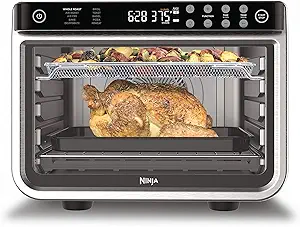
From a feature and programmatic perspective, Ninja easily outpaces Panasonic in the sheer breadth of cooking modes and customizability. Most modern Ninja countertop ovens incorporate up to ten distinct functions, encompassing dedicated air frying, dehydrating, broiling, whole-roast settings, and even dual-zone heat management. Many of Ninja's flagship units, such as the Foodi series, also boast proprietary features like flip-up storage mechanisms to reclaim counter space, alongside smart integrated meat thermometers that halt cooking automatically when a targeted internal temperature is reached. These programmatic capabilities are calibrated to streamline complex dinner routines with minimal user intervention.
Panasonic takes a far more austere, specialized approach to feature sets. Rather than inundating the user with digital sub-menus and specialized accessory probes, Panasonic emphasizes intuitive, push-button ease with pre-programmed keys dedicated to everyday staples like toast, bagels, pizza, and hash browns. The brand's defining technological feature is its dual-infrared heating architecture (combining near and far infrared quartz elements), which eliminates the need to preheat entirely. While it lacks the air frying convection speeds, dehydrating modes, and rotisserie-scale capacities of Ninja, Panasonic provides an exquisitely tuned workflow for the tasks standard households perform most frequently.
Performance
In terms of raw cooking performance, both brands excel, but in fundamentally different thermodynamic styles. Panasonic's signature advantage lies in its radiant infrared heating. Far-infrared elements penetrate the interior of food efficiently to warm it through, while near-infrared elements intensely crisp the exterior. This results in superior performance for toast, pastries, and frozen appetizers, yielding a delicate, golden-brown crunch without drying out the crumb beneath. The instantaneous heat ramp-up means a frozen slice of bread can be toasted to perfection in a fraction of the time a conventional resistive-element oven takes, all without the thermal inertia of long preheating cycles.
Ninja, conversely, relies on high-velocity convection fans paired with heavy-duty tubular heating elements to drive thermal energy through dynamic air circulation. This engineering profile makes Ninja vastly superior for air frying, caramelizing sheet-pan dinners, and roasting proteins. Where Panasonic struggles with high-moisture foods due to limited convective airflow, Ninja's powerful fans strip surface humidity rapidly, delivering deep, fryer-like crisping on chicken wings and french fries. However, this aggressive airflow can occasionally work against Ninja when handling delicate baked goods or light breads, which can dry out prematurely or brown unevenly if temperatures are not diligently managed.
Design
The industrial design languages of Panasonic and Ninja diverge dramatically, reflecting their regional heritage and target ergonomics. Panasonic maintains a retro, utilitarian aesthetic characterized by lightweight sheet metal construction, analog-style mechanical buttons, and an exceptionally compact footprint. Its front door mechanisms are uniquely synchronized with the wire rack, pulling food forward smoothly as the door drops down—a thoughtful ergonomic touch that prevents wrist burns. While this compact, boxy profile is a boon for cramped urban kitchens, it inevitably limits interior headroom, meaning Panasonic units cannot accommodate whole chickens or tall baking vessels.
Ninja favors a bold, contemporary American aesthetic, featuring brushed stainless steel, dark textured plastics, and high-visibility digital LED interfaces. Ninja appliances are substantial, heavy, and engineered with wider internal cavities capable of fitting full 12-inch pizzas or multiple sheet pans simultaneously. To mitigate the sheer counter footprint this requires, Ninja introduced innovative hinge engineering that allows certain units to flip upright against the kitchen backsplash when idle. While Ninja feels sturdier and more robust overall, its reliance on dense exterior materials and high-speed fans results in a heavier, louder, and more visually commanding presence on the countertop compared to the quiet, modest Panasonic.