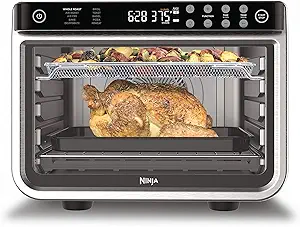
Ninja vs Val cucine: Overview
Comparing Ninja and Val cucine helps you determine which brand is best suited for your needs in Toaster Ovens. Both brands offer strong choices depending on your budget and key feature requirements.
Key Features & Comparison
Evaluate factors such as build quality, warranty, customer satisfaction, and total value before making your final purchase choice between Ninja and Val cucine.
Features
From a feature and versatility standpoint, Ninja integrates deeply integrated cooking modes that rely on intelligent microprocessors and algorithmic thermal curves. Depending on the model, Ninja features everything from dual-zone cooking chambers with independent temperature control to high-velocity convection fans that simulate commercial deep frying. Features like the Foodi series’ smart probe thermometers, precision crisping cycles, and distinct multi-rack searing functions offer modern cooks precise culinary automation. Val Cucine focuses its feature set on traditional high-output convection cooking, offering generous rotisserie accessories, multi-layer dehydrating racks, and an array of manual or analog-hybrid presets that give users direct control over high-wattage heating elements.
However, the execution of these features reveals a distinct engineering divide. Ninja implements proprietary multi-element arrays with specialized heat deflectors that adapt dynamically to the selected function, ensuring that 'Bake' does not subject pastries to the aggressive direct heat of an 'Air Roast' cycle. Val Cucine relies heavily on a high-speed top convection fan coupled with standard quartz or calrod elements; while this provides immense air circulation, it can lead to less nuance between delicate settings like proofing or gentle baking versus rapid air frying. Cooks seeking deep automation and fail-safe presets will find Ninja’s feature suite markedly more sophisticated, whereas Val Cucine appeals to those who favor classic high-capacity accessories like full-sized chicken rotisseries.
Performance
Performance benchmarks highlight a contrast between Ninja’s high-precision thermal dynamics and Val Cucine’s broad, raw-heat output. Ninja ovens are engineered with rapid-response heating technology, requiring virtually zero preheat time for many settings and demonstrating exceptional heat recovery when the door is opened. Their air frying performance is particularly renowned, as internal airflow reaches high static pressures that rapidly pull moisture from the surface of foods for uniform, golden browning. Val Cucine’s larger cavity inherently requires slightly longer preheating intervals, but once up to temperature, its sheer thermal mass and powerful convection fan deliver intense, even heat that excels at roasting whole birds and rendering multi-pound cuts of meat.
The trade-offs become evident in thermal uniformity across edge cases. Ninja’s digital sensor arrays continually pulse the elements to eliminate cold spots, producing consistent toast shade gradients and predictable baking results even when the cavity is tightly packed. Val Cucine, with its larger surface area, can occasionally exhibit hot spots near the rear exhaust and heating points, requiring the user to manually rotate baking sheets halfway through prolonged cycles. For intense air-crisping, delicate pastry baking, and time-sensitive daily meals, Ninja delivers tighter performance tolerances, whereas Val Cucine holds an advantage when raw volume and continuous high-temperature roasting are the primary performance metrics.
Design
Design-wise, Ninja is famed for its innovative, problem-solving spatial engineering. Many Ninja countertop ovens feature ingenious form factors, such as flip-up vertical storage mechanisms that reclaim valuable counter space when the unit is idle, or double-stack doors with independent top-and-bottom seals. The physical controls are sleek, centered around tactile digital displays, clear cycle status bars, and modern brushed stainless or matte black finishes. In contrast, Val Cucine adopts a more traditional, industrial-inspired look. Featuring large French doors or wide-swing glass panels, robust commercial-style handles, and high-visibility internal halogen lighting, Val Cucine designs prioritize internal visual access and an unapologetically bold, professional kitchen aesthetic.
From an ergonomic and maintenance perspective, both brands have clear advantages and compromises. Val Cucine’s French door designs allow for seamless one-handed opening and wide-angle access when handling heavy Dutch ovens or multiple baking racks, but the unit’s substantial footprint demands dedicated, permanent counter space. Ninja’s designs are fundamentally tailored for modern, busy kitchens where counter space is at a premium, though their flip-away units require thorough cleaning before vertical storage to prevent residual oils from smoking. Ninja’s non-stick interior coatings and dishwasher-safe accessories generally make day-to-day cleaning easier, whereas Val Cucine’s interior is built with heavy-gauge, durable metal that withstands intense scrubbing but lacks high-end non-stick treatments.