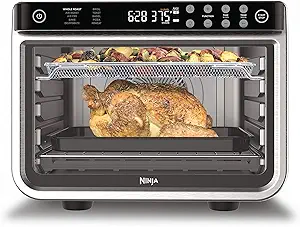
Ninja vs Oster: Overview
Comparing Ninja and Oster helps you determine which brand is best suited for your needs in Toaster Ovens. Both brands offer strong choices depending on your budget and key feature requirements.
Key Features & Comparison
Evaluate factors such as build quality, warranty, customer satisfaction, and total value before making your final purchase choice between Ninja and Oster.
Features
Ninja toaster ovens distinguish themselves through an expansive suite of smart, multifunctional presets that go far beyond standard baking and broiling. Most Ninja models, such as the Foodi series, integrate high-performance air fry, dehydrate, air roast, and crisping modes powered by multi-directional heating elements and variable-speed convection fans. Furthermore, higher-end Ninja models frequently include integrated smart thermometers that actively monitor internal food temperatures and automatically halt cooking to prevent overcooking, providing an advanced layer of precision that technical cooks will appreciate.
Oster approaches feature sets with an emphasis on practical essentials, typically offering standard convection, bake, broil, toast, and warm cycles. While newer Oster units feature French door configurations and basic air fry functionality, their mechanical dials or rudimentary digital interfaces provide less granular control over fan speed and targeted heat zones compared to Ninja. Oster avoids overwhelming the user with complex programming, resulting in an intuitive appliance that handles foundational cooking tasks well, though it falls short for consumers seeking the specialized, high-heat air frying and multi-level cooking racks standard in Ninja's lineups.
Performance
In terms of thermal efficiency and cooking speed, Ninja consistently outperforms Oster due to its advanced heating infrastructure and optimized airflow engineering. Ninja's "Digital Crisp Control" and high-output quartz heating elements generate rapid heat recovery and uniform hot air circulation, which translates into exceptionally fast preheat times and superior crisping without hot spots. Whether toasting a slice of bread to an even golden brown or air frying chicken wings to high crunch levels, Ninja delivers consistent, chef-quality results that rival dedicated countertop air fryers and standard full-sized convection ovens.
Oster provides solid, traditional thermal performance, relying primarily on conventional calrod heating elements that produce steady, radiant heat. While Oster ovens reliably bake casseroles, melt cheese, and toast bread satisfactorily, they typically experience longer preheat intervals and higher heat dissipation through their single-pane glass doors. In high-demand scenarios like convection roasting or rapid air frying, Oster models can exhibit minor temperature fluctuations and uneven browning across larger baking sheets, requiring users to manually rotate pans to achieve the even results that Ninja produces automatically through superior air dynamics.
Design
Ninja leads the industry in spatial engineering and contemporary kitchen aesthetics, most notably showcased by its innovative "flip-up" storage mechanism found in models like the Foodi SP101. This engineering feat allows the entire oven to fold vertically against the backsplash when not in use, reclaiming valuable countertop footprint. Ninja products feature premium brushed stainless steel, dark textured plastics, and sleek digital LED control panels integrated smoothly into handles or bases, giving them a distinctly modern, high-tech appearance that fits seamlessly into contemporary kitchen spaces.
Oster adopts a more conventional, utilitarian design language characterized by wide footprints, high-clearance vertical cavities, and mechanical or simple push-button interfaces. A standout in Oster’s portfolio is the French door design, which allows users to open both doors simultaneously with a single hand, mitigating accidental burns and simplifying the insertion of large dishes like 12-inch pizzas or whole chickens. While Oster’s exterior materials—often lighter-gauge metals and plastic accents—feel less premium than Ninja's heavy-duty chassis, their tall internal profiles comfortably accommodate higher-profile foods that would struggle to fit in Ninja’s ultra-compact, low-profile designs.