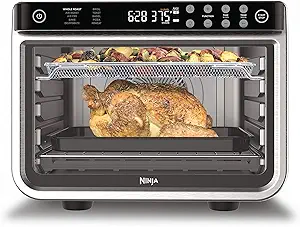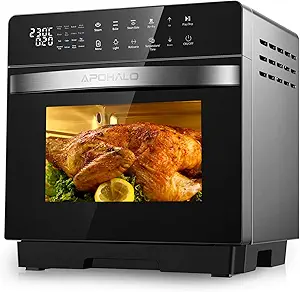







Ninja vs Apohalo: Overview
Comparing Ninja and Apohalo helps you determine which brand is best suited for your needs in Toaster Ovens. Both brands offer strong choices depending on your budget and key feature requirements.
Key Features & Comparison
Evaluate factors such as build quality, warranty, customer satisfaction, and total value before making your final purchase choice between Ninja and Apohalo.
Features
Feature architecture reveals significant divergence between Apohalo's minimalist utility and Ninja's multi-functional sophistication. Apohalo toaster ovens generally incorporate essential presets such as bake, broil, toast, and keep warm, driven by mechanical dials or basic digital microcontrollers that execute standard heating profiles without complex sensor feedback. Ninja, however, incorporates advanced digital control boards offering extensive cooking modes, including precise air frying, dehydrating, whole-roasting, and specialized dual-heat searing. Ninja models frequently feature proprietary digital crisping technology and variable fan-speed programming that actively modifies convection intensity depending on the selected preset, providing users with a level of culinary customization that Apohalo simply cannot match.
In terms of auxiliary systems and hardware accessories, Ninja consistently out-engineers Apohalo through thoughtful user-experience enhancements. Ninja units often include multi-level cooking racks, high-density non-stick crisper baskets, and integrated smart thermometers that automatically monitor internal protein temperatures to prevent overcooking. Apohalo provides the requisite wire rack, crumb tray, and basic baking pan, but the accessory materials are generally lighter-gauge metals prone to warping under sustained high heat. Furthermore, Ninja’s advanced feature sets often extend to intelligent preheat routines and automated shut-off sequences tied to internal thermal sensors, creating a more foolproof, precision-driven cooking environment.
Performance
Thermal output and distribution metrics illustrate Ninja’s engineering dominance over Apohalo’s conventional heating architecture. Ninja toaster ovens typically feature high-wattage quartz heating elements paired with high-velocity convection fans that minimize preheat times and virtually eliminate thermal dead zones within the cavity. This high-speed airflow creates the aggressive convective heat transfer necessary for restaurant-grade air frying, rapid protein searing, and uniform surface browning. Apohalo generally relies on standard Nichrome or basic calrod heating elements with passive or low-RPM convection assist. While this is sufficient for evenly toasting sliced bread or reheating pizza, it struggles with temperature recovery when the door is opened and exhibits noticeable hot spots during dense roasting tasks.
Temperature precision and stability under varying loads further distinguish the two brands. Ninja utilizes sophisticated algorithm-driven PID (Proportional-Integral-Derivative) temperature control that continuously micro-adjusts power to individual heating elements, ensuring the internal cavity remains tightly aligned with the set temperature throughout the cooking cycle. Apohalo units, operating on simpler bi-metal or entry-level electronic thermostats, exhibit wider temperature swings that can lead to unintended scorching or extended cook times for delicate baked goods. Consequently, while Apohalo satisfies standard, forgiving culinary tasks, Ninja demonstrates the rigorous thermodynamic control required for consistent, high-heat air frying and exacting pastry work.
Design
The structural design and industrial ergonomics of these appliances highlight contrasting approaches to countertop optimization and spatial efficiency. Ninja is renowned for innovative industrial designs, notably its flip-away storage mechanisms that allow select models to tilt vertically against the kitchen backsplash when not in use, liberating valuable counter space. Ninja appliances also employ heavy-gauge brushed stainless steel exteriors, thick double-walled glass doors for superior thermal insulation, and cool-touch handles that enhance physical safety during extended high-temperature operation. The control panels are logically partitioned, combining tactile rotary dials with high-contrast digital displays that clearly communicate time, temperature, and rack-position guidance.
Apohalo favors a conventional, stationary rectangular form factor that prioritizes classic countertop integration over spatial innovation. While functional, the exterior housing of an Apohalo oven typically utilizes thinner sheet metal that dissipates more heat into the surrounding environment, resulting in higher exterior surface temperatures during operation. The doors are often single-pane glass, which, while offering acceptable visibility, reduces overall thermal containment compared to Ninja’s insulated designs. Aesthetically, Apohalo presents a clean, simple silhouette that blends into standard kitchen decors without drawing attention, but it lacks the premium tactile feedback, weighted hinges, and refined panel ergonomics found throughout Ninja’s hardware lineup.