June vs Balmuda: Overview
Comparing June and Balmuda helps you determine which brand is best suited for your needs in Toaster Ovens. Both brands offer strong choices depending on your budget and key feature requirements.
Key Features & Comparison
Evaluate factors such as build quality, warranty, customer satisfaction, and total value before making your final purchase choice between June and Balmuda.
Features
The feature landscape of the June oven is heavily anchored in software intelligence, digital connectivity, and sensor fusion. Its defining attribute is an integrated, heat-resistant internal HD camera paired with proprietary machine learning algorithms that instantly identify hundreds of food types and recommend tailored, multi-stage cooking programs. June is controlled via an expansive, responsive full-color touchscreen alongside a comprehensive mobile application that streams live video of the cook cycle and pushes push notifications when target core temperatures are reached via its digital food thermometer probe. Furthermore, June's continuous over-the-air (OTA) firmware updates frequently introduce new food recognitions and cooking profiles, ensuring the machine's software-defined capabilities evolve over time.
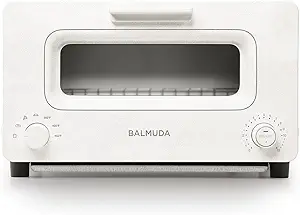
Balmuda takes the opposite path, rejecting Wi-Fi connectivity, digital screens, and complex submenus in favor of a specialized 5cc steam injection system and intuitive analog controls. The centerpiece of Balmuda's feature suite is the tiny water reservoir atop the unit, which vaporizes a precise shot of water at the onset of heating to lock in internal moisture before switching to dry radiant heat. Its operating interface consists of tactile, clicking rotary dials dedicated to specialized bread modes—Sandwich Bread, Artisan Bread, Pizza, and Pastry—alongside standard non-steam temperature settings. While June wins decisively on multifunctional utility and automation, Balmuda’s features are laser-targeted toward solving the specific thermodynamic problem of stale crumb revitalization without the need for an internet connection or digital diagnostics.
Performance
Performance benchmarks showcase the disparate thermodynamic architectures of each appliance. The June oven is powered by an array of carbon fiber heating elements capable of reaching maximum temperatures nearly instantaneously, coupled with dual convection fans that eliminate cold spots and dramatically reduce cook times. In real-world thermal testing, June behaves like a commercial combi-oven, excelling at roasting dense meats, rapid air-frying with crisp exterior textures, and executing precise low-temperature dehydrating cycles. The integration of its internal meat probe provides exceptional thermal consistency, virtually eliminating the risk of overcooking poultry or beef by automatically shifting into a keep-warm mode upon reaching the target internal temperature.
Balmuda’s performance, while vastly narrower in scope, is arguably peerless within its specialty. The micro-thin steam layer that blankets the bread prevents the surface moisture from evaporating prematurely while the interior gently warms; once the steam phase concludes, the quartz heating elements rapidly cycle to caramelize the exterior starch via the Maillard reaction. This phased heating profile yields an unmistakable contrast of a crackling, golden-brown crust with a pillowy, hydrated crumb that June cannot replicate through dry convection alone. However, Balmuda's lower maximum temperature ceiling, lack of convection airflow, and absence of active core monitoring mean it falters on savory culinary tasks, showing significant heat dissipation and uneven thermal distribution when taxed with proteins or roasted vegetables.
Design
From an industrial design perspective, June conveys a muscular, contemporary aesthetic reminiscent of high-end consumer electronics. Built with double-paned, edge-to-edge tempered glass and a brushed stainless steel chassis, the exterior is modern, sleek, and dominated by its smartphone-like touch display. Its internal cavity is generously proportioned, easily accommodating a 12-inch pizza, a whole 10-pound chicken, or standard quarter-sheet pans. The industrial execution extends to internal LED illumination tuned specifically for color-accurate video monitoring, though its imposing footprint and heavier weight make it a permanent countertop centerpiece that demands considerable clearance for heat dissipation during extended convection cycles.
Balmuda, by contrast, champions a warm, retro-modern aesthetic that elevates compact living spaces. With its textured matte finish, soft curving lines, analog dials, and nostalgic ticking sound that accompanies the timer, Balmuda evokes emotional delight alongside functional utility. Its remarkably diminutive footprint fits effortlessly on cluttered counters or beneath low-hanging cabinetry, functioning as much as a piece of curated countertop decor as a working appliance. The trade-off for this charming, compact footprint is a severely restricted interior volume, requiring users to slice bread to specific dimensions and strictly limiting the oven to single-serving applications. Both units demonstrate exceptional build quality, but June reflects Silicon Valley functionalism while Balmuda channels Japanese artisanal craftsmanship.