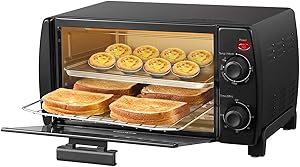
Instant Pot vs Comfee: Overview
Comparing Instant Pot and Comfee helps you determine which brand is best suited for your needs in Toaster Ovens. Both brands offer strong choices depending on your budget and key feature requirements.
Key Features & Comparison
Evaluate factors such as build quality, warranty, customer satisfaction, and total value before making your final purchase choice between Instant Pot and Comfee.
Features
In terms of features and programming versatility, Instant Pot clearly outpaces Comfee by integrating advanced smart electronics and multi-stage cooking algorithms. Instant Pot toaster ovens frequently boast anywhere from 7 to 14 distinct cooking presets, including dehydrate, rotisserie, broil, slow cook, and dedicated proofing modes. Their units often feature independent heating element control (quartz or calrod elements positioned above and below) that dynamically adapt power outputs based on the selected mode. Additionally, high-end Instant Pot models frequently incorporate intuitive digital LED interfaces with dual-display dials, interior halogen lights, and integrated temperature probe support, providing fine-grained temperature adjustment in five-degree increments.
Comfee, by comparison, prioritizes essentialism and mechanical directness. While select Comfee models feature digital panels with standard presets, the core of their portfolio relies on traditional three-dial mechanical systems controlling temperature, timer, and function (toast, bake, broil). These units eschew niche capabilities like proofing or high-speed dehydration in favor of core, reliable competencies. Even in their air fry-enabled units, Comfee's feature set is utilitarian—offering static convection airflow rather than variable fan speeds. While this straightforward architecture lacks the granular culinary control and automation found in Instant Pot's digital ecosystem, it ensures virtually zero software failure points and instant, intuitive operation right out of the box.
Performance
Performance benchmarks reveal distinct operational behaviors, particularly regarding thermal mass, air circulation speed, and heat distribution. Instant Pot toaster ovens excel in thermal recovery and high-velocity convection, driven by powerful interior fans and engineered airflow channels that simulate deep-frying with impressive crispness. Their quartz heating elements reach target temperatures rapidly, producing even browning and minimizing cooking times for heavier proteins, roasts, and frozen foods. However, this high-powered output demands attention; the intense top-down radiant heat can occasionally lead to premature scorching on delicate baked goods or standard sliced bread if preset times are not dialed down by the user.
Comfee toaster ovens deliver a more predictable, moderate thermal profile that is fundamentally well-suited for everyday toasting and gentle baking. Because they typically run on lower wattage platforms (often between 1000W and 1500W compared to Instant Pot's 1800W), Comfee units take slightly longer to preheat and lack the aggressive air-velocity required for ultra-crisp air frying. Nevertheless, this measured heat transfer excels in simple tasks like melting cheese, reheating pizza, and achieving consistent edge-to-edge browning on bread without over-drying the crumb. While Instant Pot is the superior choice for high-heat roasting and rapid air-frying, Comfee provides reliable, forgiving thermal performance for modest daily kitchen tasks.
Design
From a design and build quality perspective, Instant Pot emphasizes a substantial, modern commercial aesthetic characterized by brushed stainless steel housings, double-pane glass doors, and substantial handles. The internal cavities are deliberately expansive, often designed to accommodate a 12-inch pizza, six slices of bread, or a whole five-pound chicken. The fit and finish reflect higher-grade consumer hardware, incorporating silicone gaskets for heat retention, smooth-glide rack tracks, and intuitive microswitches that pause operations when the door opens. However, this robust construction results in a heavy, sprawling footprint that can aggressively crowd smaller countertops with limited vertical clearance.
Comfee adopts a design philosophy centered on ergonomics, compactness, and spatial efficiency. With smaller footprints, lighter gauge sheet metal, and classic color choices—including matte blacks, whites, and subtle retro accents—Comfee ovens integrate seamlessly into cramped apartments, dorm rooms, or secondary kitchenettes. The physical interfaces are uncluttered, featuring high-contrast dials that can be operated quickly without deciphering digital menus. While the single-pane glass doors and lightweight chassis emit more external surface heat and feel less premium to the touch than Instant Pot's insulated enclosures, Comfee's practical design ensures easy portability, effortless repositioning, and straightforward maintenance.
Compare current retail pricing, active promotions, and verified stock availability directly from authorized stores: