COSORI vs Balmuda: Overview
Comparing COSORI and Balmuda helps you determine which brand is best suited for your needs in Toaster Ovens. Both brands offer strong choices depending on your budget and key feature requirements.
Key Features & Comparison
Evaluate factors such as build quality, warranty, customer satisfaction, and total value before making your final purchase choice between COSORI and Balmuda.
Features
From a feature-set perspective, COSORI embraces an all-in-one approach packed with digital automation and expansive functionality. Typical COSORI models feature extensive preset libraries—often offering up to 12 distinct cooking modes, including air fry, bake, broil, dehydrate, keep warm, and ferment. High-end COSORI models frequently integrate smart home connectivity through their proprietary VeSync application, enabling remote monitoring, preheat notifications, and extensive recipe libraries directly accessible via smartphone or voice assistants. The internal engineering supports multiple rack positions and often includes specialized accessories like air fry baskets, baking pans, and crumb trays, maximizing the oven's readiness for diverse cooking tasks immediately out of the box.
Balmuda deliberately avoids this modern kitchen-sink approach, opting instead for a minimalist, highly specialized feature architecture centered on its revolutionary steam technology. Rather than dozens of generic presets, Balmuda features precise bread-centric modes: Sandwich Bread, Artisan Bread, Pizza, and Pastry, alongside a standard classic oven mode operating at specific set temperatures. The core engineering highlight is the integrated water reservoir, requiring the user to pour a small 5cc cup of water before each cycle. This water evaporates instantly into a thin blanket of micro-steam that locks in moisture before specialized quartz heaters caramelize the exterior. While lacking the app integration, expansive capacity, and air fryer fans of COSORI, Balmuda’s features are technically sophisticated in their hyper-specialization, delivering an unmatched level of hydration control that conventional ovens simply cannot replicate.
Performance
Performance evaluations between these two appliances reveal stark contrasts rooted in their thermodynamic implementations. COSORI relies on high-velocity convection fans paired with traditional metallic heating elements to drive rapid thermal transfer. In air fry and convection modes, COSORI excels at generating intense, dry heat that rapidly dehydrates surfaces, yielding crisp coatings on meats, vegetables, and frozen foods while sustaining steady ambient temperatures throughout its spacious interior. However, this same dry, high-velocity airflow can be a drawback when toasting standard bread, occasionally leading to uneven browning, moisture loss, and an overly desiccated crumb structure compared to specialized bread toasters.
Balmuda’s thermal performance is governed by a micro-second temperature control system developed in Japan that operates in three distinct phases: low-heat moisture infusion, core warming, and final surface caramelization. By surrounding the bread with steam early in the cycle, Balmuda prevents the bread's inner crumb from losing hydration, keeping the center pillow-soft and piping hot while the top and bottom heating elements rapidly brown the crust at the final stage. The result is consistently hailed as the pinnacle of toast performance, transforming stale bread into bakery-fresh slices. However, Balmuda cannot compete in raw cooking tasks; its low wattage and compact interior cannot handle standard roasting, air frying, or cooking dense raw proteins effectively, limiting its top-tier performance strictly to bread, pastries, and shallow reheating tasks.
Design
COSORI adopts an unmistakably contemporary, utilitarian design aesthetic common to high-volume kitchen appliances. Built with brushed stainless steel or matte black sheet metal, COSORI toaster ovens present a bold, purposeful presence on the countertop. The user interface prioritizes clarity and information density, utilizing bright digital LED/LCD displays, touch controls, and large rotary dials to navigate the plethora of presets and temperature selections. The interior is generously proportioned, designed with wide glass doors and internal lighting to allow users to easily monitor larger culinary loads. However, the expansive footprint demands significant countertop real estate, and the overall fit and finish emphasize durable industrial mass-production rather than luxury bespoke design.
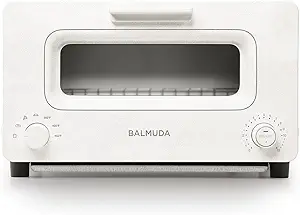
Balmuda presents an architectural masterclass in Japanese minimalism and retro-futuristic elegance. Compact, sculptural, and designed with a deliberate economy of space, the Balmuda toaster features a soft-matte exterior finish, clean rounded lines, and an understated aesthetic that enhances rather than clutters the kitchen environment. The user interface eschews loud digital screens for two tactile analog dials that click with satisfying precision, accompanied by soft auditory chimes and a soothing internal light that resembles an antique hearth. The engineering tolerance on the drop-down door, the magnetic water cup holder, and the integration of the tiny water intake are all executed with exceptional attention to detail. While its petite stature inherently restricts its capacity to roughly two slices of bread, its superior materials, tactile feedback, and heirloom design quality make it a stunning centerpiece on any countertop.