Comfee vs Val cucine: Overview
Comparing Comfee and Val cucine helps you determine which brand is best suited for your needs in Toaster Ovens. Both brands offer strong choices depending on your budget and key feature requirements.
Key Features & Comparison
Evaluate factors such as build quality, warranty, customer satisfaction, and total value before making your final purchase choice between Comfee and Val cucine.
Features
In terms of feature sets and technological integration, Val Cucine demonstrates clear sophistication with its modern multi-cooker design. Val Cucine units typically feature microcomputer-driven digital control interfaces boasting upwards of 10 to 16 preset algorithmic programs, ranging from standard bake, broil, and toast to specialized dehydrate, rotisserie, and high-velocity convection air frying. Furthermore, Val Cucine frequently incorporates higher-tier features such as dual-speed convection fans, digital temperature probes, and precision dual-zone or independent upper-and-lower heating element selection. This extensive feature profile provides seasoned cooks with a granular level of command over airflow dynamics and temperature curves.
Conversely, Comfee embraces a minimalist, functionally focused feature landscape that relies primarily on electromechanical rotary dials or simplified digital interfaces with fewer preset options. While select Comfee models do incorporate basic convection or air fry modes, they lack the sophisticated sensory feedback loops and wide-ranging presets seen in Val Cucine’s lineup. Comfee’s timers are typically limited to 60 minutes with basic stay-on functions, whereas Val Cucine allows for prolonged low-temperature dehydration sequences running multiple hours. What Comfee sacrifices in high-end feature breadth, however, it gains in user accessibility, presenting a practically zero-learning-curve operation that is immediately approachable for non-technical users.
Performance
Performance benchmarks reveal distinct thermal behaviors directly correlated with the internal componentry of each brand. Val Cucine toaster ovens routinely employ heavy-duty quartz or stainless steel heating elements powered by 1700 to 1800 watts, paired with high-RPM convection blowers. This infrastructure facilitates rapid preheating phases, negligible thermal drop when opening doors, and superior cross-chamber heat distribution. In high-demand tasks such as air frying crispy proteins or uniformly browning an entire 12-inch pizza, Val Cucine's dynamic airflow prevents cold pockets and delivers consistent, repeatable results across multi-rack configurations.
Comfee toaster ovens, which typically operate in the 1000 to 1500-watt range depending on their footprint, deliver respectable thermal performance strictly calibrated for lower-intensity workloads. Standard toasting cycles achieve predictable surface browning, and basic baking yields satisfactory results for single-portion dishes. However, analytical testing often exposes minor edge-to-center thermal gradients inside Comfee ovens due to passive radiant heating or lower-velocity convection systems, requiring users to manually rotate pans midway through baking. While Comfee adequately satisfies everyday heating tasks, Val Cucine excels in thermal precision, temperature recovery, and high-intensity, even heat transfer.
Design
From an industrial design standpoint, Val Cucine exhibits a robust, commercial aesthetic characterized by brushed stainless steel housings, heavy-gauge dual-pane tempered glass doors, and ergonomic bar handles. The inclusion of dual-pane glass serves an essential engineering function, vastly improving thermal retention, exterior housing safety, and internal ambient stability. The interior cavities are generally lined with high-grade non-stick or galvanized surfaces that simplify grease management, illuminated by bright internal halogen lighting that allows users to monitor culinary progress without compromising the thermal seal by opening the door.
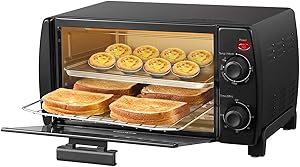
Comfee approaches design with an emphasis on spatial conservation, lightweight chassis construction, and a clean, unobtrusive presence suited for limited counter space. Utilizing powder-coated sheet metal shells, single-pane tempered glass doors, and intuitive tactile knobs, Comfee units are built to minimize footprint and production overhead. While this construction keeps the appliances light and compact, the exterior casing can become noticeably warmer during prolonged high-heat cycles due to thinner insulation barriers. For buyers prioritizing compact footprints and lightweight portability, Comfee’s design is highly practical, whereas Val Cucine's design appeals to those who prioritize structural rigidity, premium thermal insulation, and a modern culinary aesthetic.