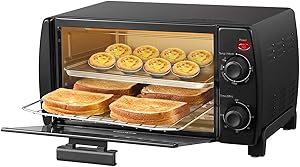
Breville vs Comfee: Overview
Comparing Breville and Comfee helps you determine which brand is best suited for your needs in Toaster Ovens. Both brands offer strong choices depending on your budget and key feature requirements.
Key Features & Comparison
Evaluate factors such as build quality, warranty, customer satisfaction, and total value before making your final purchase choice between Breville and Comfee.
Features
Breville's feature set is anchored by its proprietary Element IQ technology, which intelligently modulates power across independent quartz heating elements to eliminate cold spots and tailor heat direction based on the selected preset. Higher-end models in Breville's lineup expand this utility with dual-speed super convection fans, integrated air fry baskets, dedicated dehydrate or slow cook modes, and automated interior lighting that activates when the cooking cycle concludes. The intuitive digital interface, complete with a high-contrast LCD screen that changes backlight color to indicate preheating and active cooking, allows users to dial in precise temperatures down to individual increments while adjusting timing with effortless rotational dials.
Comfee adopts a back-to-basics approach, stripping away microprocessor-driven intelligence in favor of straightforward, analog functionality. Most Comfee models utilize mechanical dials to manage fundamental parameters: standard temperature control, a mechanical timer (often limited to 30 or 60 minutes with a stay-on option), and a selector for basic modes such as bake, broil, and toast. While Comfee lacks advanced capabilities like smart thermal steering, dedicated multi-stage cooking programs, or true convection circulation, its simplicity means there are fewer electronic points of failure. For consumers who prefer unadorned, tactile controls and do not require sophisticated culinary programs, Comfee covers the fundamentals competently without operational complexity.
Performance
In empirical performance testing, Breville demonstrates superior thermal accuracy, stability, and heat distribution. The combination of quartz heating elements—which heat and cool far more rapidly than conventional metal calrod coils—and algorithmic power distribution ensures that roasts are evenly caramelized, crusts are properly browned, and delicate pastries bake uniformly without hot-spot scorching. The convection systems move air with sufficient velocity to crisp wings and fries effectively, producing results comparable to standalone air fryers. Furthermore, Breville's thermal insulation keeps heat contained within the cooking cavity, reducing exterior wall temperatures and ensuring that internal temperatures do not precipitously drop when the door is briefly opened.
Comfee delivers acceptable performance for standard domestic tasks, but its technical limitations become apparent during demanding culinary applications. Utilizing standard metal heating elements without dynamic power management, Comfee units can exhibit noticeable temperature swings and uneven radiant patterns, often requiring users to rotate sheet pans or bread slices halfway through a cycle to achieve even browning. The lack of heavy thermal insulation also leads to faster heat dissipation, meaning the oven takes longer to recover target temperatures and radiates notable ambient heat into the surrounding kitchen. While it handles frozen waffles, open-faced melts, and single-serving pizzas adequately, it struggles with the precision necessary for delicate baking or high-heat searing.
Design
Breville's design language reflects an industrial, premium aesthetic characterized by heavy-duty brushed stainless steel construction, reinforced hinges, and robust, magnetic auto-eject rack mechanisms. The doors feature thick, tempered double-wall glass designed to maximize heat retention and enhance user safety, while the cast-metal ergonomic handles provide a sturdy, high-end tactile feel. Even maintenance is thoroughly considered; non-stick internal cavity coatings resist grease baked-on splatters, and front-accessible crumb trays slide out smoothly without disturbing the rest of the unit. The footprint is undeniably substantial, requiring dedicated, deep countertop clearance, but the visual presence is modern, polished, and architecturally deliberate.
Comfee’s physical design emphasizes compactness, lightweight transportability, and manufacturing cost-efficiency. Utilizing thinner rolled sheet metal, painted exterior finishes, and single-pane glass doors, Comfee appliances keep both physical mass and manufacturing footprints minimal. The mechanical dials feature high-contrast markings that are easy to read, though the plastic construction and spring-wound timers communicate an entry-level build standard. While the compact dimensions are a distinct advantage for kitchens with constrained counter space, the lighter chassis means the unit can slide during aggressive door opening or tray extraction. Maintenance requires more diligence due to basic galvanized or bare metal interiors, yet for small-scale operations, its modest, space-efficient profile is a practical fit.
Compare current retail pricing, active promotions, and verified stock availability directly from authorized stores: