Balmuda vs Crownful: Overview
Comparing Balmuda and Crownful helps you determine which brand is best suited for your needs in Toaster Ovens. Both brands offer strong choices depending on your budget and key feature requirements.
Key Features & Comparison
Evaluate factors such as build quality, warranty, customer satisfaction, and total value before making your final purchase choice between Balmuda and Crownful.
Features
Balmuda’s feature architecture is purposefully minimalist yet technologically sophisticated, anchored by its revolutionary five-cubic-centimeter steam-injection system. By using a designated water boiler and tailored microprocessor-controlled heating cycles, Balmuda offers dedicated presets for artisan bread, sandwich toast, pizza, and pastry re-crisping, alongside a conventional bake setting without steam. The machine purposely eliminates modern digital clutter, eschewing touchscreens, smart connectivity, or noisy convection fans in favor of analog dials that execute complex, multi-phase thermal profiles. This technical restraint ensures that every feature included operates with exceptional fidelity to its stated purpose: achieving an interior crumb that remains soft and gelatinized while the exterior develops an ethereal, paper-thin crunch.
Crownful, on the other hand, embraces an expansive, high-octane feature set dominated by digital multi-functionality and convection technology. A typical Crownful appliance boasts ten to twenty distinct cooking presets, including air fry, dehydrate, broil, rotisserie, and keep-warm modes, controlled through an LED digital touchscreen. With expansive internal capacity often exceeding twenty to thirty liters, it accommodates multiple racks, rotating skewer baskets, and baking trays simultaneously. The trade-off for this technological abundance is a noticeable drop in specialization; its algorithms are generalized approximations rather than hyper-calibrated thermal cycles. However, the presence of high-speed dual-fan convection provides rapid hot air circulation that Balmuda physically cannot match, making Crownful dramatically more capable for proteins, frozen snacks, and whole poultry.
Performance
In terms of thermal execution, Balmuda performs with unmatched precision within its targeted envelope. The proprietary heating curve operates in three discrete stages: first, rapid steam generation fills the chamber and creates a thin layer of condensed moisture on the food’s surface, preventing core desiccation; second, gentle baseline heating warms the interior crumb through radiant heat; and third, an intense burst of top-and-bottom infrared energy caramelizes the exterior through the Maillard reaction. This specialized cycle produces the finest toasted bread, bagels, and pastries in the countertop appliance industry. However, its thermal performance degrades in general cooking contexts: with a low internal ceiling and lack of dynamic airflow, high-moisture proteins or grease-heavy cuts are prone to smoking, and the thermal recovery time can lag if the door is opened frequently.
Crownful approaches performance through raw wattage, radiant heat distribution, and high-velocity air movement. Its multi-element heating configurations combined with industrial-strength convection fans yield blistering ramp-up times and aggressive surface dehydration, making it an exceptional air fryer that achieves deep, uniform crunch on breaded cutlets, fries, and wings. The thermal stability over larger volumes is maintained via digital thermostat controls that handle heavy thermal mass far better than Balmuda. Nevertheless, its performance reveals shortcomings in delicate applications: the intense, continuous airflow can dry out delicate baked goods, and toast produced via standard broil elements often ends up desiccated throughout rather than crisp exclusively on the surface, sacrificing nuance for sheer thermodynamic power.
Design
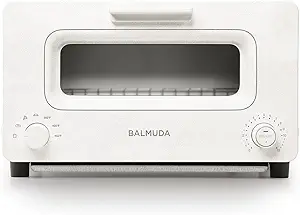
The aesthetic and physical design of Balmuda reflects the pinnacle of modern Japanese industrial minimalism. Featuring smooth, tactile matte finishes, understated typography, cast metal handles, and impeccably weighted dials, the unit is constructed to be a visually serene centerpiece on a curated countertop. Every interactive element has been engineered to evoke an emotional response, from the nostalgic ticking audio cue that mimics an antique mechanical clock to the warm, subtle glow of its interior light. Its compact footprint is intentional, fitting seamlessly into tight metropolitan kitchens where space is at a premium and appliance clutter is actively avoided, though this deliberately restricts its utility to single-tier, small-batch cooking.
Crownful leans into a pragmatic, utilitarian design aesthetic common among contemporary multi-cookers. Utilizing brushed stainless steel housing paired with high-gloss polycarbonate control panels, the design prioritizes cleanability, visibility, and internal capacity over Scandinavian or Japanese subtlety. Its expansive glass viewing windows and bright interior halogen lighting are engineered to let cooks monitor massive roasts or multi-tiered dehydrator trays without opening the door. While the interface is intuitive and user-friendly, the tactile feedback of the buttons, the door hinge friction, and the overall fit-and-finish lack the tight tolerances, substantial heft, and curated acoustic feedback that make interacting with a Balmuda a uniquely tactile pleasure.