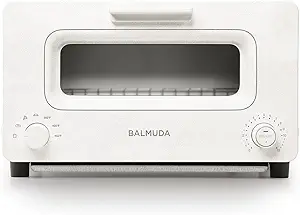
Balmuda vs Anova Culinary: Overview
Comparing Balmuda and Anova Culinary helps you determine which brand is best suited for your needs in Toaster Ovens. Both brands offer strong choices depending on your budget and key feature requirements.
Key Features & Comparison
Evaluate factors such as build quality, warranty, customer satisfaction, and total value before making your final purchase choice between Balmuda and Anova Culinary.
Features
The feature set of the Balmuda toaster oven is intentionally restrained to maintain an uncomplicated user experience. It provides five specialized dial-based heating modes: Sandwich Bread, Artisan Bread, Pizza, Pastry, and a standard Oven mode that operates without steam across fixed temperature thresholds (typically 350°F, 400°F, and 450°F). The centerpiece of its functionality is a small water intake port on top, which requires the manual addition of 5cc of water via a dedicated miniature cup. There is no Wi-Fi connectivity, digital probe integration, or multi-step recipe programming; every feature is strictly mechanical and automated internally to eliminate decision fatigue.
Conversely, Anova Culinary outfits its Precision Oven with a formidable suite of professional features centered around high-precision combi-steam technology. It features a massive 5-liter external water reservoir, a continuous boiler system that delivers steam from 77°F to 212°F, and integrated relative humidity sensors that can maintain exact moisture levels throughout the chamber. Furthermore, Anova integrates fully with a companion smartphone application via Wi-Fi, provides a plug-in food probe for core temperature tracking, and supports complex multi-stage cooking sequences—such as executing a bagless sous-vide step followed by high-heat convection browning without moving the food.
Performance
In real-world performance, Balmuda excels in localized heat transfer and micro-steaming speed, specifically calibrated for starches. By flash-heating the 5cc of water into steam within the first few seconds of operation, it envelops the bread in a protective thermal envelope that locks in moisture before the dual top-and-bottom quartz heating elements cycle through specific temperature thresholds to crisp the exterior. This process avoids the dry, desiccated texture typical of conventional toaster ovens, yielding toast with a thin, brittle crust and an intensely pillowy crumb. However, its small chamber limits cooking capacity to roughly two slices of bread, and its non-steam oven mode struggles with larger, denser proteins.
Anova Culinary operates on a different performance tier, functioning as a true laboratory-grade convection combi-oven. Its performance strengths lie in absolute thermal stability and precise wet-bulb/dry-bulb temperature control, allowing users to cook delicate proteins without moisture loss or achieve the high-humidity initial burst required for blistered, artisanal bread crusts. Convection fan speeds are fully adjustable, minimizing hot spots across multiple rack positions. The trade-off is warm-up time and operational noise: the Anova requires several minutes to preheat its large cavity and generate dense steam, making it far slower and less energy-efficient for quickly toasting a single morning bagel than the instantaneous Balmuda.
Design
Balmuda demonstrates a masterclass in mid-century modern and Japanese minimalist aesthetics. Featuring clean geometric proportions, smooth matte finishes, a softly curved viewing window, and tactile analog dials with integrated LED indicators, it blends seamlessly into curated designer kitchens. Every interaction is sensory, from the gentle ticking sound during operation to the melodic chime that signals cooking completion. Its compact physical footprint occupies minimal counter space, though this directly translates to a diminutive internal cavity that restricts utility for broader roasting tasks.
The Anova Precision Oven exhibits an industrial, utilitarian design language prioritized around volume and accessibility. Dominated by stainless steel, a large double-pane glass door, and a capacitive touchscreen handle with an integrated digital display, it reads as a commercial appliance shrunk down for home use. The heavy-duty chassis and protruding external water tank demand a significant, permanent footprint on the countertop, along with generous clearance for venting steam. While sleek in modern, gadget-forward kitchens, Anova prioritizes functional capacity and thermal mass over the graceful, quiet elegance that characterizes Balmuda.
Compare current retail pricing, active promotions, and verified stock availability directly from authorized stores: