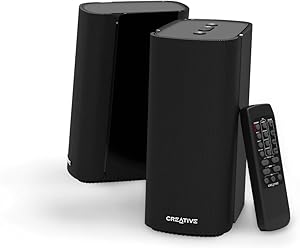







Logitech vs Creative: Overview
Comparing Logitech and Creative helps you determine which brand is best suited for your needs in Speakers. Both brands offer strong choices depending on your budget and key feature requirements.
Key Features & Comparison
Evaluate factors such as build quality, warranty, customer satisfaction, and total value before making your final purchase choice between Logitech and Creative.
Product Selection
Logitech maintains an expansive and varied product catalog that caters extensively to the computer and home entertainment markets. Their portfolio spans entry-level desktop companion speakers, THX-certified multi-channel surround sound configurations like the venerable Z906, and contemporary wireless bookshelf units featuring modern aesthetic finishes and multi-device Bluetooth pairing. In addition, through their Ultimate Ears (UE) subsidiary, Logitech exerts significant dominance in the rugged, portable outdoor speaker space. This breadth ensures that whether an enterprise client seeks simple plug-and-play voice conferencing units or an audiophile gamer demands an immersive 5.1 channel acoustic environment with optical inputs, Logitech possesses an established hardware solution ready for deployment.
Creative approaches product selection with a sharper, more concentrated focus on high-fidelity desktop multimedia, PC gaming, and home-theater compact soundbars. Rather than spreading themselves across generic peripheral categories, Creative leans heavily into specialized audio niches, as demonstrated by their industry-leading Sound Blaster Katana soundbar series, Stage home entertainment bars, and the minimalist Pebble desktop series. Furthermore, Creative continues to cater to classic PC hobbyists with legacy multi-channel speaker kits, but where they distinctly outpace Logitech is in the integration of specialized digital signal processing hardware. While Logitech provides a broader cross-category footprint, Creative's selection is far more tailored toward users seeking specialized form factors and integrated desktop audio interfaces.
Affordability
When evaluating affordability, both manufacturers maintain fiercely competitive entry points, but their pricing models reflect differing core value propositions. Logitech relies heavily on vast economies of scale, allowing them to offer ultra-budget utility speakers at price points accessible to virtually any consumer. Their low-tier 2.0 and 2.1 systems prioritize plug-and-play convenience and reliable build quality without adding expensive acoustic licensing or proprietary DSP chips. However, as consumers scale into Logitech’s higher-end THX-certified systems, prices rise substantially to match the industrial component ratings, larger drivers, and discrete amplifier modules, creating a pricing curve that is wide and directly proportional to acoustic output and physical hardware scale.
Creative consistently punches above its weight class regarding feature-to-price ratios, particularly in the entry-to-midrange market segments. The Creative Pebble line, for instance, radically disrupted the ultra-budget desk speaker tier by offering dedicated passive bass radiators, angled drivers, and modern USB-C power delivery at an almost identical price point to Logitech's most basic generic plastic speakers. In the mid-to-high tier, Creative’s soundbars and modular systems bundle multi-driver arrays, Dolby Digital decoding, customizable RGB backlighting, and internal soundcards at retail prices that frequently undercut similarly powered standalone desktop systems. For budget-conscious buyers seeking the most modern technological features per dollar spent, Creative generally holds the edge in overall value density.
Quality/Durability
Logitech’s reputation in manufacturing quality rests on decades of industrial design consistency and reliable mechanical engineering. Their desktop speakers and subwoofers are typically built with high-density ABS plastics or reinforced MDF (medium-density fiberboard) enclosures that withstand years of continuous vibration without developing chassis rattles or seam splits. Cable strain reliefs are robustly integrated, auxiliary jacks demonstrate high insertion durability, and internal power transformers are engineered to endure widespread electrical fluctuations. In the portable market, their UE-branded enclosures set an industry benchmark for IP-rated waterproofing and drop resistance, demonstrating Logitech's deep mechanical aptitude in high-stress consumer electronics.
Creative focuses its manufacturing prowess primarily on thermal management, aesthetic precision, and internal electronic component selection. Their soundbar enclosures and premium desktop units frequently employ brushed aluminum accents, sturdy metal grilles, and tactile switchgear that impart a decidedly more upscale, contemporary look than Logitech's utilitarian plastic housings. However, because Creative packs sophisticated microcontrollers, digital-to-analog converters (DACs), and Bluetooth transceivers into very compact, non-traditional enclosures, thermal buildup can occasionally challenge long-term component life if placed in poorly ventilated areas. While mechanically sound and thoroughly reliable for typical home office and gaming setups, Creative prioritizes sleek integration and electronic sophistication over the ultra-rugged, abuse-tolerant construction that characterizes much of Logitech's ecosystem.
Sound Quality
Logitech's acoustic signature leans decidedly toward consumer-friendly, bass-heavy, and dynamic audio reproduction. The brand commonly employs robust downward-firing or front-ported subwoofers paired with wide-dispersion satellite drivers, engineered to provide high sound pressure levels and visceral low-end impact during cinematic movie viewing and casual gaming. Their flagship systems, calibrated to THX performance standards, excel at delivering distortion-free, room-filling sound at high volumes. However, this focus on punchy bass and crystalline high frequencies often leaves the critical midrange somewhat recessed, which can result in vocal tracks, acoustic instruments, and complex musical arrangements sounding slightly hollow or muddy to critical listeners.
Creative distinguishes itself by delivering superior acoustic accuracy, detailed midrange clarity, and advanced soundstage positioning. Leveraging the engineering legacy of the Sound Blaster lineage, Creative equips many of its speaker systems with intelligent DSP algorithms, Super X-Fi spatial processing, and custom-tuned multi-driver crossovers. The result is a much tighter, articulate audio presentation where dialogues are sharply separated from low-frequency explosions, and instruments retain their distinct acoustic spatialization. While Creative's compact subwoofers may not always generate the sheer subterranean air movement of Logitech's largest dedicated bass modules, they deliver vastly superior musical coherence, speed, and overall soundstage realism that discerning audiophiles and competitive gamers will appreciate.