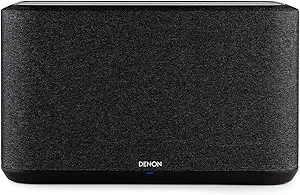
Denon vs Marshall: Overview
Comparing Denon and Marshall helps you determine which brand is best suited for your needs in Speakers. Both brands offer strong choices depending on your budget and key feature requirements.
Key Features & Comparison
Evaluate factors such as build quality, warranty, customer satisfaction, and total value before making your final purchase choice between Denon and Marshall.
Product Selection
Denon approaches product selection from a comprehensive, whole-home audio and high-fidelity home theater perspective. Renowned for its industry-leading AV receivers, soundbars, and the integrated HEOS multi-room ecosystem, Denon caters extensively to audiophiles and cinema enthusiasts who require complex, modular setups. Their product line includes everything from compact all-in-one wireless speakers like the Denon Home series to multi-channel flagship receivers that anchor dedicated acoustic spaces. This breadth gives consumers extensive flexibility to design multi-zone installations that bridge traditional wired stereo components with contemporary high-resolution wireless streaming.
Conversely, Marshall focuses heavily on lifestyle-driven personal audio, prioritizing portable Bluetooth speakers, stationary tabletop units, and headphones. Its catalog is cleanly segmented into ultra-portable pocket speakers (such as the Willen), rugged adventure units (like the Emberton), and AC-powered living room statement pieces (such as the Acton, Stanmore, and Woburn). While Marshall deliberately avoids complex AV receivers, architectural speakers, and deep surround-sound infrastructure, its targeted catalog excels in meeting the lifestyle demands of users seeking plug-and-play simplicity, aesthetic distinction, and go-anywhere ruggedness without complicated multi-room network configurations.
Affordability
Denon operates predominantly in the mid-tier to high-end audio categories, where pricing reflects advanced digital processing, licensing for spatial audio formats (like Dolby Atmos and DTS:X), and robust amplification hardware. Entry-level wireless speakers in the Denon Home family carry a premium initial investment, and scaling a system to encompass full surround sound or multiple rooms demands significant capital. However, the value proposition is anchored in longevity, extensive input/output versatility, and future-proof networking capabilities, ensuring that consumers are investing in long-term home infrastructure rather than ephemeral consumer electronics.
Marshall presents a more accessible price ladder within the consumer lifestyle space, delivering robust value across lower and mid-range price brackets. While their top-tier tabletop units like the Woburn can approach the price of dedicated hi-fi components, their highly popular portable lines offer attainable price points for casual listeners and urban dwellers. Marshall’s pricing primarily captures tactile industrial design and tuned acoustic performance; however, buyers pay a brand premium for the iconic rock-and-roll styling, which lacks the advanced networking hardware, room-correction microphones, or extensive digital connectivity found in similarly priced Denon products.
Quality/Durability
Denon’s engineering ethos is centered on component-grade reliability, thermal management, and precision circuit design. Built primarily for permanent indoor installation, their speakers and audio components utilize rigid, vibration-dampening enclosures, discrete power supplies, and high-tolerance internal crossovers designed to run continuously without performance degradation. While the physical exteriors feature refined acoustic fabric and minimalist composite surfaces that require careful handling in harsh environments, the internal build quality and structural integrity are engineered to meet exacting Japanese hi-fi standards.
Marshall prioritizes tactile resilience and lifestyle durability, engineering many of its portable units to endure outdoor environments, road travel, and heavy physical handling. Utilizing rugged vinyl-wrapped cabinets, brass hardware, metal mesh grilles, and robust corner bumpers, Marshall speakers effortlessly withstand impacts and cosmetic wear. Furthermore, several portable models boast high IP ratings (such as IP67 for dust and water resistance), making them resilient against environmental elements. The trade-off lies in the long-term serviceability of their compact, sealed chassis compared to Denon’s modular, repairable chassis architecture.
Sound Quality
Denon adheres to a neutral, highly analytical acoustic signature designed to reproduce recordings with uncolored precision, dynamic range, and expansive spatial imaging. Leveraging proprietary digital signal processing, high-grade digital-to-analog converters, and linear acoustic tuning, Denon speakers excel in vocal clarity, instrument separation, and cohesive multi-frequency balance. This transparent, reference-oriented sound profile makes them exceptionally well-suited for high-resolution audio formats, orchestral passages, and immersive movie soundtracks where subtle detail and micro-dynamics are paramount.
In contrast, Marshall engineers its sound profile to be lively, punchy, and distinctly guitar-centric, featuring pronounced midrange energy and robust, warm bass response. Marshall speakers produce an energetic, crowd-pleasing acoustic profile that shines with rock, modern pop, and alternative genres, emphasizing forward vocals and driving percussion. While stationary models feature physical analog knobs for real-time bass and treble customization, Marshall's consumer-tuned frequency curve sacrifices absolute acoustic transparency and clinical accuracy in favor of warmth, high output capability, and an engaging, room-filling presence.