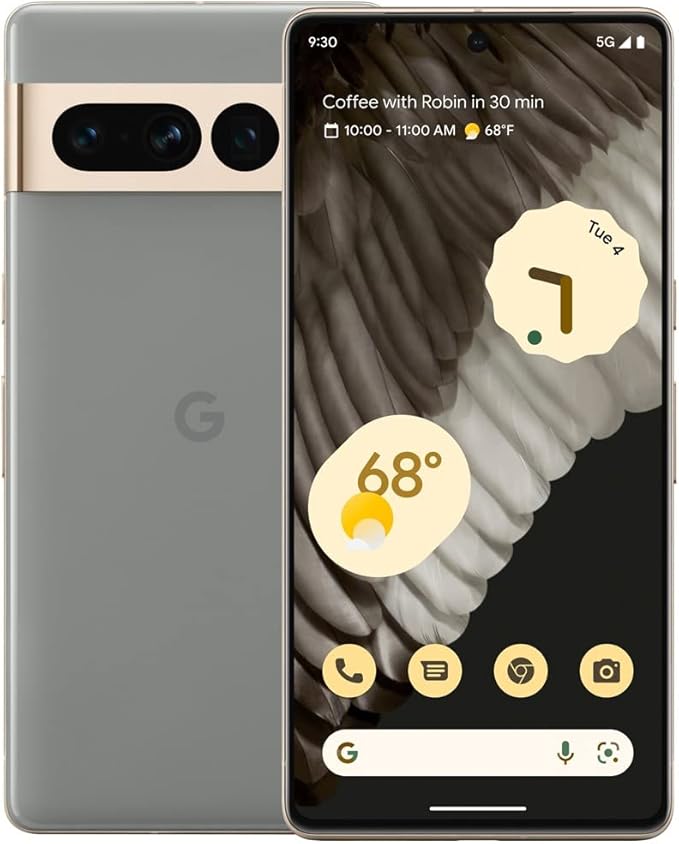
Motorola vs Google: Overview
Comparing Motorola and Google helps you determine which brand is best suited for your needs in Smartphones. Both brands offer strong choices depending on your budget and key feature requirements.
Key Features & Comparison
Evaluate factors such as build quality, warranty, customer satisfaction, and total value before making your final purchase choice between Motorola and Google.
Affordability
When evaluating affordability, Motorola consistently dominates the entry-level and mid-range spectrums with an expansive, budget-conscious portfolio. Through its Moto G and Moto E lines, Motorola delivers reliable daily functionality at accessible price points, often undercutting major competitors while still packing high-refresh-rate displays and massive 5,000 mAh batteries. For consumers seeking core smartphone utility without premium markups, Motorola offers exceptional raw value per dollar. Even within its upper-tier Edge series and foldable Razr lineup, the brand frequently introduces competitive pricing strategies and aggressive carrier discounts, making modern form factors and high-end specs available at significantly lower entry thresholds.
Google approaches affordability with a more concentrated, upper-midrange strategy centered on its 'A-series' Pixel devices. Rather than competing in the ultra-budget sub-$200 bracket, Google delivers flagship-tier engineering compromises around the $500 mark. The Pixel A-series incorporates the identical proprietary Tensor silicon found in its premium flagships, granting buyers access to flagship-grade machine learning algorithms, superior computational photography, and multi-year operating system support. While Motorola provides far better coverage for budget-constrained consumers needing basic hardware, Google offers higher long-term value retention and premium features per dollar, provided the buyer can meet a slightly higher baseline investment.
Quality/Durability
Motorola balances structural durability with cost efficiency by utilizing robust polycarbonate shells and splash-resistant nano-coatings on its entry and mid-tier models, reserving aluminum frames and Gorilla Glass Victus for its flagship Edge and Razr devices. While basic models often carry modest IP52 ingress protection ratings—meaning they resist light rain but fail under water submersion—the plastic builds offer natural shock absorption against accidental drops without shattering. On the flagship front, Motorola has embraced IP68 ratings and vegan leather backings that resist micro-abrasions, though long-term software support historically lags, meaning the physical device might outlast its manufacturer security maintenance window.
Google emphasizes premium physical materials across its lineup, employing recycled aluminum chassis, scratch-resistant Corning Gorilla Glass, and standard IP68 water and dust resistance across its main flagship tier. In terms of long-term operational durability, Google establishes an industry-leading standard by guaranteeing seven years of unified operating system upgrades, security patches, and functional feature drops on its modern flagships. While Google has experienced sporadic hardware teething issues in early production batches, such as sensitive camera visor glass or display tint discrepancies, the brand's immense structural refinement and unparalleled software longevity make Pixel hardware a far more dependable, future-proof investment over a multi-year lifecycle.
Performance
Motorola relies predominantly on off-the-shelf Qualcomm Snapdragon and MediaTek Dimensity processors across its varied lineup, yielding predictable, highly optimized performance metrics. In its budget models, power-efficient chipsets deliver exceptional multi-day battery endurance, while its top-tier Edge devices harness flagship Snapdragon 8-series silicon to deliver top-tier graphical throughput, seamless thermal management, and robust mobile gaming performance. Motorola complements this hardware with 'My UX,' an exceptionally lightweight Android skin that stays close to stock Android, ensuring snappy UI navigation, minimal bloatware overhead, and responsive multitasking even on lower-tier silicon.
Google equips its devices with custom-engineered Tensor chipsets, developed in partnership with Samsung, which pivot away from raw synthetic GPU benchmarks to prioritize local artificial intelligence and machine learning pipelines. Tensor silicon powers real-time voice translation, advanced on-device speech-to-text, and sophisticated call screening features that redefine daily smartphone utility. However, Tensor chips tend to run warmer under sustained graphical loads, throttle faster during intensive gaming, and exhibit slightly lower peak thermal efficiency compared to the Snapdragon chips found in high-end Motorolas. For users prioritizing AI integration and specialized software synergy, Google leads, whereas Motorola excels in sustained raw processing throughput and thermal predictability.
Camera Quality
Motorola approaches camera hardware through a high-spec, pixel-dense lens strategy, regularly incorporating 50MP to 200MP sensors across its mid-to-high-tier devices. Under optimal lighting, Motorola flagships capture crisp, vibrant images with natural depth of field and commendable detail retention. However, Motorola's software processing pipeline struggles in challenging environments; aggressive noise reduction frequently softens fine textures, dynamic range can be inconsistent in high-contrast scenes, and shutter lag remains a hurdle when capturing fast-moving subjects. While Motorola provides capable optical image stabilization and high-resolution video capture on its upper models, its photographic output remains geared toward standard social sharing rather than photographic mastery.
Google stands as a titan in computational photography, consistently setting mobile imaging benchmarks regardless of the raw hardware sensors used. Leveraging bespoke machine learning models, Google's camera pipeline excels in extreme dynamic range, ultra-accurate skin tone mapping via Real Tone, and unparalleled low-light clarity via Night Sight. The Pixel effortlessly captures moving subjects in dim conditions without motion blur, an area where Motorola routinely falters. Combined with generative post-processing tools like Magic Eraser, Best Take, and Photo Unblur integrated directly into Google Photos, the Pixel delivers a profoundly superior, point-and-shoot imaging ecosystem that decisively outperforms Motorola across every lighting condition.